












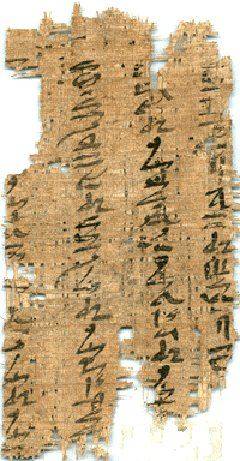
Egyptian Tales, Translated from the Papyri: First Series, IVth to XIIth Dynasty
Short stories written down on papyrus more than 3,000 years ago, including the one about a sailor shipwrecked on an island ruled by a giant talking serpent. Petrie collected translations of the best.
Public domain copy
Read Egyptian Tales, Translated from the Papyri: First Series, IVth to XIIth Dynasty online
Egyptian Tales, Translated from the Papyri: First Series, IVth to XIIth Dynasty Author: W. M. Flinders Petrie Translator: W. M. Flinders Petrie (editor) Digitized by Project Gutenberg, ebook #7386
Produced by Eric Eldred
EGYPTIAN TALES, TRANSLATED FROM THE PAPYRI
First Series, IVth To XIIth Dynasty
By W. M. Flinders Petrie, D.C.L., LL.D.., Ph.D., Hon. F.S.A. (Scot.)
Illustrated By Tristram Ellis
Second Edition
London
1899
LIST OF CONTENTS
INTRODUCTION
TALES OF THE MAGICIANS
KHAFRA'S TALE
BAUFRA'S TALE
HORDEDEF'S TALE
REMARKS
THE PEASANT AND THE WORKMAN
REMARKS
THE SHIPWRECKED SAILOR
REMARKS
THE ADVENTURES OF SANEHAT
REMARKS
INTRODUCTION
IT is strange that while literature occupies so much attention as at present, and while fiction is the largest division of our book-work, the oldest literature and fiction of the world should yet have remained unpresented to English readers. The tales of ancient Egypt have appeared collectively only in French, in the charming volume of Maspero's "Contes Populaires"; while some have been translated into English at scattered times in volumes of the "Records of the Past." But research moves forward; and translations that were excellent twenty years ago may now be largely improved, as we attain more insight into the language.
For another reason also there is a wide ground for the present volume. In no case have any illustrations been attempted, to give that basis for imagination which is all the more needed when reading of an age and a land unfamiliar to our ideas. When following a narrative, whether of real events or of fiction, many persons--perhaps most--find themselves unconsciously framing in their minds the scenery and the beings of which they are reading. To give a correct picture of the character of each of the various ages to which these tales belong, has been the aim of the present illustrations. A definite period has been assigned to each tale, in accordance with the indications, or the history, involved in it; and, so far as our present knowledge goes, all the details of life in the scenes here illustrated are rendered in accord with the period of the story.
To some purely scholastic minds it may seem presumptuous to intermingle translations of notable documents with fanciful illustrations. But, considering the greater precision with which in recent years we have been able to learn the changes and the fashions of ancient life in Egypt, and the essentially unhistorical nature of most of these tales, there seems ample reason to provide such material for the reader's imagination in following the stories; it may-give them more life and reality, and may emphasise the differences which existed between the different periods to which these tales refer.
It will be noticed how the growth of the novel is shadowed out in the varied grounds and treatment of the tales. The earliest is purely a collection of marvels or fabulous incidents of the simplest kind. Then we advance to contrasts between town and country, between Egypt and foreign lands. Then personal adventure, and the interest in schemes and successes, becomes the staple material; while only in the later periods does character come in as the groundwork. The same may be seen in English literature--first the tales of wonders and strange lands, then the novel of adventure, and lastly the novel of character.
In translating these documents into English I have freely used the various translations already published in other languages; but in all cases more or less revision and retranslation from the original has been made. In this matter I am indebted to Mr. F. Ll. Griffith, who has in some cases--as in Anpu and Bata--almost entirely retranslated the original papyrus. The material followed in each instance will be found stated in the notes accompanying the tales. As to the actual phraseology, I am alone responsible for that. How far original idiom should be retained in any translation is always a debated question, and must entirely depend on the object in view. Here the purpose of rendering the work intelligible to ordinary readers required the modifying of some idioms and the paraphrasing of others. But so far as possible the style and tone of the original has been preserved, and whatever could be easily followed has been left to speak for itself. In many plainnesses of speech the old Egyptian resembled the modern Oriental, or our own forefathers, more than ourselves in this age of squeamishness as yet unparalleled in the world. To avoid offence a few little modifications of words have been made; but rather than give a false impression by tampering with any of the narrative, I have omitted the sequel of the last tale and given only an outline of it. The diction adopted has been the oldest that could be used without affectation when dealing with the early times. It has been purposely modified in the later tales; and in the last--which is of Ptolemaic authorship--a modern style has been followed as more compatible with the later tone of the narrative.
For the illustrations Mr. Tristram Ellis's familiarity with Egypt has been of good account in his life-like scenes here used. For each drawing I have searched for the material among the monuments and remains of the age in question. The details of the dresses, the architecture, and the utensils, are all in accord with the period of each tale. In the tale of Setnau two different styles are introduced. Ahura is probably of the time of Amenhotep III., whereas Setnau is a son of Ramessu II.; and the change of fashion between the two different dynasties has been followed as distinctive of the two persons, one a _ka_ or double of the deceased, the other a living man. To the reader who starts with the current idea that all Egyptians were alike, this continual change from one period to another may seem almost fanciful. But it rests on such certain authority that we may hope that this little volume may have its use as an object-lesson in practical archaeology.
The use and abuse of notes is a matter of dispute. To be constantly interrupted in reading by some needless and elementary explanation is an impertinence both to the author and the reader: the one cannot resent it, the other therefore resents it for both. But what is to be deemed needless entirely depends on the reader: I have been asked in what country Pompei is, as it is not in the English Gazetteer. Rather than intrude, then, on the reader when he is in high discourse with the ancients, I humbly set up my interpreter's booth next door; and if he cares to call in, and ask about any difficulties, I shall be glad to help him if I can. Not even numbers are intruded to refer to notes; for how often an eager reader has been led off his trail, and turned blithely to refer to 37 or 186 only to find, "See J. Z. xxxviii. 377," at which he gnashed his teeth and cursed such interruptions. So those to whom the original tales are obscure are humbly requested to try for some profit from the remarks after them, that have been gleaned by the translator.
Much might be said by a "folk-lorist"--in proportion to his ardour. But as there are folk-lorists and folk-lorists, and the schools of Rabbi Andrew and Rabbi Joseph write different targums, I have left each to make his own commentary without prejudice.
TALES OF THE MAGICIANS
One day, when King Khufu reigned over all the land, he said to his chancellor, who stood before him, "Go call me my sons and my councillors, that I may ask of them a thing." And his sons and his councillors came and stood before him, and he said to them, "Know ye a man who can tell me tales of the deeds of the magicians?"
Then the royal son Khafra stood forth and said, "I will tell thy majesty a tale of the days of thy forefather Nebka, the blessed; of what came to pass when he went into the temple of Ptah of Ankhtaui."
KHAFRA'S TALE
"His majesty was walking unto the temple of Ptah, and went unto the house of the chief reciter Uba-aner, with his train. Now when the wife of Uba-aner saw a page, among those who stood behind the king, her heart longed after him; and she sent her servant unto him, with a present of a box full of garments.
"And he came then with the servant. Now there was a lodge in the garden of Uba-aner; and one day the page said to the wife of Uba-aner, 'In the garden of Uba-aner there is now a lodge; behold, let us therein take our pleasure.' So the wife of Uba-aner sent to the steward who had charge over the garden, saying, 'Let the lodge which is in the garden be made ready.' And she remained there, and rested and drank with the page until the sun went down.
"And when the even was now come the page went forth to bathe. And the steward said, 'I must go and tell Uba-aner of this matter.' Now when this day was past, and another day came, then went the steward to Uba-aner, and told him of all these things.
"Then said Uba-aner, 'Bring me my casket of ebony and electrum.' And they brought it; and he fashioned a crocodile of wax, seven fingers long: and he enchanted it, and said, 'When the page comes and bathes in my lake, seize on him.' And he gave it to the steward, and said to him, 'When the page shall go down into the lake to bathe, as he is daily wont to do, then throw in this crocodile behind him.' And the steward went forth bearing the crocodile.
"And the wife of Uba-aner sent to the steward who had charge over the garden, saying, 'Let the lodge which is in the garden be made ready, for I come to tarry there.'
Read the story behind it

The same story, told elsewhere
Shared story · Floods and lost lands
Lost Lands Under the Sea: Atlantis, Dvaraka and Ys
A rich city, a proud people and one terrible day when the sea comes in and never leaves. Greece, India, Egypt, Wales, Cornwall and Brittany all tell of a land that now lies under the waves.
The Tale of the Shipwrecked Sailor (the serpent's island) is one telling. The same story is told 8 more times, in 4 parts of the world. Follow it:
- Ancient EgyptianEgypt · c. 1900-1800 BCE · Ancient textTied to this page
- Hindu (Sanskrit epic)Dvaraka · c. 400 BCE · Ancient text
- Greek, retold in a Roman-era geographyHelike, on the Gulf of Corinth, Greece · 373 BCE · Ancient text
- GreekAthens · c. 360 BCE · Ancient text
- Tamil (South India)Tamil Nadu, southern tip of India · c. 5th-6th century CE · Ancient text
- WelshCardigan Bay, Wales · c. 1250 CE · Medieval text
- BretonBay of Douarnenez, Brittany, France · 15th century · Retold in English
- CornishBetween Land's End and the Isles of Scilly, Cornwall, England · c. 1478 · Medieval text
- Modern science (19th-century Europe)Germany and Britain · 1864 · Modern book
The open question: Do these stories keep real memories of lost coastlines, or is a drowned city simply a story people tell to warn against pride? Join the debate
Where this comes from
Comes from Egyptian Tales, translated by Flinders Petrie, the copy of Egyptian Tales, Translated from the Papyri: First Series, IVth to XIIth Dynasty we host here, by W. M. Flinders Petrie. Flinders Petrie's edited English translations of ancient Egyptian tales from the papyri, first series (IVth to XIIth dynasty), illustrated by Tristram Ellis.
What this means
A primary record or a faithful public-domain copy of one. This page says what the file is and where it comes from; it does not say every claim in it is true.
Primary records exist: an original document, a published text, an official file or a dated report. We link to them. This level says the record exists and what it says, not that every claim in it is true.
Where and when was it found?
- Written
- The tales are set in the Old Kingdom but were written down in the Middle Kingdom; the Story of Sinuhe was likely composed early in the 12th Dynasty, some time after 1971 BCE, and the Eloquent Peasant around 1850 BCE
- Where it was found
- Egypt. The Westcar Papyrus (Tales of the Magicians) is in Berlin (Papyrus Berlin 3033); Sinuhe survives on Berlin papyri and other copies including a fragment from Harageh now in the Petrie Museum, London; the Shipwrecked Sailor survives in one papyrus that was in the Hermitage, St Petersburg
- When it was found
- Henry Westcar apparently got the Westcar Papyrus in Egypt in 1823 or 1824; Karl Richard Lepsius received it from Westcar's niece in 1838 or 1839, and the Berlin Museum bought it from his estate
- Oldest copy
- The Westcar Papyrus, written in hieratic and dated to the Hyksos period (18th to 16th century BCE), is the only copy of the Tales of the Magicians; it is in the Egyptian Museum, Berlin
- Original language
- Middle Egyptian, written in hieratic script
About this copy
This is a public-domain copy. The line below says where the file comes from and why we may host it.
Why we can share it: Project Gutenberg record: 'Copyright Status: Public domain in the USA.' Petrie (1853-1942); the title page in the text reads 'Second Edition, London, 1899', published before 1931 so public domain in the US.
Updated