












Norse: Ancient texts
Ancient Texts pages that draw on Norse, each with the sources shown. Start with Bifrost, Ginnungagap, Skidbladnir, Voluspa.
Files on this shelf (5)
- Voluspa DocumentedA seeress tells Odin everything: the first giant, the falling stars, the sun turning black and the world burning. Then the poem does something odd…
- Bifrost Myth or legendThe Norse bridge to the gods is said to be partly made of burning fire, to keep giants out. Its guard can hear grass grow and see a hundred leagues…
- Ginnungagap Myth or legendBefore anything existed, the Norse sources describe a yawning void with fire at one end and ice at the other, and life began where they met. Later…
- Skidbladnir Myth or legendSnorri describes a ship big enough to carry every Norse god with their weapons, one that always catches a fair wind and folds up like a napkin to…
- Ymir Myth or legendIn Norse myth, the world was built from a butchered giant: his flesh became earth, his blood the sea, his skull the sky. The story says the gods…
What is Norse mythology?
Norse mythology is the old religion and storytelling of the Scandinavian peoples: Odin, Thor, the world tree Yggdrasil, the rainbow bridge Bifröst and the end of the world, Ragnarök. Almost everything we know of it was written down in Iceland in the 1200s, about two centuries after Iceland became Christian. It survives in two books: the Poetic Edda, a collection of older poems, and the Prose Edda, a handbook of myths written by the Icelandic scholar Snorri Sturluson.
How people see it
Believers
- BeliefModern heathen belief. Ásatrú and related groups today honor the old gods, using the Eddas as inspiration rather than as fixed scripture.
Scholars
- MeasuredScholars. Scholars caution that Christian writers recorded these myths long after the old religion ended, and may have shaped them; they compare the Eddas with runestones and archaeology to find older beliefs.
- When
- Poems told for generations before; written down in the 1200s; Snorri's Prose Edda about 1220
- Language
- Old Norse (Old Icelandic)
- Oldest copy
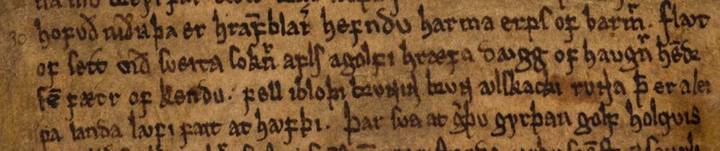
- The Codex Regius of the Poetic Edda, written in the 1270s, found in 1643 and returned from Denmark to Iceland in 1971; kept at the Árni Magnússon Institute, Reykjavík
- Who believed
- The Scandinavian peoples until they became Christian, about 1000 CE in Iceland; a modern revival, Ásatrú, has been a recognized religion in Iceland since 1973
- Other evidence
- Runestones, picture stones and outsiders' accounts, such as the German chronicler Adam of Bremen around 1075
Documented The manuscripts are documented. The gods and worlds are rated as myth or legend on their own pages. How we rate evidence
Start here
- Voluspa · A seeress tells Odin the whole history of the world, from the void and the first giant to the fall of the…
- Ymir · The first giant of Norse myth, born in the void, killed by Odin and his brothers, and butchered to build the…
- Ginnungagap · The yawning void that existed before the Norse world, where fire met ice and the first giant was born.
- Bifrost · The burning three-colored bridge between earth and the home of the Norse gods, guarded by Heimdall until…
- Skidbladnir · The dwarf-built ship of the Norse gods: big enough for all of them, always sailing with a fair wind, and…
Read it yourself: The Poetic Edda in our Library.
Sources for this overview
- The Poetic EddaA collection of Old Norse poems about gods such as Odin and Thor and about the world's beginning and end. The poems are older, but they survive mainly in one Icelandic manuscript of about 1270, found in 1643 and now in Reykjavik. Henry Adams Bellows's English version came out in 1923.Poetic Edda, trans. Henry Adams Bellows (1923) Online copyPrimary text Archived copy, 2026-08-20
- WikipediaA free online encyclopedia written and edited by volunteers. It is a good starting point and usually lists its own sources, but anyone can change it, so we treat it as a guide to better sources, not the final word.Wikipedia, "Norse mythology"Reference
- WikipediaWikipedia, "Codex Regius"Reference
- WikipediaWikipedia, "Prose Edda"Reference
Other shelves in Ancient Texts
Updated