Every claim on this site comes from a credible source, and the source is always shown so you can check it yourself. How we check
Credible TheoriesTheories sourced with evidence Dive in blind

STS-48: the 'zig-zag' video

A camera on Space Shuttle Discovery filmed dots of light drifting over the Earth; after a flash, some of them suddenly changed direction.

EvidenceWell supportedThe footage is genuine shuttle video, and the ice-and-thruster explanation is supported by NASA and by independent space experts, though individual dots cannot be identified.
What this means

For STS-48: the 'zig-zag' video, several independent sources agree on the main points (3 sources listed at the bottom of this page). Experts still argue about some details.

Several independent lines of evidence agree, such as excavations, measurements or peer-reviewed studies. Experts still argue about details.

See all five labels

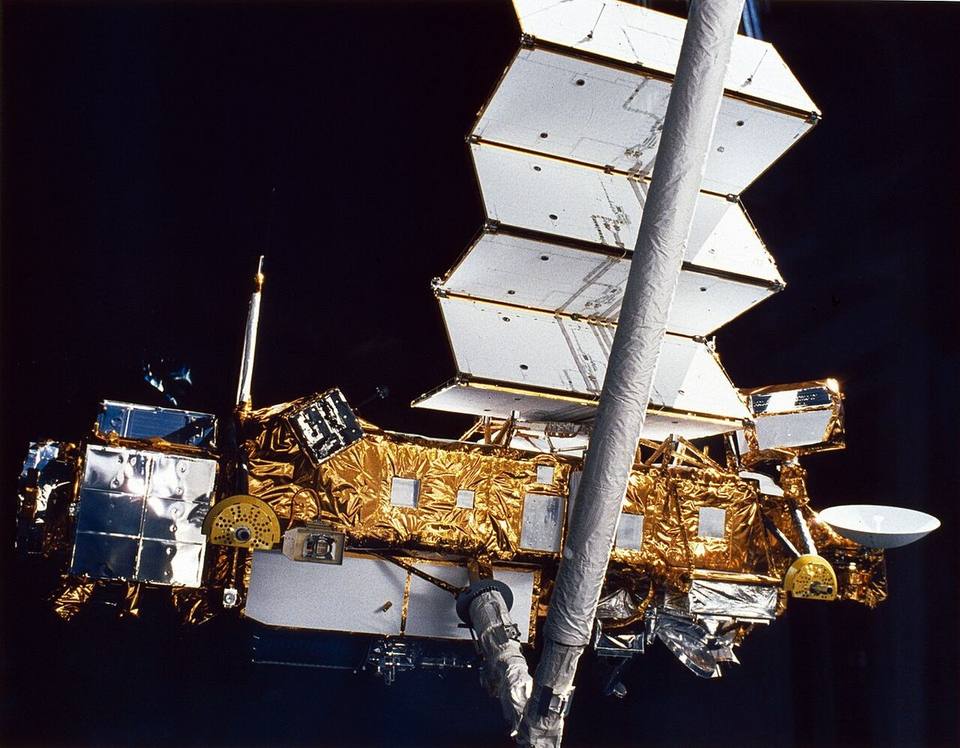
The UARS satellite held by the shuttle arm during STS-48, September 1991

NASA. Public domain. Picture source

Strangest fact

On the video, the dots seem to react to the flash all at once, as if something had signaled them. That looks deliberate, which is why the clip is still shared more than 30 years later.

STS-48 was a five-day Space Shuttle Discovery mission in September 1991 that put the Upper Atmosphere Research Satellite into orbit. On September 15, a camera in the payload bay, looking out toward the Earth's horizon, recorded several small points of light moving slowly across the view.

Partway through the clip there is a flash near the bottom of the frame. Right after it, several of the dots change direction, and one appears to shoot away quickly. The clip was later shown on television and online as evidence of objects moving under intelligent control, and some researchers argued the shuttle's attitude did not change, so no thruster could have fired.

NASA's explanation is that the dots are small particles near the shuttle, such as ice and bits of insulation, lit by the Sun, and that the flash was a small steering thruster firing. Its exhaust pushed the nearby particles onto new paths. The former NASA engineer James Oberg, interviewed by Atlas Obscura in 2016, pointed out that anything that stays in a shuttle camera's view for long has to be moving with the shuttle at about 17,500 miles per hour, which means it almost certainly came from the shuttle. He calls this debris space dandruff.

The astronomer Phil Plait reached the same conclusion in his 2002 book Bad Astronomy. Because the points are only dots, no one can say exactly what each one is.

Watch videos about STS-48: the 'zig-zag' video

Found by a YouTube search, not checked by us. The player loads from YouTube only when you press play.

Sources

  1. NASAThe official website of NASA, the US government's space agency, with mission histories, records and news releases.STS-48 mission page, NASAPrimary text
  2. Atlas ObscuraA US website that writes about strange places and odd history. Its articles are journalism, good for background, not original records.Cara Giaimo, 'How One Man Has Explained Almost Every Internet UFO Theory', Atlas Obscura, June 6, 2016Reference
  3. WikipediaA free online encyclopedia written and edited by volunteers. It is a good starting point and usually lists its own sources, but anyone can change it, so we treat it as a guide to better sources, not the final word.STS-48, Wikipedia (section on the ice particles video)Reference

Quotations come from public-domain translations. Links open the free online copy or the reference page.

Updated