












Credible Theories Sign in

The record

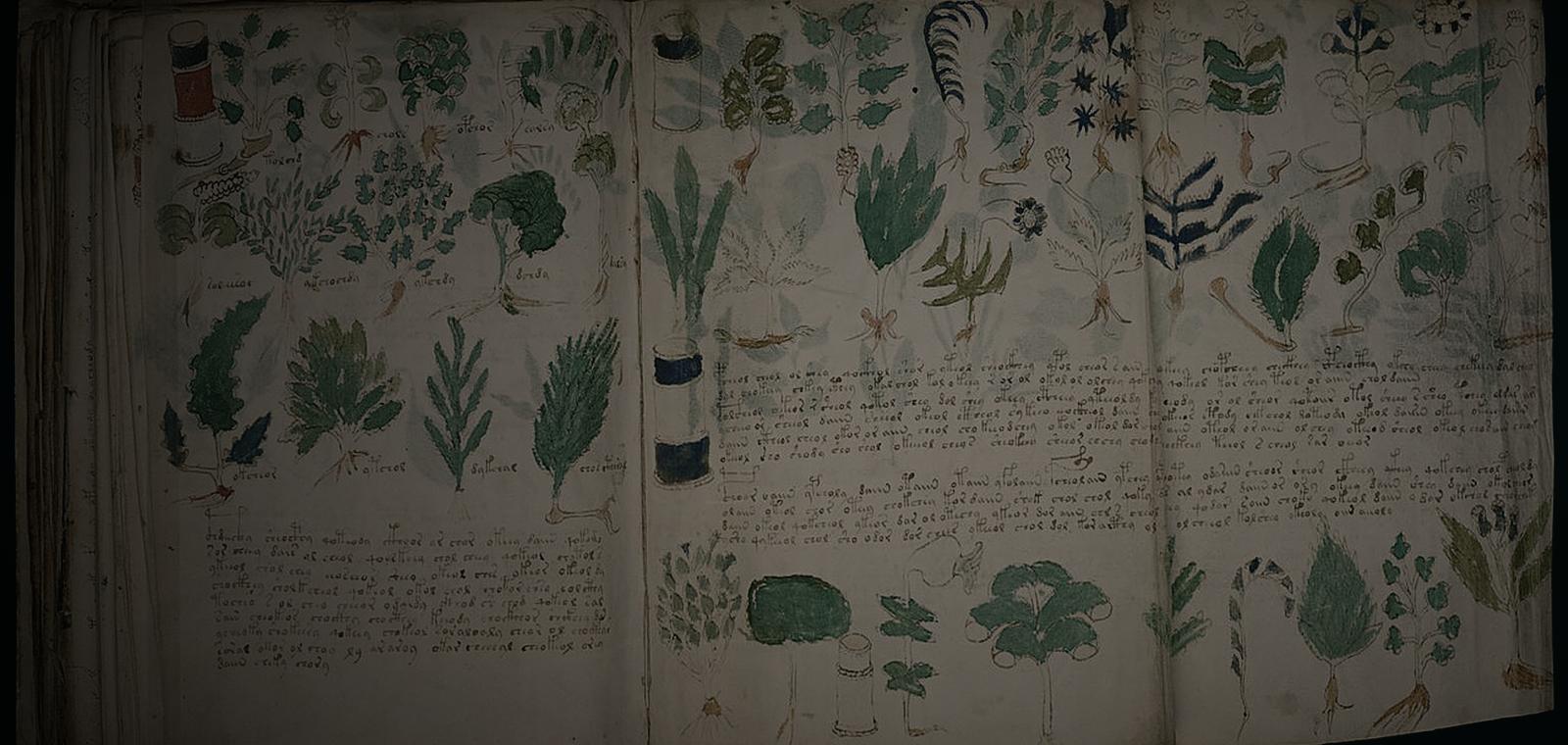
The Voynich manuscript is a small book of about 240 vellum pages, vellum being prepared animal skin used for writing. It is filled with flowing writing in an unknown script and colorful drawings. Yale University's Beinecke Rare Book and Manuscript Library, where it is kept as MS 408, says it was written in an unidentified script by an unknown author and that its meaning has been debated since it appeared on the rare book market in 1912.

The library sorts the drawings into six groups: plants, many of which no one can match to real species; astronomical and astrological drawings; balneological drawings, meaning pictures of bathing, with small naked women in pools and tubes; cosmological medallions, round diagrams of the heavens; pharmaceutical drawings of herbs and roots next to jars; and a final section of text marked with small stars.

Its history can be traced back about 400 years. The Beinecke lists Emperor Rudolf II, who ruled from Prague and collected rare and occult objects, as an early owner who is said to have paid 600 gold ducats for it. In 1666 the scholar Johannes Marcus Marci sent it to Athanasius Kircher in Rome, a famous scholar of the time, hoping he could read it. In 1912 a book dealer named Wilfrid Voynich bought it from a Jesuit college near Rome, which is why it carries his name. A later owner, the New York dealer H. P. Kraus, gave it to Yale in 1969.

In 2009 a team led by Greg Hodgins at the University of Arizona cut four tiny strips of vellum from four pages and radiocarbon dated them. Radiocarbon dating measures how much of a slowly fading form of carbon is left in once-living material. The animal skins dated to between 1404 and 1438, about a century earlier than many experts had guessed.

Codebreakers have tried for more than a century, including American military cryptographers in the 20th century. People have announced solutions many times, saying it is a lost language, a code for Latin, a medical handbook, or a hoax made of meaningless symbols. None of these has been accepted by other experts, because no one has shown a method that turns the pages into clear, checkable text.

Questions people ask about The Voynich manuscript

Can I see the Voynich manuscript online for free?

Yes. Yale's Beinecke Library has scanned every page and offers the full set of images free on its website, so anyone can study the script and drawings at home. In 2016 Yale University Press also published a full color facsimile with essays by experts. The original book is fragile and is shown in person only rarely.

Was the Voynich manuscript forged by Wilfrid Voynich?

The evidence argues against it. The 2009 radiocarbon dates show the animal skins are from the early 1400s, and that same year McCrone Associates tested the inks and found nothing that would not fit that period. A modern forger would have needed blank medieval vellum and old-style ink. Letters from the 1600s also describe the book before Voynich was born.

Who wrote the Voynich manuscript?

No one knows. Voynich himself believed the English friar Roger Bacon wrote it, but Bacon died in 1292, more than a century before the skins were made. Others have named John Dee or Edward Kelley, two Elizabethan occultists, without proof. William Friedman, a leading American codebreaker, studied it for decades and never cracked it.

The open question

Still strange: Radiocarbon tests dated its animal skin pages to between 1404 and 1438, about a century earlier than many experts had guessed.

About these videos

Found by a YouTube search for this topic, not checked by us. The player loads from YouTube only when you press play.

Where this comes from

EvidenceDocumented

Comes from Voynich Manuscript, Beinecke Rare Book and Manuscript Library, Yale University. A primary record: the document itself, not a retelling of it. Published at beinecke.library.yale.edu; it opens in a new tab.

What this means

The manuscript is at Yale and its vellum is radiocarbon dated to 1404 to 1438; no proposed reading of its text has been accepted.

For The Voynich manuscript, the original record exists and is linked: Voynich Manuscript, Beinecke Rare Book and Manuscript Library, Yale University. That tells you the record is real and what it says. It does not mean every claim in it is true.

Primary records exist: an original document, a published text, an official file or a dated report. We link to them. This level says the record exists and what it says, not that every claim in it is true.

See all five labels

Sources

  1. Voynich Manuscript, Beinecke Rare Book and Manuscript Library, Yale UniversityPrimary text
  2. Mysterious Voynich manuscript dates back to the 15th century, Medievalists.net, February 2011 (reporting the University of Arizona announcement)Reference
  3. UA-led team solves age of mysterious text, Arizona Daily Star (tucson.com), February 2011Reference
  4. WikipediaA free online encyclopedia written and edited by volunteers. It is a good starting point and usually lists its own sources, but anyone can change it, so we treat it as a guide to better sources, not the final word.Voynich manuscript, Wikipedia (background on decipherment attempts)Reference

Quotations come from public-domain translations. A book in our Library links to its Library page; other links open the free online copy or the reference page.

Updated

Credible or not?

Tap one to see how other readers voted.

Discussion