












The King James Apocrypha (1611)
The books that sat between the Old and New Testaments in the 1611 Bible, then were quietly dropped from most printings. Here they are in the same English, with their own stories of angels, demons and sky armies.
Public domain copy
Read The King James Apocrypha (1611) online
Deuterocanonical Books of the Bible (Apocrypha) Credits: Robert Kraft Digitized by Project Gutenberg, ebook #124
Deuterocanonical Books of the Bible
Contents
The First Book of Esdras The Second Book of Esdras [sometimes Fourth Book of Ezra] The Book of Tobit The Book of Judith The Greek Additions to Esther The Wisdom of Solomon The Book of Sirach (or Ecclesiasticus) The Book of Baruch The Epistle (or letter) of Jeremiah The Song of the Three Holy Children The Book of Susanna (in Daniel) The History of the Destruction of Bel and the Dragon The Prayer of Manasses The First Book of the Maccabees The Second Book of the Maccabees
The First Book of Esdras
1:1 And Josias held the feast of the passover in Jerusalem unto his Lord, and offered the passover the fourteenth day of the first month;
1:2 Having set the priests according to their daily courses, being arrayed in long garments, in the temple of the Lord.
1:3 And he spake unto the Levites, the holy ministers of Israel, that they should hallow themselves unto the Lord, to set the holy ark of the Lord in the house that king Solomon the son of David had built:
1:4 And said, Ye shall no more bear the ark upon your shoulders: now therefore serve the Lord your God, and minister unto his people Israel, and prepare you after your families and kindreds,
1:5 According as David the king of Israel prescribed, and according to the magnificence of Solomon his son: and standing in the temple according to the several dignity of the families of you the Levites, who minister in the presence of your brethren the children of Israel,
1:6 Offer the passover in order, and make ready the sacrifices for your brethren, and keep the passover according to the commandment of the Lord, which was given unto Moses.
1:7 And unto the people that was found there Josias gave thirty thousand lambs and kids, and three thousand calves: these things were given of the king’s allowance, according as he promised, to the people, to the priests, and to the Levites.
1:8 And Helkias, Zacharias, and Syelus, the governors of the temple, gave to the priests for the passover two thousand and six hundred sheep, and three hundred calves.
1:9 And Jeconias, and Samaias, and Nathanael his brother, and Assabias, and Ochiel, and Joram, captains over thousands, gave to the Levites for the passover five thousand sheep, and seven hundred calves.
1:10 And when these things were done, the priests and Levites, having the unleavened bread, stood in very comely order according to the kindreds,
1:11 And according to the several dignities of the fathers, before the people, to offer to the Lord, as it is written in the book of Moses: and thus did they in the morning.
1:12 And they roasted the passover with fire, as appertaineth: as for the sacrifices, they sod them in brass pots and pans with a good savour,
1:13 And set them before all the people: and afterward they prepared for themselves, and for the priests their brethren, the sons of Aaron.
1:14 For the priests offered the fat until night: and the Levites prepared for themselves, and the priests their brethren, the sons of Aaron.
1:15 The holy singers also, the sons of Asaph, were in their order, according to the appointment of David, to wit, Asaph, Zacharias, and Jeduthun, who was of the king’s retinue.
1:16 Moreover the porters were at every gate; it was not lawful for any to go from his ordinary service: for their brethren the Levites prepared for them.
1:17 Thus were the things that belonged to the sacrifices of the Lord accomplished in that day, that they might hold the passover,
1:18 And offer sacrifices upon the altar of the Lord, according to the commandment of king Josias.
1:19 So the children of Israel which were present held the passover at that time, and the feast of sweet bread seven days.
1:20 And such a passover was not kept in Israel since the time of the prophet Samuel.
1:21 Yea, all the kings of Israel held not such a passover as Josias, and the priests, and the Levites, and the Jews, held with all Israel that were found dwelling at Jerusalem.
1:22 In the eighteenth year of the reign of Josias was this passover kept.
1:23 And the works or Josias were upright before his Lord with an heart full of godliness.
1:24 As for the things that came to pass in his time, they were written in former times, concerning those that sinned, and did wickedly against the Lord above all people and kingdoms, and how they grieved him exceedingly, so that the words of the Lord rose up against Israel.
1:25 Now after all these acts of Josias it came to pass, that Pharaoh the king of Egypt came to raise war at Carchamis upon Euphrates: and Josias went out against him.
1:26 But the king of Egypt sent to him, saying, What have I to do with thee, O king of Judea?
1:27 I am not sent out from the Lord God against thee; for my war is upon Euphrates: and now the Lord is with me, yea, the Lord is with me hasting me forward: depart from me, and be not against the Lord.
1:28 Howbeit Josias did not turn back his chariot from him, but undertook to fight with him, not regarding the words of the prophet Jeremy spoken by the mouth of the Lord:
1:29 But joined battle with him in the plain of Magiddo, and the princes came against king Josias.
1:30 Then said the king unto his servants, Carry me away out of the battle; for I am very weak. And immediately his servants took him away out of the battle.
1:31 Then gat he up upon his second chariot; and being brought back to Jerusalem died, and was buried in his father’s sepulchre.
1:32 And in all Jewry they mourned for Josias, yea, Jeremy the prophet lamented for Josias, and the chief men with the women made lamentation for him unto this day: and this was given out for an ordinance to be done continually in all the nation of Israel.
1:33 These things are written in the book of the stories of the kings of Judah, and every one of the acts that Josias did, and his glory, and his understanding in the law of the Lord, and the things that he had done before, and the things now recited, are reported in the book of the kings of Israel and Judea.
1:34 And the people took Joachaz the son of Josias, and made him king instead of Josias his father, when he was twenty and three years old.
1:35 And he reigned in Judea and in Jerusalem three months: and then the king of Egypt deposed him from reigning in Jerusalem.
Read the story behind it
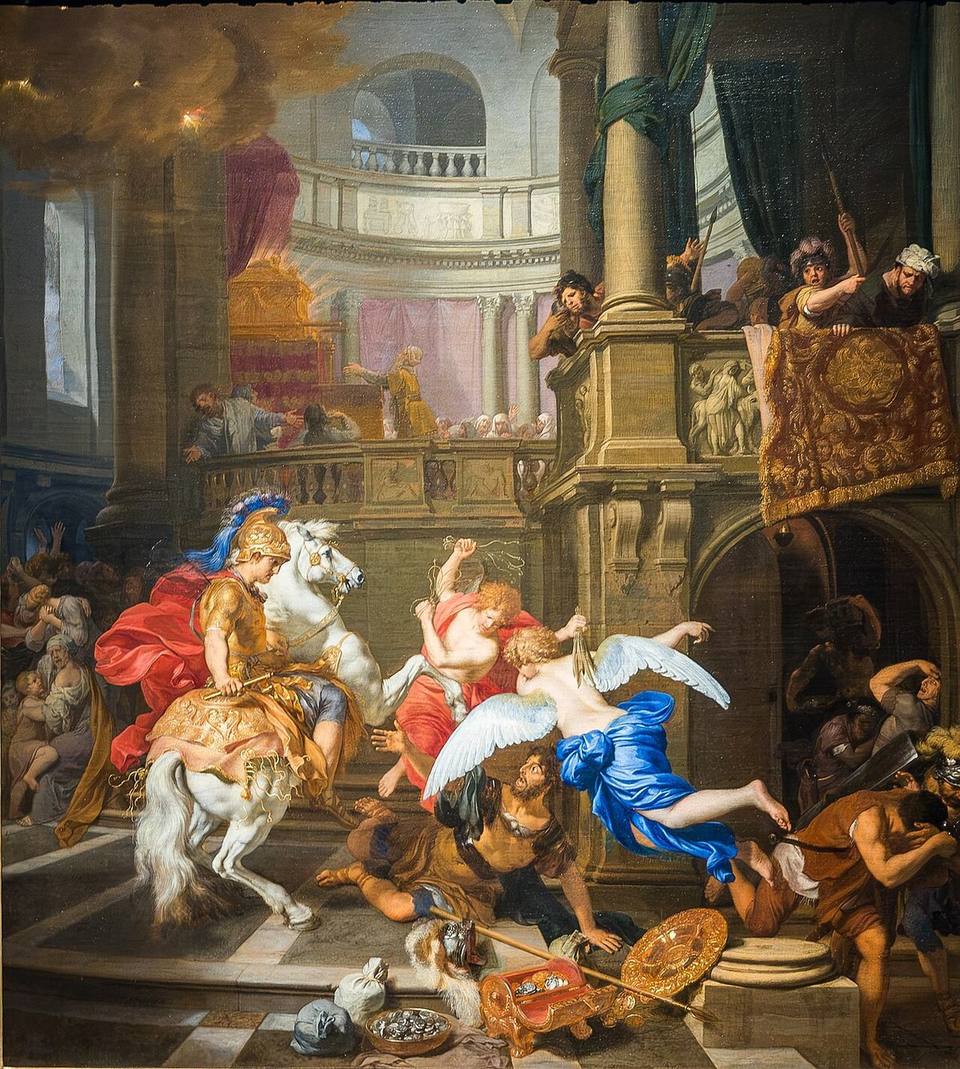
 PersonHeliodorusMyth or legendA stone inscription found in Israel preserves a real letter addressed to Heliodorus, a king's minister. In the Apocrypha, the same man marches into the Jerusalem Temple to seize its treasury and is beaten by a horse with a terrible rider and two strong young men. The history is real. What does the story say happened?
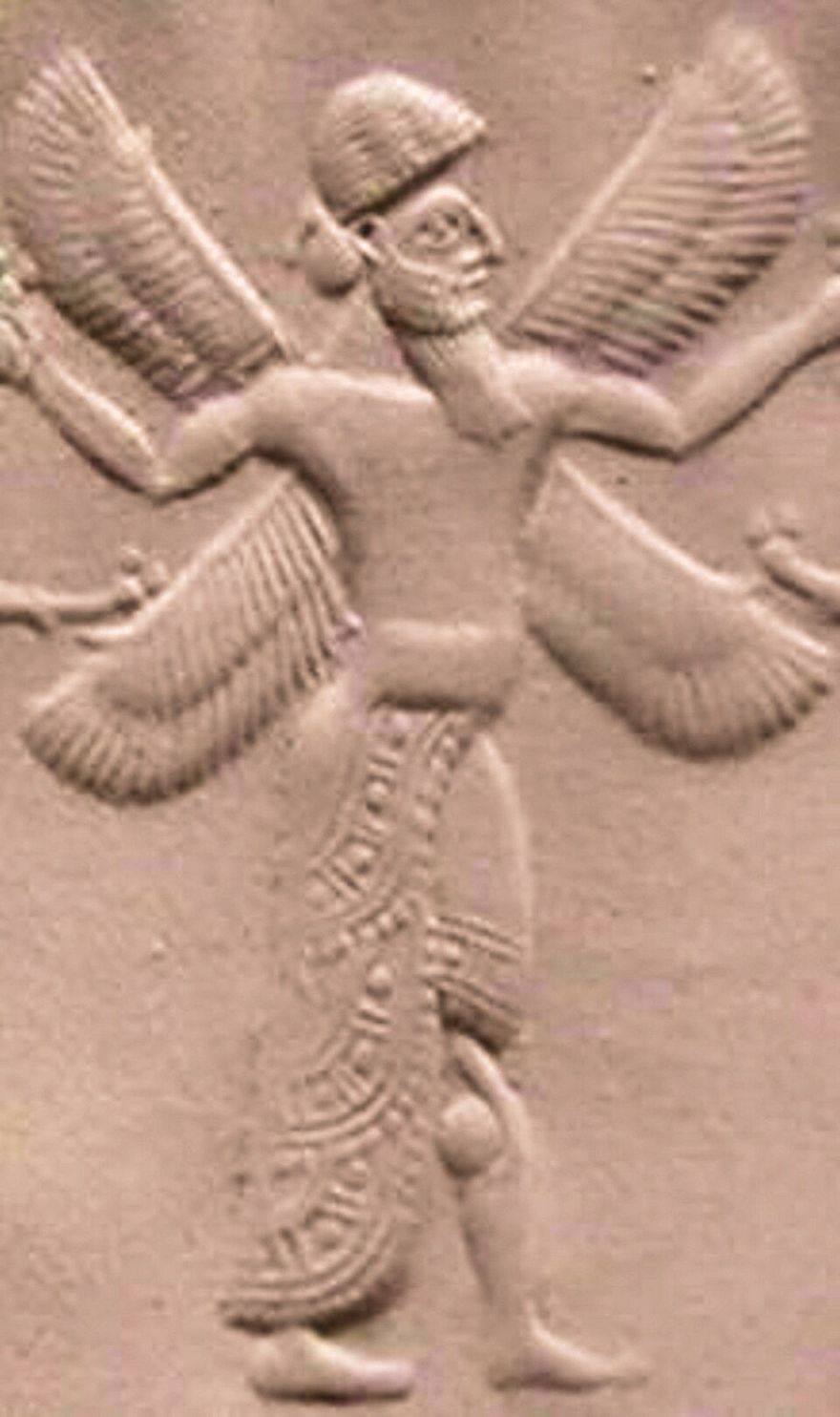 BeingCherubimMyth or legendForget the chubby babies. The first angelic beings in the Bible are armed security, posted at the gate of Eden with a flaming sword that turned every way, to guard the road to the tree of life. Later, God is said to ride one. What were the cherubim really supposed to be?
Where this comes from
Comes from Project Gutenberg, the copy of The King James Apocrypha (1611) we host here. Apocrypha / deuterocanonical books of the Bible, from 1 Esdras to 2 Maccabees, as released by Project Gutenberg.
What this means
A primary record or a faithful public-domain copy of one. This page says what the file is and where it comes from; it does not say every claim in it is true.
Primary records exist: an original document, a published text, an official file or a dated report. We link to them. This level says the record exists and what it says, not that every claim in it is true.
Where and when was it found?

- Written
- Between about 200 BCE and 100 CE; Sirach, for example, was written in Hebrew between 196 and 175 BCE and translated into Greek around 117 BCE
- Where it was found
- Mainly in Greek manuscripts of the Septuagint such as Codex Sinaiticus (St Catherine's Monastery, Sinai; now mostly in the British Library). Hebrew fragments of Sirach were found in the Cairo Geniza and at Masada and Qumran
- When it was found
- The books were kept in the Greek and Latin Bibles throughout. Hebrew fragments of Sirach (copied in the 11th and 12th centuries) came to light in the Cairo Geniza in 1896; three older Hebrew fragments were found near the Dead Sea, at Masada and Qumran, in the 1950s and 1960s
- Oldest copy
- Codex Sinaiticus (4th century CE) holds 2 Esdras, Tobit, Judith, 1 and 4 Maccabees, Wisdom and Sirach in Greek; in Hebrew, the Masada scroll of Sirach (Mas1H) was found in the fortress the Romans destroyed in 73 CE
- Original language
- Greek, with some books first written in Hebrew or Aramaic
Sources for these facts
About this copy
This is a public-domain copy. The line below says where the file comes from and why we may host it.
Why we can share it: Project Gutenberg record: "Public domain in the USA."
Updated