












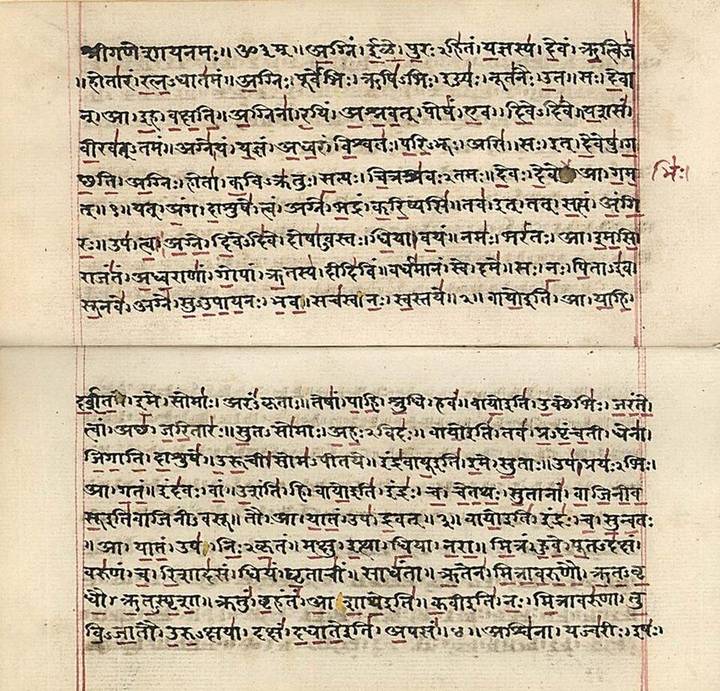
The Hymns of the Rigveda, Vol. I
The oldest hymns of India, sung to gods of fire, storm and dawn long before anyone wrote them down. Griffith's 1889 verse translation, volume 1, with his notes.
Public domain copy
Read The Hymns of the Rigveda, Vol. I online
This is a digital copy of a book that was preserved for generations on library shelves before it was carefully scanned by Google as part of a project to make the world's books discoverable online.
It has survived long enough for the copyright to expire and the book to enter the public domain. A public domain book is one that was never subject to copyright or whose legal copyright term has expired. Whether a book is in the public domain may vary country to country. Public domain books are our gateways to the past, representing a wealth of history, culture and knowledge that's often difficult to discover.
Marks, notations and other marginalia present in the original volume will appear in this file - a reminder of this book's long journey from the publisher to a library and finally to you.
Usage guidelines
Google is proud to partner with libraries to digitize public domain materials and make them widely accessible. Public domain books belong to the public and we are merely their custodians. Nevertheless, this work is expensive, so in order to keep providing this resource, we have taken steps to prevent abuse by commercial parties, including placing technical restrictions on automated querying.
We also ask that you:
+ Make non-commercial use of the files We designed Google Book Search for use by individuals, and we request that you use these files for personal, non-commercial purposes.
+ Refrain from automated querying Do not send automated queries of any sort to Google's system: If you are conducting research on machine translation, optical character recognition or other areas where access to a large amount of text is helpful, please contact us. We encourage the use of public domain materials for these purposes and may be able to help.
+ Maintain attribution The Google "watermark" you see on each file is essential for informing people about this project and helping them find additional materials through Google Book Search. Please do not remove it.
+ Keep it legal Whatever your use, remember that you are responsible for ensuring that what you are doing is legal. Do not assume that just because we believe a book is in the public domain for users in the United States, that the work is also in the public domain for users in other countries. Whether a book is still in copyright varies from country to country, and we can't offer guidance on whether any specific use of any specific book is allowed. Please do not assume that a book's appearance in Google Book Search means it can be used in any manner anywhere in the world. Copyright infringement liability can be quite severe.
About Google Book Search
Google's mission is to organize the world's information and to make it universally accessible and useful. Google Book Search helps readers discover the world's books while helping authors and publishers reach new audiences. You can search through the full text of this book on the web
at |http : //books . google . com/
//-
^''^ %^ <^
HYMNS OF THE RIGVEDA
TRANSLATED WITH A POPULAR COMMENTARY
BY
RALPH T. H. GRIFFITH,
FORMERLY PRINCIPAL OF BENARES COLLEGE.
VOL. I.
BENARES :
E. J. LAZARUS AND CO.
1889.
"'^sr.ssir'
'.1 i"^ ♦ J . ^ »
3olC>
PREFACE
"What can be more tedious than the Veda, and yet what can be more interesting, if once we know that it is the first word spoken by the Aryan man ? "
"The Veda has a two-fold interest: it belongs to the history of
the world and to the history of India As long as man continues
to take an interest in the history of his race, and as long as we collect in libraries and museums the relics of former ages, the first place in that long row of books which contains the records of the Aryan branch of mankind, will belong for oyer to the Rig-yeda." F. Max Mullbr.
This work is an attempt to bring within easy reach of all readers of English a translation of the Hymns of the Rigveda which, while aiming especially at close fidelity to the letter and the spirit of the original, shall be as readable and intelligible as the nature of the subject and other circumstances permit.
Veda, meaning literally knowledge, is the name given to certain ancient works which formed the founda- tion of the early religious belief of the Hindus. These are the Rigveda, the Sd^maveda, the Yajurveda, and the Atharvaveda ] and of these the Rigveda — so called be- cause its Sanhit& or collection of mantras or hymns consists of Richas or verses intended for loud recitation — is the oldest, the most important, and the most gener- ally interesting, some of its hymns being rather Indo- European than Hindu, and representing the condition of the Aryans before their final settlement in India.
IV PREFACE.
These four Vedas are considered to be oF divine origin and to have existed from all eternity, the Rishis or sacred poets to whom the hymns are ascribed being merely in- spired seers who saw or received them by sight directly from the Supreme Creator. In accordance with this be- lief these sacred books have been preserved and handed down with the most reverential care from generation to generation, and have accompanied the great army of Aryan immigrants in their onward march from the Land of the Seven Rivers to the Indian Ocean and the Bay of Bengal. Each of these four Vedas is divided into two dis- tinct parts, one the Mantra containing prayer and praise, the other the Br&hmana containing detailed directions for the performance of the ceremonies at which the Man- tras were to be used, and explanations of the legends connected with them, the whole forming a vast body of sacred literature in verse and in prose, devotiotial, ceremo- nial, expository and theosophic.
The Sanhit^ of the Rigveda is a collection of hymns and songs brought by the remote ancestors of the pre- sent Hindus from their ancient homes on the banks of the Indus where they had been first used in adoration of the Father of Heaven, of the Sun, of Dawn, of Agni or the God of fire, in prayers for health, wealth, long life, offspring, cattle, victory in battle, and freedom from the bonds of sin ; and in celebration of the ever-renewed warfare between the beneficent thunder-wielding Indra, the special champion of the Aryans, and the malevolent powers of darkness and the demons of drought who with- held the rain of heaven.
PREFACB. V
Of these hymns there are more than a thousand, arranged in ten Ma^4alas, Circles, or Books, in accordance with an ancient tradition of what we should call author- ship, the hymns ascribed to the same Rishi, inspired poet or seer, or to the same school or family of Rishis being placed together. Within these divisions the hymns are generally arranged more or less in the order of the deities to whom they are addressed. Agni and Indra are the gods most frequently invoked. Hymns to Agni generally come first, next come those addressed to Indra, and after them those in honour of other deities or deified objects of adoration. The ninth Book is devoted almost entirely to Soma, the deified juice used in pouring libations to the gods, and the tenth forms a sort of appendix of peculiar and miscellaneous materials. Independently of the evidence afforded by Indian tra- dition, there can be no reasonable doubt of the great antiquity of the Tligveda Sanhit4 which, with the excep- tion of the Egyptian monumental records and papyrus rolls, and the recently discovered Assyrian literature, is probably the oldest literary document in existence. But it seems impossible to fix, with anything approaching to certainty, any date for the composition of the hymns* In the first Hymn of Book I. ancient and recent or modern Rishis or seers are spoken of, and there is other internal evidence that some hymns are much older than others, Colebrooke came to the conclusion, from astro- nomical calculations, that a certain Vedic calendar was composed in the fourteenth century before the Christian era ; from which it would follow, that as this calendar must have been prepared after the arrangement of the
VI PREFACE.
Read the story behind it
The same story, told elsewhere
Shared story · Heroes and trials
The Dragon Slayer: Marduk, Indra, Thor and Saint George
A god or a hero faces a giant serpent that blocks the waters, eats the young or threatens the whole world, and cuts it down. The same fight is told in Babylon, India, Greece, Egypt, Iceland, Japan and medieval Europe.
Rig Veda, Book 1, Hymn 32 (Indra slays Vritra) is one telling. The same story is told 7 more times, in 6 parts of the world. Follow it:
- Vedic IndiaNorthwest India · c. 1500-1200 BCE · Ancient textTied to this page
- Babylonian (Akkadian)Babylon · c. 1200-1100 BCE · Ancient text
- GreekBoeotia, Greece · c. 700 BCE · Ancient text
- EgyptianThebes, Egypt · c. 312 BCE · Ancient text
- Hebrew BibleJudah · 24 to 27 BCE · Ancient text
- Japanese (Shinto)Izumo, Japan · 712 CE · Medieval text
- NorseIceland · c. 1220 CE · Medieval text
- Medieval Christian (Europe)Written in northern Italy · c. 1260 CE · Medieval text
The open question: Did one ancient story of a hero and a serpent spread across the world, or do people everywhere turn their fears into dragons on their own? Join the debate
Where this comes from
Comes from Internet Archive, the copy of The Hymns of the Rigveda, Vol. I we host here, by Rigveda (anonymous). Ralph T. H. Griffith's English translation of the Rigveda hymns with commentary, Vol. I (E. J. Lazarus, Benares, 1889).
What this means
A primary record or a faithful public-domain copy of one. This page says what the file is and where it comes from; it does not say every claim in it is true.
Primary records exist: an original document, a published text, an official file or a dated report. We link to them. This level says the record exists and what it says, not that every claim in it is true.
Where and when was it found?
- Written
- Most likely about 1500 to 1000 BCE, in the northwest of the Indian subcontinent
- Where it was found
- Passed down by memory for centuries. The oldest surviving manuscripts were found in Nepal; thirty manuscripts collected in the 19th century are at the Bhandarkar Oriental Research Institute in Pune, India
- When it was found
- Max Muller used 24 manuscripts then in Europe for his edition of the Rigveda with Sayana's commentary; the Pune manuscripts were collected in the 19th century by Georg Buhler, Franz Kielhorn and others
- Oldest copy
- The oldest surviving manuscripts come from Nepal and date to about 1040 CE; the oldest in the Pune collection is dated 1464 CE. The Pune set was added to UNESCO's Memory of the World Register in 2007
- Original language
- Vedic Sanskrit
Sources for these facts
About this copy
This is a public-domain copy. The line below says where the file comes from and why we may host it.
Why we can share it: Internet Archive metadata: possible-copyright-status NOT_IN_COPYRIGHT, copyright-region US. Griffith died 1906; published 1889.
Updated