












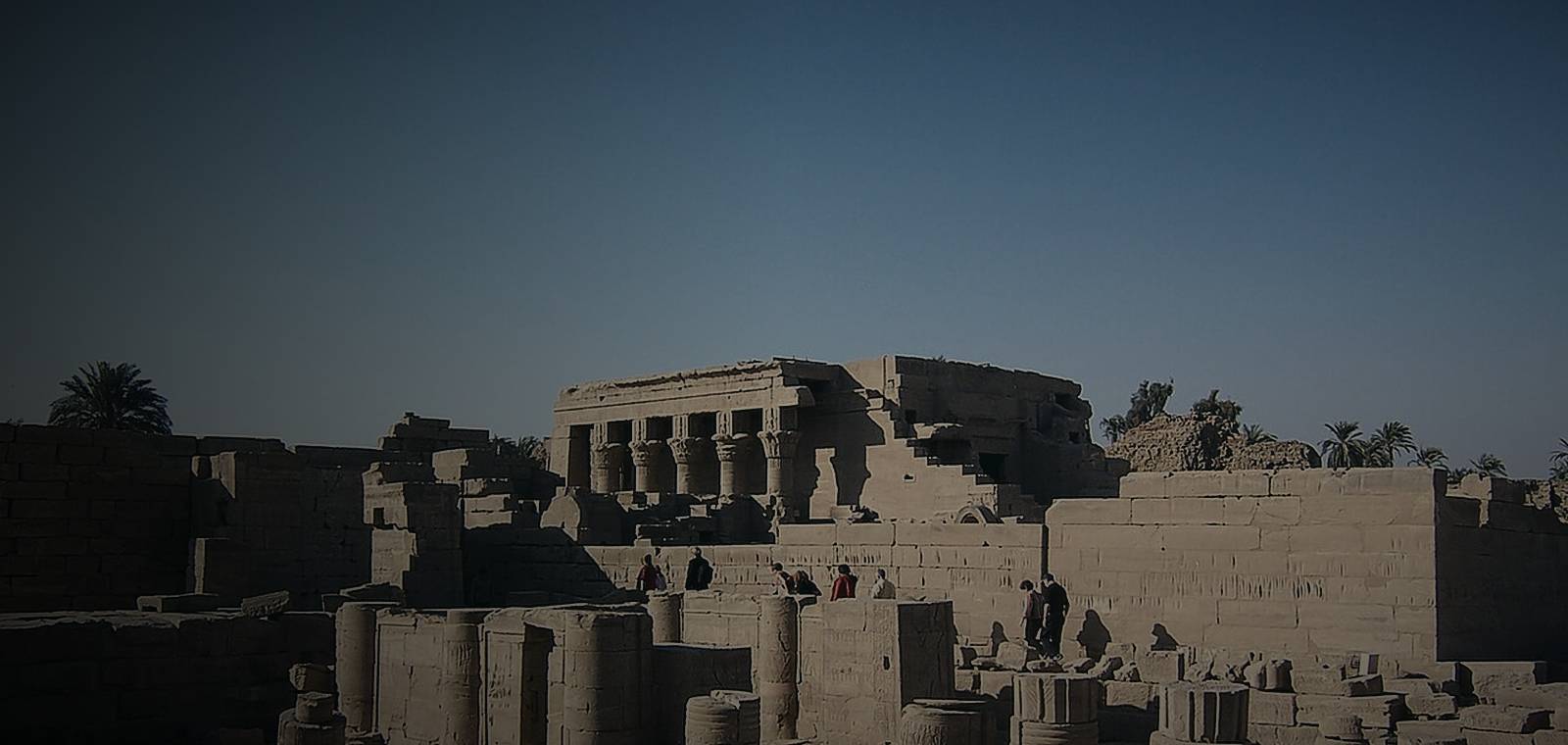
What is Dendera known for?
Dendera, near Qena in Upper Egypt, was the cult center of Hathor, goddess of love, music and joy. Its temple, built mainly under the last Ptolemies and the early Roman emperors, is one of the best preserved in Egypt. A carved ceiling zodiac from one of its rooftop chapels was removed in 1821 and is now in the Louvre.
Reliefs in a crypt beneath the temple show a large bulb-like shape with a wavy snake inside, rising from a lotus flower and supported by a djed pillar. Some ancient-astronaut books present them as electric lamps with cables and insulators.
Egyptologists read them using the hieroglyphic texts carved next to them. The images show a snake emerging from a lotus flower, a creation image linked to the sun god, with the djed pillar as a symbol of stability. No wiring, glass or electrical equipment has been found in Egypt.
Where this comes from
Comes from Encyclopaedia Britannica, 'Dandarah'. An encyclopedia first published in Scotland in 1768 and now online. Its articles are written and checked by named experts and editors, which makes it a reliable source for basic facts.
What this means
A real place with records. Sources are listed below.
For Dendera, the original record exists and is linked: Encyclopaedia Britannica, 'Dandarah'. That tells you the record is real and what it says. It does not mean every claim in it is true.
Primary records exist: an original document, a published text, an official file or a dated report. We link to them. This level says the record exists and what it says, not that every claim in it is true.
Sources
- Encyclopaedia BritannicaAn encyclopedia first published in Scotland in 1768 and now online. Its articles are written and checked by named experts and editors, which makes it a reliable source for basic facts.Encyclopaedia Britannica, 'Dandarah'Reference
- WikipediaA free online encyclopedia written and edited by volunteers. It is a good starting point and usually lists its own sources, but anyone can change it, so we treat it as a guide to better sources, not the final word.Wikipedia, 'Dendera light'Reference Archived copy, 2026-10-01