The Night the Tent Was Cut
Share
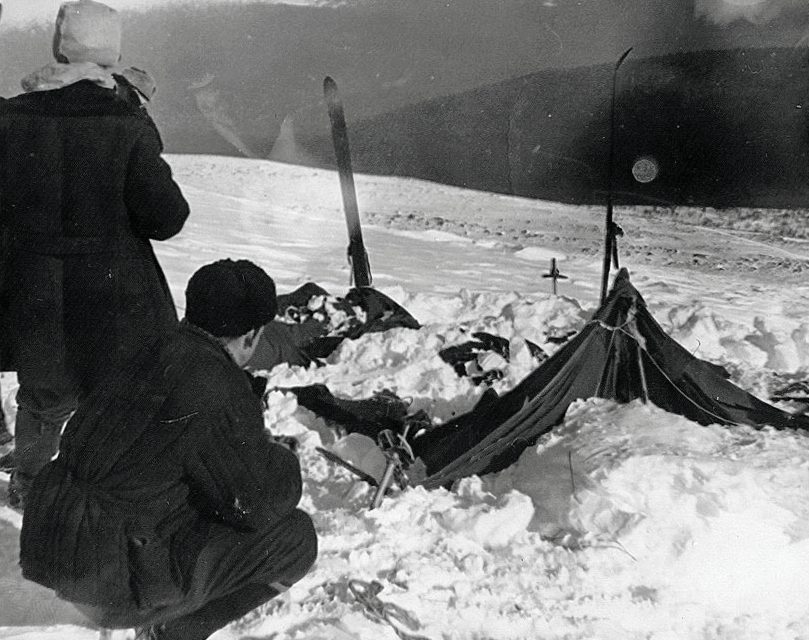
Some hours after dark the nine cut their way out of the tent from the inside and leave almost all their boots and coats behind.
Night of 1 to 2 February 1959 (the exact hour is disputed)
The story
Inside, the tent is set up properly. Nine backpacks lie on the floor with jackets on top. Blankets are spread. Searchers later find pieces of crust from a loin of meat on a blanket, so in this story they are eating when the night is still quiet.
Outside, the wind keeps blowing snow over the slope above them. In this reconstruction, which follows the 2021 study, that snow piles up above the cut they made in the slope. The extra weight builds slowly on a weak layer of loose, grainy crystals (depth hoar) buried in the old snow.
At some point in the night the snow above the tent gives way. In this telling it is a small slab, not a huge avalanche. It lands on part of the tent. The story supposes it also blocks the entrance, which would explain why they cut the wall instead; no document says so. No one wrote down what they heard or saw, so the story does not invent it.
Someone cuts the tent wall with a knife from the inside, and they get out through the cuts. They leave in socks, felt boots or bare feet, in whatever they are wearing. They go down the slope, away from the danger they believe is above them.
What the record says
All these cuts are done on the inside of the tent.
Act No. 199, forensic examination of the tent by G. E. Churkina, 16 April 1959, sheet 304
Location and availability of items in the tent (almost all shoes, all outer clothing, personal belongings and diaries) indicated that the tent was abandoned suddenly by all hikers at the same time
Resolution to close the case, 28 May 1959, sheet 385
our model shows that the conditions for avalanche release can be met after a delay of 7.5 to 13.5 h from the moment the hikers made the cut in the slope
Gaume and Puzrin, Communications Earth & Environment (2021)
That the tent was cut from the inside is a forensic finding from 1959. That all nine left suddenly and at the same time is the investigator's reading of the scene, and searchers found no sign of a struggle or of other people. The cause is the open question. The 2019 Investigative Committee review and the 2020 prosecutors' review both named an avalanche. Gaume and Puzrin built a model in which wind-blown snow loads a small slab above the cut until it fails hours later. The timing does not agree across sources: the prosecutors' reconstruction has the group leaving at about 9 pm, while Gaume and Puzrin place the event after midnight. Searchers 26 days later reported no obvious avalanche debris, which is the main argument against this theory.