Every claim on this site comes from a credible source, and the source is always shown so you can check it yourself. How we check
Credible TheoriesTheories sourced with evidence Dive in blind

Apollo 10 'outer-space music'

Behind the Moon and out of radio contact with Earth, the Apollo 10 crew heard a whistling sound they called 'outer-space-type music' and wondered whether anyone would believe them.

EvidenceDocumentedNASA's own onboard transcript records the conversation word for word, and the radio-interference explanation is the engineers' account, supported by Collins's experience on the next flight.
What this means

For Apollo 10 'outer-space music', the original record exists and is linked: Apollo 10 Onboard Voice Transcription, Command Module, NASA Manned Spacecraft Center…. That tells you the record is real and what it says. It does not mean every claim in it is true.

Primary records exist: an original document, a published text, an official file or a dated report. We link to them. This level says the record exists and what it says, not that every claim in it is true.

See all five labels

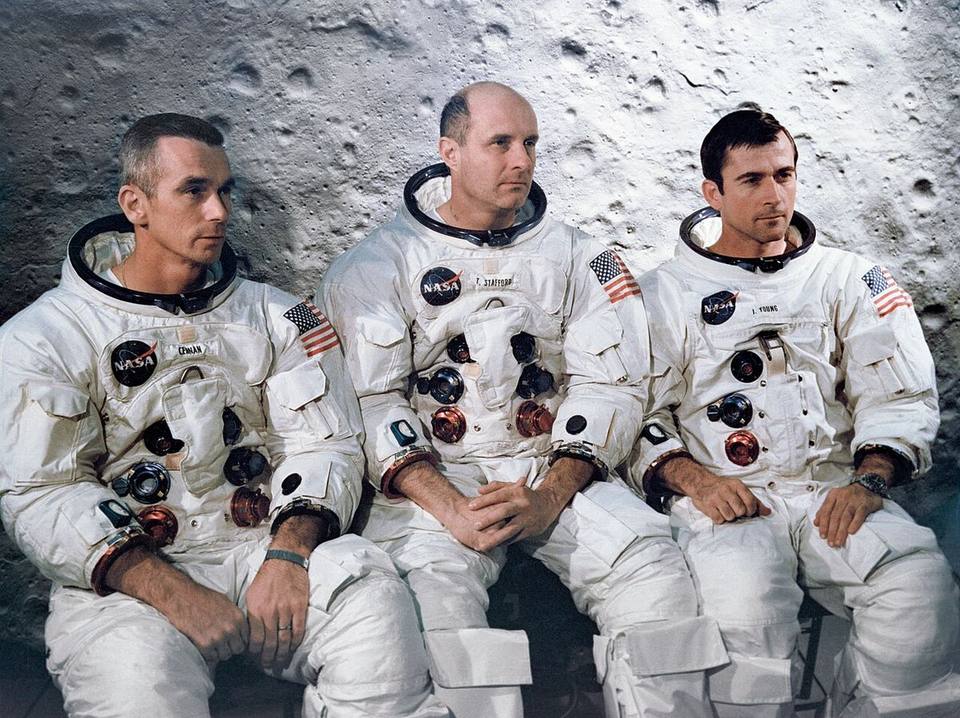
The Apollo 10 prime crew, Eugene Cernan, John Young and Thomas Stafford

NASA. Public domain. Picture source

Strangest fact

Three test pilots, alone behind the Moon where no signal from Earth could reach them, heard something that sounded like music and joked that no one would believe them. The sound was real and was recorded, and it happened in the one place a human voice or radio station from Earth could not be the source.

Apollo 10 flew in May 1969 as the dress rehearsal for the first Moon landing. Its crew were commander Tom Stafford, command module pilot John Young and lunar module pilot Gene Cernan. A tape recorder inside the command module captured the crew's own conversation, including stretches when the spacecraft was behind the Moon and cut off from radio contact with Earth.

NASA's onboard voice transcript records the exchange at about 102 hours and 13 minutes into the mission. Cernan says: That music even sounds outer-spacy, doesn't it? You hear that? That whistling sound? Young asks, Did you hear that whistling sound, too? and Cernan answers, Sounds like, you know, outer-space-type music. A few minutes later the transcript has the line Nobody will believe us, and later still Cernan says that eerie music is what's bothering me, and the crew discuss whether to tell the ground about it.

The recordings drew wide attention twice. Reports have described the transcripts as kept secret until their release in 2008, and in February 2016 the Science Channel series NASA's Unexplained Files played the audio. NASA said the material had never been classified. CBS News reported that the full transcript had been published in 1973 and later put online; it is now on NASA's own transcript page.

The crew themselves were already guessing at the cause. A few seconds after the 'nobody will believe us' line, Young's next remark, partly garbled in the transcript, mentions the VHF radio. NASA engineers explained the sound as interference between the VHF radios of the command module and the lunar module flying near each other. Michael Collins, who flew Apollo 11 two months later, wrote in his 1974 book Carrying the Fire that he heard the same whistling and had been warned about it in advance.

Watch videos about Apollo 10 'outer-space music'

Found by a YouTube search, not checked by us. The player loads from YouTube only when you press play.

Sources

  1. NASA mission transcriptsTyped records of what astronauts said to Mission Control and to each other during the Mercury, Gemini and Apollo flights of the 1960s and 1970s, plus their debriefings after landing. NASA made them at the time and has put them online, so anyone can check what was actually said.Apollo 10 Onboard Voice Transcription, Command Module, NASA Manned Spacecraft Center, June 1969, pages 242 to 243 and laterPrimary text
  2. NASA mission transcriptsMission Transcripts: Mercury, Gemini, and Apollo, NASA HistoryPrimary text
  3. CBS NewsThe news division of CBS, one of the major US television networks. A mainstream news source with professional editors; it reports on events rather than being the original record.Apollo 10 astronauts' "outer-spacey" music encounter: The true story, CBS News, February 22, 2016Reference
  4. Voice of AmericaThe US government-funded international news service, founded in 1942 and meant to be independent in what it reports.'Outer-space Type Music' Reported by Apollo 10 Astronauts, Voice of America, February 22, 2016Reference

Quotations come from public-domain translations. Links open the free online copy or the reference page.

Updated