












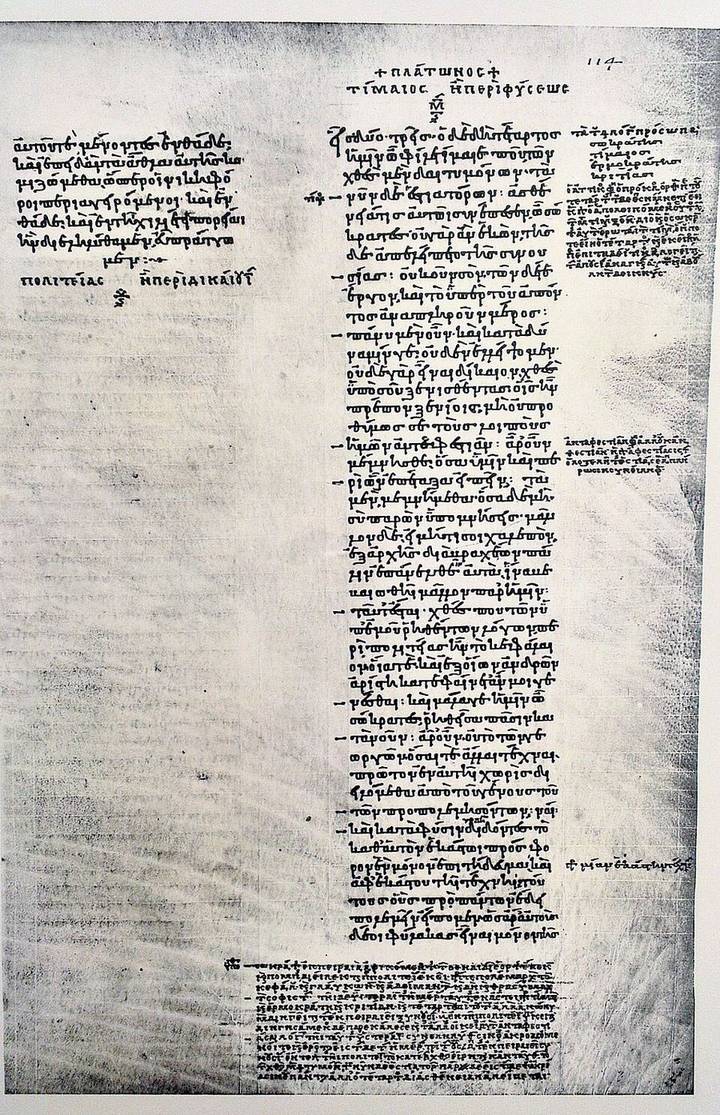
Timaeus
Where Plato first describes how the world was built, and where the Atlantis story begins. Atlantis is told here as a tale an Egyptian priest passed to Solon. Read the setup before the sequel.
Public domain copy
Read Timaeus online
Timaeus Author: Plato Translator: Benjamin Jowett Digitized by Project Gutenberg, ebook #1572
TIMAEUS
by Plato
Translated by Benjamin Jowett
Contents
INTRODUCTION AND ANALYSIS. Section 1. Section 2. Section 3. Section 4. Section 5. Section 6. Section 7. Section 8.
TIMAEUS
INTRODUCTION AND ANALYSIS.
Of all the writings of Plato the Timaeus is the most obscure and
repulsive to the modern reader, and has nevertheless had the
greatest influence over the ancient and mediaeval world. The
obscurity arises in the infancy of physical science, out of the
confusion of theological, mathematical, and physiological
notions, out of the desire to conceive the whole of nature
without any adequate knowledge of the parts, and from a greater
perception of similarities which lie on the surface than of
differences which are hidden from view. To bring sense under the
control of reason; to find some way through the mist or labyrinth
of appearances, either the highway of mathematics, or more
devious paths suggested by the analogy of man with the world, and
of the world with man; to see that all things have a cause and
are tending towards an end—this is the spirit of the ancient
physical philosopher. He has no notion of trying an experiment
and is hardly capable of observing the curiosities of nature
which are ‘tumbling out at his feet,’ or of interpreting even the
most obvious of them. He is driven back from the nearer to the
more distant, from particulars to generalities, from the earth to
the stars. He lifts up his eyes to the heavens and seeks to guide
by their motions his erring footsteps. But we neither appreciate
the conditions of knowledge to which he was subjected, nor have
the ideas which fastened upon his imagination the same hold upon
us. For he is hanging between matter and mind; he is under the
dominion at the same time both of sense and of abstractions; his
impressions are taken almost at random from the outside of
nature; he sees the light, but not the objects which are revealed
by the light; and he brings into juxtaposition things which to us
appear wide as the poles asunder, because he finds nothing
between them. He passes abruptly from persons to ideas and
numbers, and from ideas and numbers to persons,—from the heavens
to man, from astronomy to physiology; he confuses, or rather does
not distinguish, subject and object, first and final causes, and
is dreaming of geometrical figures lost in a flux of sense. He
contrasts the perfect movements of the heavenly bodies with the
imperfect representation of them (Rep.), and he does not always
require strict accuracy even in applications of number and figure
(Rep.). His mind lingers around the forms of mythology, which he
uses as symbols or translates into figures of speech. He has no
implements of observation, such as the telescope or microscope;
the great science of chemistry is a blank to him. It is only by
an effort that the modern thinker can breathe the atmosphere of
the ancient philosopher, or understand how, under such unequal
conditions, he seems in many instances, by a sort of inspiration,
to have anticipated the truth.
The influence with the Timaeus has exercised upon posterity is
due partly to a misunderstanding. In the supposed depths of this
dialogue the Neo-Platonists found hidden meanings and connections
with the Jewish and Christian Scriptures, and out of them they
elicited doctrines quite at variance with the spirit of Plato.
Believing that he was inspired by the Holy Ghost, or had received
his wisdom from Moses, they seemed to find in his writings the
Christian Trinity, the Word, the Church, the creation of the
world in a Jewish sense, as they really found the personality of
God or of mind, and the immortality of the soul. All religions
and philosophies met and mingled in the schools of Alexandria,
and the Neo-Platonists had a method of interpretation which could
elicit any meaning out of any words. They were really incapable
of distinguishing between the opinions of one philosopher and
another— between Aristotle and Plato, or between the serious
thoughts of Plato and his passing fancies. They were absorbed in
his theology and were under the dominion of his name, while that
which was truly great and truly characteristic in him, his effort
to realize and connect abstractions, was not understood by them
at all. Yet the genius of Plato and Greek philosophy reacted upon
the East, and a Greek element of thought and language overlaid
and partly reduced to order the chaos of Orientalism. And kindred
spirits, like St. Augustine, even though they were acquainted
with his writings only through the medium of a Latin translation,
were profoundly affected by them, seeming to find ‘God and his
word everywhere insinuated’ in them (August. Confess.)
There is no danger of the modern commentators on the Timaeus
falling into the absurdities of the Neo-Platonists. In the
present day we are well aware that an ancient philosopher is to
be interpreted from himself and by the contemporary history of
thought. We know that mysticism is not criticism. The fancies of
the Neo-Platonists are only interesting to us because they
exhibit a phase of the human mind which prevailed widely in the
first centuries of the Christian era, and is not wholly extinct
in our own day. But they have nothing to do with the
interpretation of Plato, and in spirit they are opposed to him.
They are the feeble expression of an age which has lost the power
not only of creating great works, but of understanding them. They
are the spurious birth of a marriage between philosophy and
tradition, between Hellas and the East—(Greek) (Rep.). Whereas
the so-called mysticism of Plato is purely Greek, arising out of
his imperfect knowledge and high aspirations, and is the growth
of an age in which philosophy is not wholly separated from poetry
and mythology.
A greater danger with modern interpreters of Plato is the
tendency to regard the Timaeus as the centre of his system. We do
not know how Plato would have arranged his own dialogues, or
whether the thought of arranging any of them, besides the two
‘Trilogies’ which he has expressly connected; was ever present to
his mind. But, if he had arranged them, there are many
indications that this is not the place which he would have
assigned to the Timaeus. We observe, first of all, that the
dialogue is put into the mouth of a Pythagorean philosopher, and
not of Socrates. And this is required by dramatic propriety; for
the investigation of nature was expressly renounced by Socrates
in the Phaedo. Nor does Plato himself attribute any importance to
his guesses at science. He is not at all absorbed by them, as he
is by the IDEA of good. He is modest and hesitating, and
confesses that his words partake of the uncertainty of the
subject (Tim.). The dialogue is primarily concerned with the
animal creation, including under this term the heavenly bodies,
and with man only as one among the animals. But we can hardly
suppose that Plato would have preferred the study of nature to
man, or that he would have deemed the formation of the world and
the human frame to have the same interest which he ascribes to
the mystery of being and not-being, or to the great political
problems which he discusses in the Republic and the Laws. There
are no speculations on physics in the other dialogues of Plato,
and he himself regards the consideration of them as a rational
pastime only. He is beginning to feel the need of further
divisions of knowledge; and is becoming aware that besides
dialectic, mathematics, and the arts, there is another field
which has been hitherto unexplored by him. But he has not as yet
defined this intermediate territory which lies somewhere between
medicine and mathematics, and he would have felt that there was
as great an impiety in ranking theories of physics first in the
order of knowledge, as in placing the body before the soul.
It is true, however, that the Timaeus is by no means confined to
speculations on physics. The deeper foundations of the Platonic
philosophy, such as the nature of God, the distinction of the
sensible and intellectual, the great original conceptions of time
and space, also appear in it. They are found principally in the
first half of the dialogue. The construction of the heavens is
for the most part ideal; the cyclic year serves as the connection
between the world of absolute being and of generation, just as
the number of population in the Republic is the expression or
symbol of the transition from the ideal to the actual state. In
some passages we are uncertain whether we are reading a
description of astronomical facts or contemplating processes of
the human mind, or of that divine mind (Phil.) which in Plato is
hardly separable from it. The characteristics of man are
transferred to the world-animal, as for example when intelligence
and knowledge are said to be perfected by the circle of the Same,
and true opinion by the circle of the Other; and conversely the
motions of the world-animal reappear in man; its amorphous state
continues in the child, and in both disorder and chaos are
gradually succeeded by stability and order. It is not however to
passages like these that Plato is referring when he speaks of the
uncertainty of his subject, but rather to the composition of
bodies, to the relations of colours, the nature of diseases, and
the like, about which he truly feels the lamentable ignorance
prevailing in his own age.
We are led by Plato himself to regard the Timaeus, not as the
centre or inmost shrine of the edifice, but as a detached
building in a different style, framed, not after the Socratic,
but after some Pythagorean model. As in the Cratylus and
Parmenides, we are uncertain whether Plato is expressing his own
opinions, or appropriating and perhaps improving the
philosophical speculations of others. In all three dialogues he
is exerting his dramatic and imitative power; in the Cratylus
mingling a satirical and humorous purpose with true principles of
language; in the Parmenides overthrowing Megarianism by a sort of
ultra-Megarianism, which discovers contradictions in the one as
great as those which have been previously shown to exist in the
ideas. There is a similar uncertainty about the Timaeus; in the
first part he scales the heights of transcendentalism, in the
latter part he treats in a bald and superficial manner of the
functions and diseases of the human frame. He uses the thoughts
and almost the words of Parmenides when he discourses of being
and of essence, adopting from old religion into philosophy the
conception of God, and from the Megarians the IDEA of good. He
agrees with Empedocles and the Atomists in attributing the
greater differences of kinds to the figures of the elements and
their movements into and out of one another. With Heracleitus, he
acknowledges the perpetual flux; like Anaxagoras, he asserts the
predominance of mind, although admitting an element of necessity
which reason is incapable of subduing; like the Pythagoreans he
supposes the mystery of the world to be contained in number.
Many, if not all the elements of the Pre-Socratic philosophy are
included in the Timaeus. It is a composite or eclectic work of
imagination, in which Plato, without naming them, gathers up into
a kind of system the various elements of philosophy which
preceded him.
If we allow for the difference of subject, and for some growth in
Plato’s own mind, the discrepancy between the Timaeus and the
other dialogues will not appear to be great. It is probable that
the relation of the ideas to God or of God to the world was
differently conceived by him at different times of his life. In
all his later dialogues we observe a tendency in him to personify
mind or God, and he therefore naturally inclines to view creation
as the work of design. The creator is like a human artist who
frames in his mind a plan which he executes by the help of his
servants. Thus the language of philosophy which speaks of first
and second causes is crossed by another sort of phraseology: ‘God
made the world because he was good, and the demons ministered to
him.’ The Timaeus is cast in a more theological and less
philosophical mould than the other dialogues, but the same
general spirit is apparent; there is the same dualism or
opposition between the ideal and actual—the soul is prior to the
body, the intelligible and unseen to the visible and corporeal.
There is the same distinction between knowledge and opinion which
occurs in the Theaetetus and Republic, the same enmity to the
poets, the same combination of music and gymnastics. The doctrine
of transmigration is still held by him, as in the Phaedrus and
Republic; and the soul has a view of the heavens in a prior state
of being. The ideas also remain, but they have become types in
nature, forms of men, animals, birds, fishes. And the attribution
of evil to physical causes accords with the doctrine which he
maintains in the Laws respecting the involuntariness of vice.
The style and plan of the Timaeus differ greatly from that of any
other of the Platonic dialogues. The language is weighty, abrupt,
and in some passages sublime. But Plato has not the same mastery
over his instrument which he exhibits in the Phaedrus or
Symposium. Nothing can exceed the beauty or art of the
introduction, in which he is using words after his accustomed
manner. But in the rest of the work the power of language seems
to fail him, and the dramatic form is wholly given up. He could
write in one style, but not in another, and the Greek language
had not as yet been fashioned by any poet or philosopher to
describe physical phenomena. The early physiologists had
generally written in verse; the prose writers, like Democritus
and Anaxagoras, as far as we can judge from their fragments,
never attained to a periodic style. And hence we find the same
sort of clumsiness in the Timaeus of Plato which characterizes
the philosophical poem of Lucretius. There is a want of flow and
often a defect of rhythm; the meaning is sometimes obscure, and
there is a greater use of apposition and more of repetition than
occurs in Plato’s earlier writings. The sentences are less
closely connected and also more involved; the antecedents of
demonstrative and relative pronouns are in some cases remote and
perplexing. The greater frequency of participles and of absolute
constructions gives the effect of heaviness. The descriptive
portion of the Timaeus retains traces of the first Greek prose
composition; for the great master of language was speaking on a
theme with which he was imperfectly acquainted, and had no words
in which to express his meaning. The rugged grandeur of the
opening discourse of Timaeus may be compared with the more
harmonious beauty of a similar passage in the Phaedrus.
To the same cause we may attribute the want of plan. Plato had
not the command of his materials which would have enabled him to
produce a perfect work of art. Hence there are several new
beginnings and resumptions and formal or artificial connections;
we miss the ‘callida junctura’ of the earlier dialogues. His
speculations about the Eternal, his theories of creation, his
mathematical anticipations, are supplemented by desultory remarks
on the one immortal and the two mortal souls of man, on the
functions of the bodily organs in health and disease, on sight,
hearing, smell, taste, and touch. He soars into the heavens, and
then, as if his wings were suddenly clipped, he walks
ungracefully and with difficulty upon the earth. The greatest
things in the world, and the least things in man, are brought
within the compass of a short treatise. But the intermediate
links are missing, and we cannot be surprised that there should
be a want of unity in a work which embraces astronomy, theology,
physiology, and natural philosophy in a few pages.
It is not easy to determine how Plato’s cosmos may be presented
to the reader in a clearer and shorter form; or how we may supply
a thread of connexion to his ideas without giving greater
consistency to them than they possessed in his mind, or adding on
consequences which would never have occurred to him. For he has
glimpses of the truth, but no comprehensive or perfect vision.
There are isolated expressions about the nature of God which have
a wonderful depth and power; but we are not justified in assuming
that these had any greater significance to the mind of Plato than
language of a neutral and impersonal character... With a view to
the illustration of the Timaeus I propose to divide this
Introduction into sections, of which the first will contain an
outline of the dialogue: (2) I shall consider the aspects of
nature which presented themselves to Plato and his age, and the
elements of philosophy which entered into the conception of them:
(3) the theology and physics of the Timaeus, including the soul
of the world, the conception of time and space, and the
composition of the elements: (4) in the fourth section I shall
consider the Platonic astronomy, and the position of the earth.
There will remain, (5) the psychology, (6) the physiology of
Plato, and (7) his analysis of the senses to be briefly commented
upon: (8) lastly, we may examine in what points Plato approaches
or anticipates the discoveries of modern science.
Section 1.
Socrates begins the Timaeus with a summary of the Republic. He
lightly touches upon a few points,—the division of labour and
distribution of the citizens into classes, the double nature and
training of the guardians, the community of property and of women
and children. But he makes no mention of the second education, or
of the government of philosophers.
And now he desires to see the ideal State set in motion; he would
like to know how she behaved in some great struggle. But he is
unable to invent such a narrative himself; and he is afraid that
the poets are equally incapable; for, although he pretends to
have nothing to say against them, he remarks that they are a
tribe of imitators, who can only describe what they have seen.
And he fears that the Sophists, who are plentifully supplied with
graces of speech, in their erratic way of life having never had a
city or house of their own, may through want of experience err in
their conception of philosophers and statesmen. ‘And therefore to
you I turn, Timaeus, citizen of Locris, who are at once a
philosopher and a statesman, and to you, Critias, whom all
Athenians know to be similarly accomplished, and to Hermocrates,
who is also fitted by nature and education to share in our
discourse.’
HERMOCRATES: ‘We will do our best, and have been already
preparing; for on our way home, Critias told us of an ancient
tradition, which I wish, Critias, that you would repeat to
Socrates.’ ‘I will, if Timaeus approves.’ ‘I approve.’ Listen
then, Socrates, to a tale of Solon’s, who, being the friend of
Dropidas my great-grandfather, told it to my grandfather Critias,
and he told me. The narrative related to ancient famous actions
of the Athenian people, and to one especially, which I will
rehearse in honour of you and of the goddess. Critias when he
told this tale of the olden time, was ninety years old, I being
not more than ten. The occasion of the rehearsal was the day of
the Apaturia called the Registration of Youth, at which our
parents gave prizes for recitation. Some poems of Solon were
recited by the boys. They had not at that time gone out of
fashion, and the recital of them led some one to say, perhaps in
compliment to Critias, that Solon was not only the wisest of men
but also the best of poets. The old man brightened up at hearing
this, and said: Had Solon only had the leisure which was required
to complete the famous legend which he brought with him from
Egypt he would have been as distinguished as Homer and Hesiod.
‘And what was the subject of the poem?’ said the person who made
the remark. The subject was a very noble one; he described the
most famous action in which the Athenian people were ever
engaged. But the memory of their exploits has passed away owing
to the lapse of time and the extinction of the actors. ‘Tell us,’
said the other, ‘the whole story, and where Solon heard the
story.’ He replied—There is at the head of the Egyptian Delta,
where the river Nile divides, a city and district called Sais;
the city was the birthplace of King Amasis, and is under the
protection of the goddess Neith or Athene. The citizens have a
friendly feeling towards the Athenians, believing themselves to
be related to them. Hither came Solon, and was received with
honour; and here he first learnt, by conversing with the Egyptian
priests, how ignorant he and his countrymen were of antiquity.
Perceiving this, and with the view of eliciting information from
them, he told them the tales of Phoroneus and Niobe, and also of
Deucalion and Pyrrha, and he endeavoured to count the generations
which had since passed. Thereupon an aged priest said to him: ‘O
Solon, Solon, you Hellenes are ever young, and there is no old
man who is a Hellene.’ ‘What do you mean?’ he asked. ‘In mind,’
replied the priest, ‘I mean to say that you are children; there
is no opinion or tradition of knowledge among you which is white
with age; and I will tell you why. Like the rest of mankind you
have suffered from convulsions of nature, which are chiefly
brought about by the two great agencies of fire and water. The
former is symbolized in the Hellenic tale of young Phaethon who
drove his father’s horses the wrong way, and having burnt up the
earth was himself burnt up by a thunderbolt. For there occurs at
long intervals a derangement of the heavenly bodies, and then the
earth is destroyed by fire. At such times, and when fire is the
agent, those who dwell by rivers or on the seashore are safer
than those who dwell upon high and dry places, who in their turn
are safer when the danger is from water. Now the Nile is our
saviour from fire, and as there is little rain in Egypt, we are
not harmed by water; whereas in other countries, when a deluge
comes, the inhabitants are swept by the rivers into the sea. The
memorials which your own and other nations have once had of the
famous actions of mankind perish in the waters at certain
periods; and the rude survivors in the mountains begin again,
knowing nothing of the world before the flood. But in Egypt the
traditions of our own and other lands are by us registered for
ever in our temples. The genealogies which you have recited to us
out of your own annals, Solon, are a mere children’s story. For
in the first place, you remember one deluge only, and there were
many of them, and you know nothing of that fairest and noblest
race of which you are a seed or remnant. The memory of them was
lost, because there was no written voice among you. For in the
times before the great flood Athens was the greatest and best of
cities and did the noblest deeds and had the best constitution of
any under the face of heaven.’ Solon marvelled, and desired to be
informed of the particulars. ‘You are welcome to hear them,’ said
the priest, ‘both for your own sake and for that of the city, and
above all for the sake of the goddess who is the common foundress
of both our cities. Nine thousand years have elapsed since she
founded yours, and eight thousand since she founded ours, as our
annals record. Many laws exist among us which are the counterpart
of yours as they were in the olden time. I will briefly describe
them to you, and you shall read the account of them at your
leisure in the sacred registers. In the first place, there was a
caste of priests among the ancient Athenians, and another of
artisans; also castes of shepherds, hunters, and husbandmen, and
lastly of warriors, who, like the warriors of Egypt, were
separated from the rest, and carried shields and spears, a custom
which the goddess first taught you, and then the Asiatics, and we
among Asiatics first received from her. Observe again, what care
the law took in the pursuit of wisdom, searching out the deep
things of the world, and applying them to the use of man. The
spot of earth which the goddess chose had the best of climates,
and produced the wisest men; in no other was she herself, the
philosopher and warrior goddess, so likely to have votaries. And
there you dwelt as became the children of the gods, excelling all
men in virtue, and many famous actions are recorded of you. The
most famous of them all was the overthrow of the island of
Atlantis. This great island lay over against the Pillars of
Heracles, in extent greater than Libya and Asia put together, and
was the passage to other islands and to a great ocean of which
the Mediterranean sea was only the harbour; and within the
Pillars the empire of Atlantis reached in Europe to Tyrrhenia and
in Libya to Egypt. This mighty power was arrayed against Egypt
and Hellas and all the countries bordering on the Mediterranean.
Then your city did bravely, and won renown over the whole earth.
For at the peril of her own existence, and when the other
Hellenes had deserted her, she repelled the invader, and of her
own accord gave liberty to all the nations within the Pillars. A
little while afterwards there were great earthquakes and floods,
and your warrior race all sank into the earth; and the great
island of Atlantis also disappeared in the sea. This is the
explanation of the shallows which are found in that part of the
Atlantic ocean.’
Such was the tale, Socrates, which Critias heard from Solon; and
I noticed when listening to you yesterday, how close the
resemblance was between your city and citizens and the ancient
Athenian State. But I would not speak at the time, because I
wanted to refresh my memory. I had heard the old man when I was a
child, and though I could not remember the whole of our
yesterday’s discourse, I was able to recall every word of this,
which is branded into my mind; and I am prepared, Socrates, to
rehearse to you the entire narrative. The imaginary State which
you were describing may be identified with the reality of Solon,
and our antediluvian ancestors may be your citizens. ‘That is
excellent, Critias, and very appropriate to a Panathenaic
festival; the truth of the story is a great advantage.’ Then now
let me explain to you the order of our entertainment; first,
Timaeus, who is a natural philosopher, will speak of the origin
of the world, going down to the creation of man, and then I shall
receive the men whom he has created, and some of whom will have
been educated by you, and introduce them to you as the lost
Athenian citizens of whom the Egyptian record spoke. As the law
of Solon prescribes, we will bring them into court and
acknowledge their claims to citizenship. ‘I see,’ replied
Socrates, ‘that I shall be well entertained; and do you, Timaeus,
offer up a prayer and begin.’
TIMAEUS: All men who have any right feeling, at the beginning of
any enterprise, call upon the Gods; and he who is about to speak
of the origin of the universe has a special need of their aid.
May my words be acceptable to them, and may I speak in the manner
which will be most intelligible to you and will best express my
own meaning!
First, I must distinguish between that which always is and never
becomes and which is apprehended by reason and reflection, and
that which always becomes and never is and is conceived by
opinion with the help of sense. All that becomes and is created
is the work of a cause, and that is fair which the artificer
makes after an eternal pattern, but whatever is fashioned after a
created pattern is not fair. Is the world created or
uncreated?—that is the first question. Created, I reply, being
visible and tangible and having a body, and therefore sensible;
and if sensible, then created; and if created, made by a cause,
and the cause is the ineffable father of all things, who had
before him an eternal archetype. For to imagine that the
archetype was created would be blasphemy, seeing that the world
is the noblest of creations, and God is the best of causes. And
the world being thus created according to the eternal pattern is
the copy of something; and we may assume that words are akin to
the matter of which they speak. What is spoken of the unchanging
or intelligible must be certain and true; but what is spoken of
the created image can only be probable; being is to becoming what
truth is to belief. And amid the variety of opinions which have
arisen about God and the nature of the world we must be content
to take probability for our rule, considering that I, who am the
speaker, and you, who are the judges, are only men; to
probability we may attain but no further.
SOCRATES: Excellent, Timaeus, I like your manner of approaching
the subject—proceed.
TIMAEUS: Why did the Creator make the world?...He was good, and
therefore not jealous, and being free from jealousy he desired
that all things should be like himself. Wherefore he set in order
the visible world, which he found in disorder. Now he who is the
best could only create the fairest; and reflecting that of
visible things the intelligent is superior to the unintelligent,
he put intelligence in soul and soul in body, and framed the
universe to be the best and fairest work in the order of nature,
and the world became a living soul through the providence of God.
In the likeness of what animal was the world made?—that is the
third question...The form of the perfect animal was a whole, and
contained all intelligible beings, and the visible animal, made
after the pattern of this, included all visible creatures.
Are there many worlds or one only?—that is the fourth
question...One only. For if in the original there had been more
than one they would have been the parts of a third, which would
have been the true pattern of the world; and therefore there is,
and will ever be, but one created world. Now that which is
created is of necessity corporeal and visible and
tangible,—visible and therefore made of fire,—tangible and
therefore solid and made of earth. But two terms must be united
by a third, which is a mean between them; and had the earth been
a surface only, one mean would have sufficed, but two means are
required to unite solid bodies. And as the world was composed of
solids, between the elements of fire and earth God placed two
other elements of air and water, and arranged them in a
continuous proportion—
fire:air::air:water, and air:water::water:earth,
and so put together a visible and palpable heaven, having harmony
and friendship in the union of the four elements; and being at
unity with itself it was indissoluble except by the hand of the
framer. Each of the elements was taken into the universe whole
and entire; for he considered that the animal should be perfect
and one, leaving no remnants out of which another animal could be
created, and should also be free from old age and disease, which
are produced by the action of external forces. And as he was to
contain all things, he was made in the all-containing form of a
sphere, round as from a lathe and every way equidistant from the
centre, as was natural and suitable to him. He was finished and
smooth, having neither eyes nor ears, for there was nothing
without him which he could see or hear; and he had no need to
carry food to his mouth, nor was there air for him to breathe;
and he did not require hands, for there was nothing of which he
could take hold, nor feet, with which to walk. All that he did
was done rationally in and by himself, and he moved in a circle
turning within himself, which is the most intellectual of
motions; but the other six motions were wanting to him; wherefore
the universe had no feet or legs.
And so the thought of God made a God in the image of a perfect
body, having intercourse with himself and needing no other, but
in every part harmonious and self-contained and truly blessed.
The soul was first made by him—the elder to rule the younger; not
in the order in which our wayward fancy has led us to describe
them, but the soul first and afterwards the body. God took of the
unchangeable and indivisible and also of the divisible and
corporeal, and out of the two he made a third nature, essence,
which was in a mean between them, and partook of the same and the
other, the intractable nature of the other being compressed into
the same. Having made a compound of all the three, he proceeded
to divide the entire mass into portions related to one another in
the ratios of 1, 2, 3, 4, 9, 8, 27, and proceeded to fill up the
double and triple intervals thus—
- over 1, 4/3, 3/2, - over 2, 8/3, 3, - over 4, 16/3, 6, - over 8:
- over 1, 3/2, 2, - over 3, 9/2, 6, - over 9, 27/2, 18, - over 27;
in which double series of numbers are two kinds of means; the one
exceeds and is exceeded by equal parts of the extremes, e.g. 1,
4/3, 2; the other kind of mean is one which is equidistant from
the extremes—2, 4, 6. In this manner there were formed intervals
of thirds, 3:2, of fourths, 4:3, and of ninths, 9:8. And next he
filled up the intervals of a fourth with ninths, leaving a
remnant which is in the ratio of 256:243. The entire compound was
divided by him lengthways into two parts, which he united at the
centre like the letter X, and bent into an inner and outer circle
or sphere, cutting one another again at a point over against the
point at which they cross. The outer circle or sphere was named
the sphere of the same—the inner, the sphere of the other or
diverse; and the one revolved horizontally to the right, the
other diagonally to the left. To the sphere of the same which was
undivided he gave dominion, but the sphere of the other or
diverse was distributed into seven unequal orbits, having
intervals in ratios of twos and threes, three of either sort, and
he bade the orbits move in opposite directions to one
another—three of them, the Sun, Mercury, Venus, with equal
swiftness, and the remaining four—the Moon, Saturn, Mars,
Jupiter, with unequal swiftness to the three and to one another,
but all in due proportion.
When the Creator had made the soul he made the body within her;
and the soul interfused everywhere from the centre to the
circumference of heaven, herself turning in herself, began a
divine life of rational and everlasting motion. The body of
heaven is visible, but the soul is invisible, and partakes of
reason and harmony, and is the best of creations, being the work
of the best. And being composed of the same, the other, and the
essence, these three, and also divided and bound in harmonical
proportion, and revolving within herself—the soul when touching
anything which has essence, whether divided or undivided, is
stirred to utter the sameness or diversity of that and some other
thing, and to tell how and when and where individuals are
affected or related, whether in the world of change or of
essence. When reason is in the neighbourhood of sense, and the
circle of the other or diverse is moving truly, then arise true
opinions and beliefs; when reason is in the sphere of thought,
and the circle of the same runs smoothly, then intelligence is
perfected.
When the Father who begat the world saw the image which he had
made of the Eternal Gods moving and living, he rejoiced; and in
his joy resolved, since the archetype was eternal, to make the
creature eternal as far as this was possible. Wherefore he made
an image of eternity which is time, having an uniform motion
according to number, parted into months and days and years, and
also having greater divisions of past, present, and future. These
all apply to becoming in time, and have no meaning in relation to
the eternal nature, which ever is and never was or will be; for
the unchangeable is never older or younger, and when we say that
he ‘was’ or ‘will be,’ we are mistaken, for these words are
applicable only to becoming, and not to true being; and equally
wrong are we in saying that what has become IS become and that
what becomes IS becoming, and that the non-existent IS
non-existent...These are the forms of time which imitate eternity
and move in a circle measured by number.
Thus was time made in the image of the eternal nature; and it was
created together with the heavens, in order that if they were
dissolved, it might perish with them. And God made the sun and
moon and five other wanderers, as they are called, seven in all,
and to each of them he gave a body moving in an orbit, being one
of the seven orbits into which the circle of the other was
divided. He put the moon in the orbit which was nearest to the
earth, the sun in that next, the morning star and Mercury in the
orbits which move opposite to the sun but with equal
swiftness—this being the reason why they overtake and are
overtaken by one another. All these bodies became living
creatures, and learnt their appointed tasks, and began to move,
the nearer more swiftly, the remoter more slowly, according to
the diagonal movement of the other. And since this was controlled
by the movement of the same, the seven planets in their courses
appeared to describe spirals; and that appeared fastest which was
slowest, and that which overtook others appeared to be overtaken
by them. And God lighted a fire in the second orbit from the
earth which is called the sun, to give light over the whole
heaven, and to teach intelligent beings that knowledge of number
which is derived from the revolution of the same. Thus arose day
and night, which are the periods of the most intelligent nature;
a month is created by the revolution of the moon, a year by that
of the sun. Other periods of wonderful length and complexity are
not observed by men in general; there is moreover a cycle or
perfect year at the completion of which they all meet and
coincide...To this end the stars came into being, that the
created heaven might imitate the eternal nature.
Thus far the universal animal was made in the divine image, but
the other animals were not as yet included in him. And God
created them according to the patterns or species of them which
existed in the divine original. There are four of them: one of
gods, another of birds, a third of fishes, and a fourth of
animals. The gods were made in the form of a circle, which is the
most perfect figure and the figure of the universe. They were
created chiefly of fire, that they might be bright, and were made
to know and follow the best, and to be scattered over the
heavens, of which they were to be the glory. Two kinds of motion
were assigned to them—first, the revolution in the same and
around the same, in peaceful unchanging thought of the same; and
to this was added a forward motion which was under the control of
the same. Thus then the fixed stars were created, being divine
and eternal animals, revolving on the same spot, and the
wandering stars, in their courses, were created in the manner
already described. The earth, which is our nurse, clinging around
the pole extended through the universe, he made to be the
guardian and artificer of night and day, first and eldest of gods
that are in the interior of heaven. Vain would be the labour of
telling all the figures of them, moving as in dance, and their
juxta-positions and approximations, and when and where and behind
what other stars they appear to disappear—to tell of all this
without looking at a plan of them would be labour in vain.
The knowledge of the other gods is beyond us, and we can only
accept the traditions of the ancients, who were the children of
the gods, as they said; for surely they must have known their own
ancestors. Although they give no proof, we must believe them as
is customary. They tell us that Oceanus and Tethys were the
children of Earth and Heaven; that Phoreys, Cronos, and Rhea came
in the next generation, and were followed by Zeus and Here, whose
brothers and children are known to everybody.
When all of them, both those who show themselves in the sky, and
those who retire from view, had come into being, the Creator
addressed them thus:—‘Gods, sons of gods, my works, if I will,
are indissoluble. That which is bound may be dissolved, but only
an evil being would dissolve that which is harmonious and happy.
And although you are not immortal you shall not die, for I will
hold you together. Hear me, then:—Three tribes of mortal beings
have still to be created, but if created by me they would be like
gods. Do ye therefore make them; I will implant in them the seed
of immortality, and you shall weave together the mortal and
immortal, and provide food for them, and receive them again in
death.’ Thus he spake, and poured the remains of the elements
into the cup in which he had mingled the soul of the universe.
They were no longer pure as before, but diluted; and the mixture
he distributed into souls equal in number to the stars, and
assigned each to a star—then having mounted them, as in a
chariot, he showed them the nature of the universe, and told them
of their future birth and human lot. They were to be sown in the
planets, and out of them was to come forth the most religious of
animals, which would hereafter be called man. The souls were to
be implanted in bodies, which were in a perpetual flux, whence,
he said, would arise, first, sensation; secondly, love, which is
a mixture of pleasure and pain; thirdly, fear and anger, and the
opposite affections: and if they conquered these, they would live
righteously, but if they were conquered by them, unrighteously.
He who lived well would return to his native star, and would
there have a blessed existence; but, if he lived ill, he would
pass into the nature of a woman, and if he did not then alter his
evil ways, into the likeness of some animal, until the reason
which was in him reasserted her sway over the elements of fire,
air, earth, water, which had engrossed her, and he regained his
first and better nature. Having given this law to his creatures,
that he might be guiltless of their future evil, he sowed them,
some in the earth, some in the moon, and some in the other
planets; and he ordered the younger gods to frame human bodies
for them and to make the necessary additions to them, and to
avert from them all but self-inflicted evil.
Read the story behind it
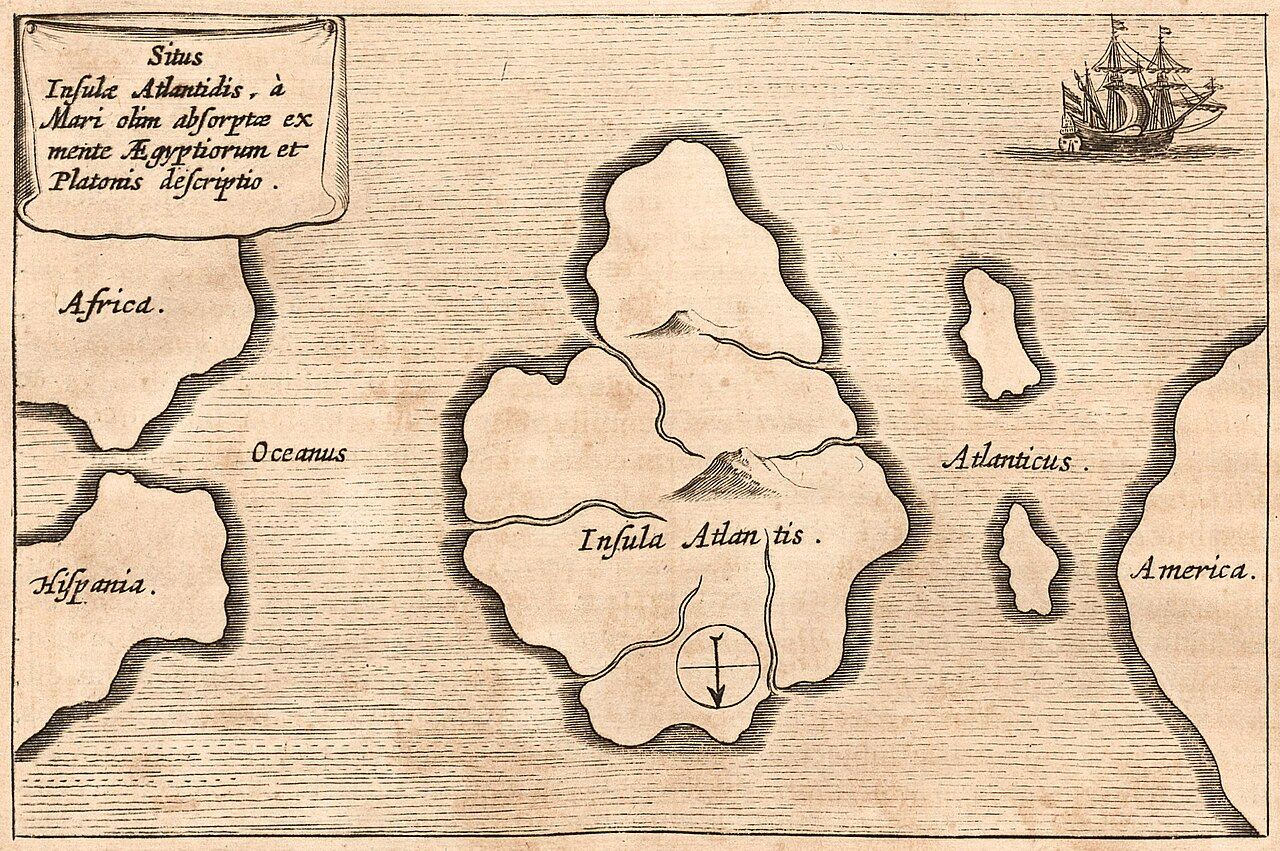 PlaceAtlantisMyth or legendPlato says a great island empire sank in a single day and night, and then his unfinished dialogue stops mid-sentence just as Zeus starts to speak. No Greek writer before him mentions Atlantis. So was it a warning parable, a memory of a real disaster, or something else? The sources point several ways.
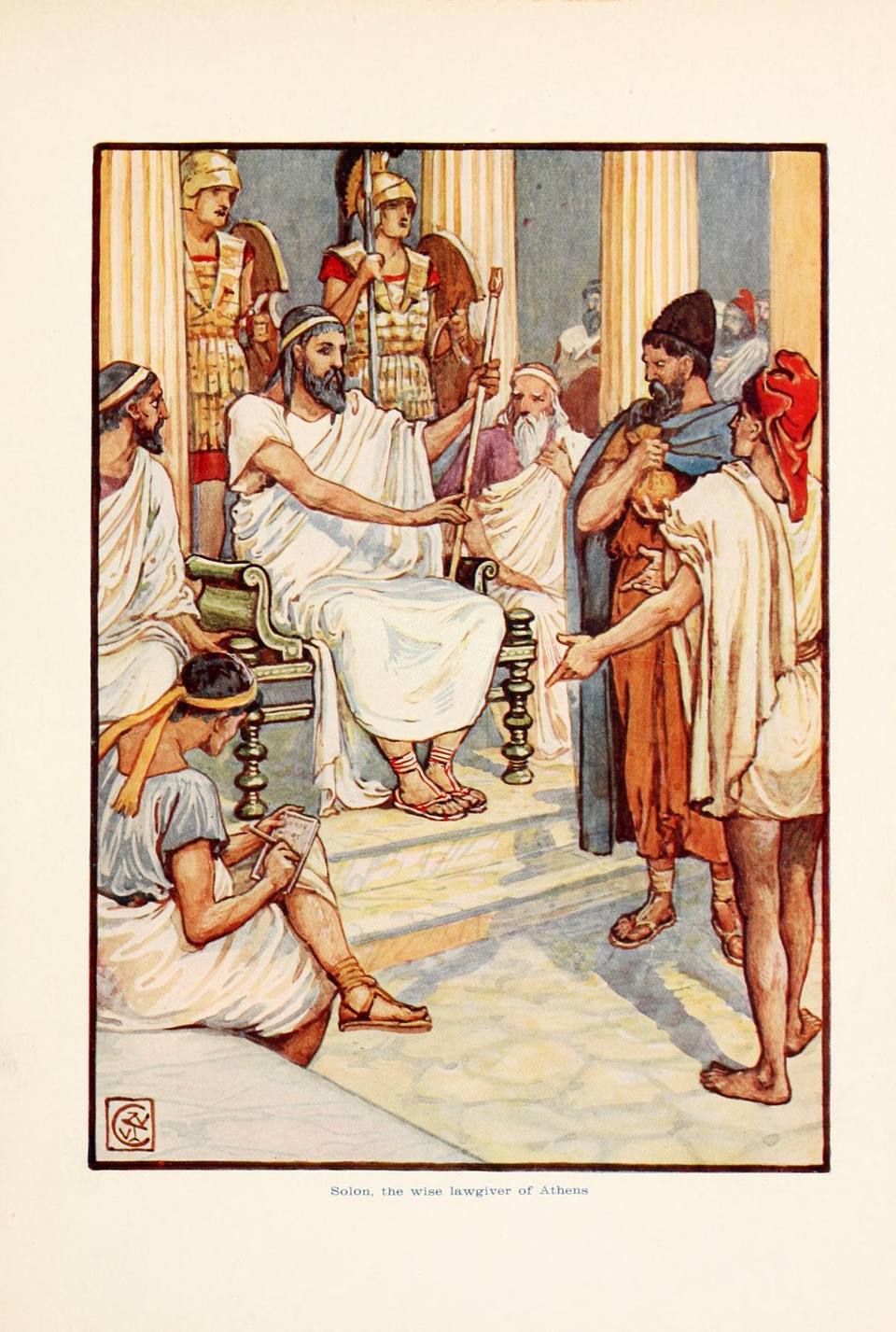 EventSolon and the priests of SaisMyth or legendAn aged Egyptian priest told the Athenian lawmaker Solon that Greeks are children with no old men among them. He said the world has been wrecked by fire and flood many times, and Egypt kept the records. Plato is the only source for this meeting. What did the priest say really happened to Phaethon?
The same story, told elsewhere
Shared story · Beginnings
The Lost Golden Age and the Ages of the World
Gold, silver, bronze, iron: Greece, Persia and the Book of Daniel all count the ages of the world in metals, India counts four yugas, and the Norse and Maya see whole worlds destroyed and remade.
Plato, Timaeus (the priest of Sais) is one telling. The same story is told 9 more times, in 6 parts of the world. Follow it:
- GreekBoeotia, Greece · c. 700 BCE · Ancient text
- Greek (Plato)Athens · c. 360 BCE · Ancient text
- Greek, about EgyptAthens, telling an Egyptian story · c. 360 BCE · Ancient textTied to this page
- Hindu law codeIndia · c. 200 BCE · Ancient text
- Hebrew BibleJudea · c. 165 BCE · Ancient text
- RomanRome · c. 8 CE · Ancient text
- Zoroastrian (Persian)Iran · 9th to 13th centuries CE · Medieval text
- Zoroastrian (Persian)Iran · 9th century CE · Medieval text
- NorseIceland · c. 1000 CE · Medieval text
- K'iche' MayaHighland Guatemala · c. 1554-1558 · Retold in English
The open question: Why do so many traditions believe the past was better and the world is running down? Memory, or human nature? Join the debate
Shared story · Floods and lost lands
Lost Lands Under the Sea: Atlantis, Dvaraka and Ys
A rich city, a proud people and one terrible day when the sea comes in and never leaves. Greece, India, Egypt, Wales, Cornwall and Brittany all tell of a land that now lies under the waves.
Plato, Timaeus (Atlantis) is one telling. The same story is told 8 more times, in 4 parts of the world. Follow it:
- Ancient EgyptianEgypt · c. 1900-1800 BCE · Ancient text
- Hindu (Sanskrit epic)Dvaraka · c. 400 BCE · Ancient text
- Greek, retold in a Roman-era geographyHelike, on the Gulf of Corinth, Greece · 373 BCE · Ancient text
- GreekAthens · c. 360 BCE · Ancient textTied to this page
- Tamil (South India)Tamil Nadu, southern tip of India · c. 5th-6th century CE · Ancient text
- WelshCardigan Bay, Wales · c. 1250 CE · Medieval text
- BretonBay of Douarnenez, Brittany, France · 15th century · Retold in English
- CornishBetween Land's End and the Isles of Scilly, Cornwall, England · c. 1478 · Medieval text
- Modern science (19th-century Europe)Germany and Britain · 1864 · Modern book
The open question: Do these stories keep real memories of lost coastlines, or is a drowned city simply a story people tell to warn against pride? Join the debate
Where this comes from
Comes from Plato's Timaeus, the copy of Timaeus we host here. Benjamin Jowett's English translation of Plato's Timaeus, with his introduction and analysis.
What this means
A primary record or a faithful public-domain copy of one. This page says what the file is and where it comes from; it does not say every claim in it is true.
Primary records exist: an original document, a published text, an official file or a dated report. We link to them. This level says the record exists and what it says, not that every claim in it is true.
Where and when was it found?
- Written
- About 360 BCE, in Athens
- Where it was found
- No copy from Plato's lifetime survives. The text comes down through Byzantine manuscripts (about 250 survive), plus papyrus scraps found in Egypt, such as Oxyrhynchus fragments of the Republic
- When it was found
- Never fully lost in the Greek world; Byzantine scholars brought Plato's Greek texts back to Western Europe in the early Renaissance. Ficino's Latin translation was printed in 1484, and Henri Estienne (Stephanus) printed the complete works in Geneva in 1578
- Oldest copy
- Codex Parisinus graecus 1807 (Paris, Bibliotheque nationale de France), copied in the 9th century, holds the last two tetralogies (including the Republic, Timaeus, Critias and Laws) and the appendix of doubtful works
- Original language
- Ancient Greek (Attic)
About this copy
This is a public-domain copy. The line below says where the file comes from and why we may host it.
Why we can share it: Project Gutenberg record: 'Copyright Status: Public domain in the USA.' Translator Benjamin Jowett (1817-1893) died 1893; translation published in the 19th century.
Updated