












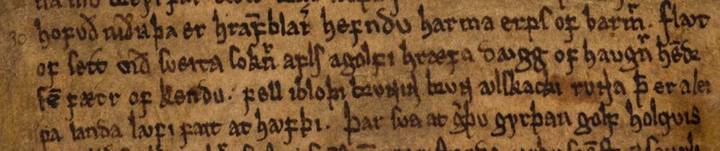
The Prose Edda
Snorri Sturluson wrote this in Iceland about 1220 as a handbook for poets, and it became our main source for Norse myth. It tells of Odin, Thor and the end of the gods.
Public domain copy
Read The Prose Edda online
nABOLD B. LE£ LtSRAR]^
BiriQ'Am YOUt«»G UWVW8ITY
r31=K)VO, UTAH
Digitized by the Internet Archive in 2011 with funding from Brigham Young University
http://www.archive.org/details/proseeddaOOsnor
This series of Scandinavian Classics is published by The American Scandinavian Foundation in the belief that greater familiarity with the chief literary monuments of the North w^ill help Americans to a better understanding of Scandinavians, and thus serve to stimulate their sympathetic cooperation to good ends
4(^rrvvaM 4rA<?^eOic
SCANDINAVIAN CLASSICS VOLUME V
THE PROSE EDDA
ESTABLISHED BY NIELS POULSON
8 3?. 6/c2
THE PROSE EDDA
BY SNORRI STURLUSON
TRANSLATED FROM THE ICELANDIC
WITH AN INTRODUCTION BY
ARTHUR GILCHRIST BRODEUR, Ph.D.
Instructor in English Philology in the Uni'versity of California
NEW YORK
THE AMERICAN-SCANDINAVIAN FOUNDATION
LONDON: HUMPHREY MILFORD
OXFORD UNIVERSITY PRESS
I916
Copyright, igi6, by The ^mertcan-Scandinavian Foundation
T). 1i. Updike ■ The ^Merrymount Tress • "Boston ■ U. S. zA.
^HE LrBRAkt
tJKiGflAIvI YOUNG UMyr^*^'^** FROVO, UTAH
TO
WILLIAM HENRY SCHOFIELD
WHO MADE THE WORK POSSIBLE
THE TRANSLATOR
RENDERS THE TRIBUTE OF
THIS BOOK
CONTENTS
INTRODUCTION ix
PROLOGUE I
GYLFAGINNING II
SKALDSKAPARMAL 87
INDEX 243
INTRODUCTION
THE life of Snorri Sturluson fell in a great but con- tradictory age, when all that was noble and spiritual in men seemed to promise social regeneration, and when bloody crimes and sordid ambitions gave this hope the lie. Not less than the rest of Europe, Scandinavia shared in the bitter conflict between the law of the spirit and the law of the members. The North, like England and the Conti- nent, felt the religious fervor of the Crusades, passed from potential anarchy into union and national consciousness, experienced a literary and spiritual revival, and suffered the fury of persecution and of fratricidal war. No greater error could be committed than to think of the Northern lands as cut ofFby barriers of distance, tongue, and custom from the heart of the Continent, and in consequence as countries where men's thoughts and deeds were more un- restrained and uncivilized. Even as England, France, and Germany acted and reacted upon one another in politics, in social growth, in art, and in literature, so all three acted upon Scandinavia, and felt the reaction of her influence. Nearly thirty years before Snorri's birth, the Danish kingdom had been the plaything of a German prince, Henry the Lion, who set up or pulled down her rulers as he saw fit; and during Snorri's boyhood, one of these rulers, Valdamarr I, contributed to Flenry's political destruction. In Norway, Sverrir Sigurdarson had swept away the old social order, and replaced it with one more highly central- ized; had challenged the power of Rome without, and that of his own nobles within, like Henry II of England and Frederick Barbarossa. After Sverrir's death, an interreg- num followed; but at last there came to the throne a mon-
Read the story behind it
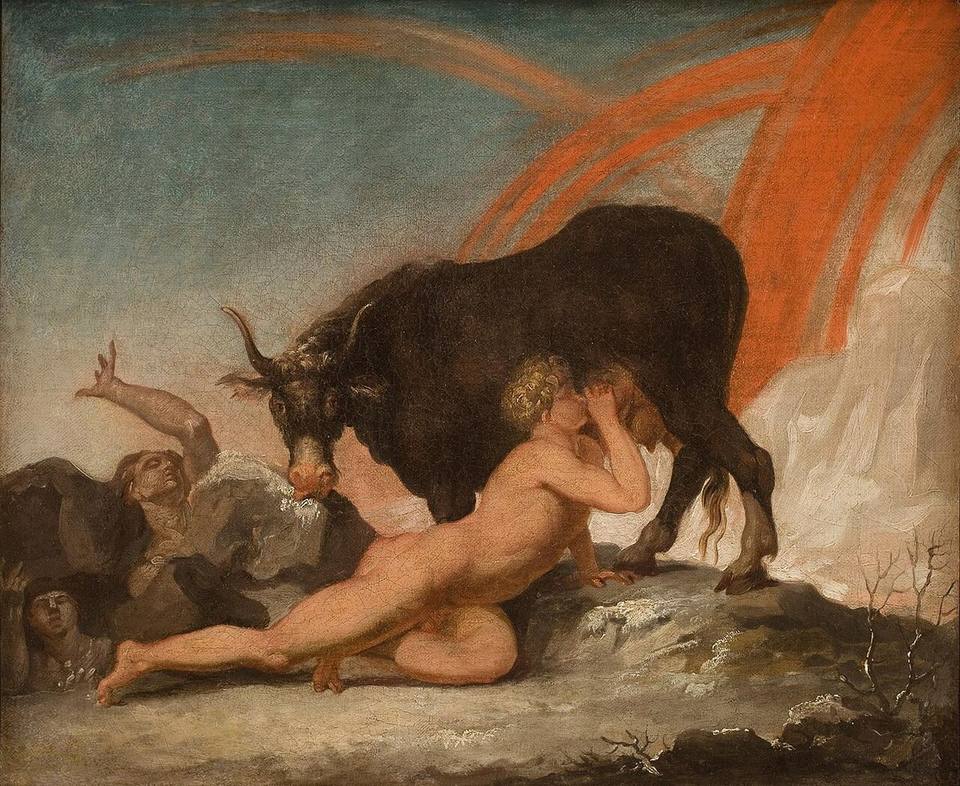 BeingYmirMyth or legendIn Norse myth, the world was built from a butchered giant: his flesh became earth, his blood the sea, his skull the sky. The story says the gods themselves descend from giants. How did a cow, a flood of blood and a lone survivor get the cosmos started? Read what the old poems and Snorri tell.
 PlaceGinnungagapMyth or legendBefore anything existed, the Norse sources describe a yawning void with fire at one end and ice at the other, and life began where they met. Later, Icelandic geographers reportedly reused the name for a real stretch of sea. What did the name actually mean, and why do scholars still argue about it?
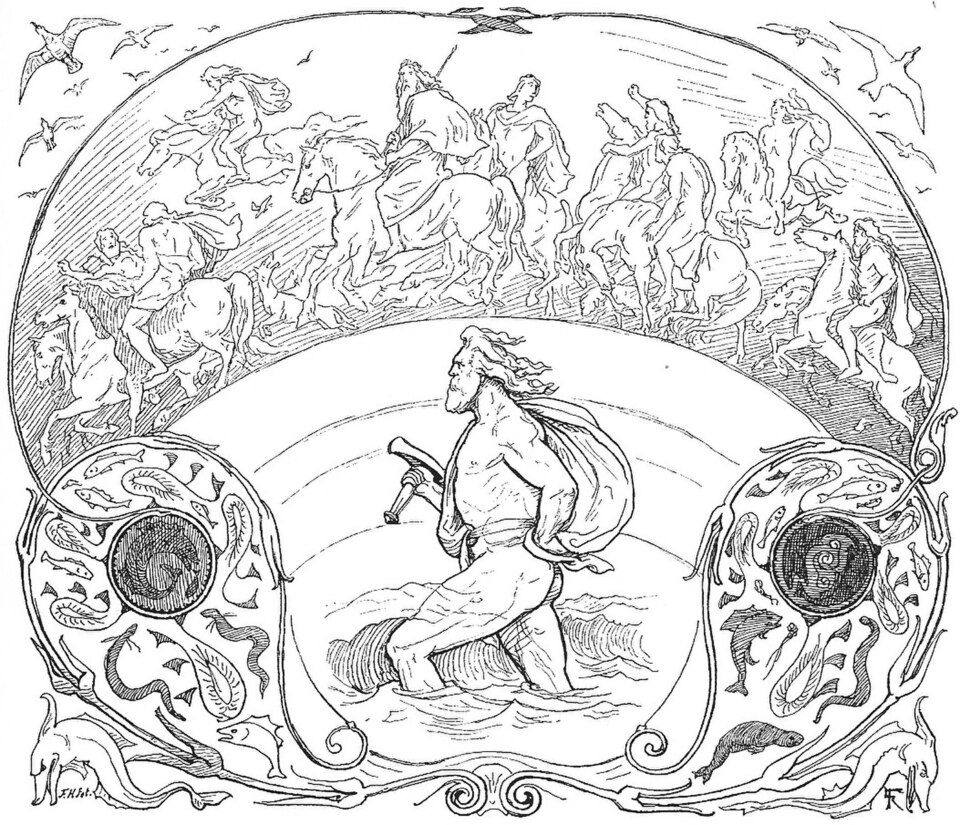 PlaceBifrostMyth or legendThe Norse bridge to the gods is said to be partly made of burning fire, to keep giants out. Its guard can hear grass grow and see a hundred leagues at night. The poems say it will break when the enemy rides across at the end of the world. Who built it, and what is it really?
 ObjectSkidbladnirMyth or legendSnorri describes a ship big enough to carry every Norse god with their weapons, one that always catches a fair wind and folds up like a napkin to fit in a pouch. Dwarves forged it in the same workshop as Odin's spear. Is it engineering fantasy or something older? See what the texts say.
The same story, told elsewhere
Shared story · Death and return
Gods Who Die and Return: Osiris, Adonis, Persephone, Baldr and Jesus
A god dies, the land mourns, and the god comes back, at least for a season. Egypt, Syria, Greece and Scandinavia all tell it. How close are these stories to Easter, and how close are they really to each other?
Prose Edda, Gylfaginning (the death of Baldr) is one telling. The same story is told 7 more times, in 5 parts of the world. Follow it:
- GreekGreece · c. 650-550 BCE · Ancient text
- Mesopotamian (seen in Jerusalem)Jerusalem temple, seen in a vision · c. 593-571 BCE · Ancient text
- HinduDvaraka, western India · c. 400 BCE · Ancient text
- ChristianWritten in Greek from Ephesus to Corinth · c. 53-55 CE · Ancient text
- EgyptianEgypt · c. 100 CE · Ancient text
- RomanRome · c. 100 CE · Ancient text
- Phoenician / SyrianByblos, Lebanon · c. 150 CE · Ancient text
- NorseIceland · c. 1220 CE · Medieval textTied to this page
The open question: Is the death-and-return story one pattern across the ancient world, or are the stories too different to group together? Scholars still argue, so where do you land? Join the debate
Shared story · Signs and numbers
The Sacred Twelve: Tribes, Disciples, Gods and Signs
Twelve tribes of Israel, twelve disciples, twelve gods of Greece and of Asgard, twelve Adityas in India, twelve signs ringing the Mithras carvings. The number twelve turns up again and again.
Prose Edda, Gylfaginning (the gods of Asgard) is one telling. The same story is told 7 more times, in 6 parts of the world. Follow it:
- Hebrew BibleCanaan and Egypt · c. 600-400 BCE · Ancient text
- Greek (about Egypt)Egypt, as reported by Egyptian priests · c. 430 BCE · Ancient text
- HinduNorthern India · c. 400 BCE · Ancient text
- GreekTiryns, Greece · c. 1st-2nd century CE · Ancient text
- ChristianGalilee · c. 80-90 CE · Ancient text
- RomanMithras temples across the Roman Empire · c. 100-400 CE · Ancient text
- NorseIceland · c. 1220 CE · Medieval textTied to this page
- Egyptian (a modern comparison)Written in London about Egyptian texts · 1907 · Modern book
The open question: Is twelve special because of the sky and the calendar, or because each tradition chose it for its own reasons? Join the debate
Shared story · Heroes and trials
The Dragon Slayer: Marduk, Indra, Thor and Saint George
A god or a hero faces a giant serpent that blocks the waters, eats the young or threatens the whole world, and cuts it down. The same fight is told in Babylon, India, Greece, Egypt, Iceland, Japan and medieval Europe.
Prose Edda, Gylfaginning (Thor and the Midgard Serpent) is one telling. The same story is told 7 more times, in 6 parts of the world. Follow it:
- Vedic IndiaNorthwest India · c. 1500-1200 BCE · Ancient text
- Babylonian (Akkadian)Babylon · c. 1200-1100 BCE · Ancient text
- GreekBoeotia, Greece · c. 700 BCE · Ancient text
- EgyptianThebes, Egypt · c. 312 BCE · Ancient text
- Hebrew BibleJudah · 24 to 27 BCE · Ancient text
- Japanese (Shinto)Izumo, Japan · 712 CE · Medieval text
- NorseIceland · c. 1220 CE · Medieval textTied to this page
- Medieval Christian (Europe)Written in northern Italy · c. 1260 CE · Medieval text
The open question: Did one ancient story of a hero and a serpent spread across the world, or do people everywhere turn their fears into dragons on their own? Join the debate
Shared story · Death and return
Journey to the Underworld: Ishtar, Orpheus, Izanagi and Savitri
Someone they love has died, so they walk into the land of the dead to bring them back. In Greece, Japan and among the Cherokee one small broken rule ruins everything, while in India a wife talks Death himself into letting go.
Prose Edda, Gylfaginning (Hermod rides to Hel for Baldr) is one telling. The same story is told 7 more times, in 6 parts of the world. Follow it:
- Babylonian (Akkadian)Mesopotamia · c. 1000-600 BCE · Ancient text
- GreekIonia · c. 725-675 BCE · Ancient text
- Hindu (Sanskrit epic)Northern India · c. 400 BCE · Ancient text
- RomanRome, Italy · 29-19 BCE · Ancient text
- Roman (Greek story)Rome, Italy · c. 8 CE · Ancient text
- Japanese (Shinto)Japan · 712 CE · Medieval text
- NorseIceland · c. 1220 CE · Medieval textTied to this page
- Cherokee (North America)Eastern Cherokee, western North Carolina, USA · 1887-1890 · Recorded folklore
The open question: Did the story of the forbidden look back travel from people to people, or did people far apart each decide that the dead are lost through one small mistake? Join the debate
Where this comes from
Comes from The Prose Edda, by Snorri Sturluson, the copy of The Prose Edda we host here. Arthur Gilchrist Brodeur's English translation of Snorri Sturluson's Prose Edda, American-Scandinavian Foundation, New York, 1916.
What this means
A primary record or a faithful public-domain copy of one. This page says what the file is and where it comes from; it does not say every claim in it is true.
Primary records exist: an original document, a published text, an official file or a dated report. We link to them. This level says the record exists and what it says, not that every claim in it is true.
Where and when was it found?
- Written
- Early 13th century, in Iceland, by or compiled by Snorri Sturluson
- Where it was found
- Seven manuscripts: the main ones are in Uppsala (Codex Upsaliensis), Reykjavik (Codex Regius), Copenhagen (Codex Wormianus) and Utrecht (Codex Trajectinus)
- When it was found
- The Codex Regius of the Prose Edda takes its name from its time in the Royal Library, Copenhagen; it is now back in Reykjavik
- Oldest copy
- Codex Upsaliensis (DG 11), first quarter of the 14th century, Uppsala University Library; the Codex Regius (GKS 2367 4to), first half of the 14th century, now in the Arni Magnusson Institute, Reykjavik
- Original language
- Old Norse (Old Icelandic)
Sources for these facts
About this copy
This is a public-domain copy. The line below says where the file comes from and why we may host it.
Why we can share it: Published 1916, before 1931, so public domain in the US (reasoning; archive metadata for this item states no copyright status).
Updated