












What is Ying Shao known for?
Ying Shao was an official and scholar of the late Eastern Han dynasty. He served as administrator of Taishan Commandery from 189 to 194, where he fought off remnants of the Yellow Turban rebels, then fled to the warlord Yuan Shao when Cao Cao invaded the region. He died at Ye in about 204.
His best-known work is the Fengsu Tongyi, a treatise on popular customs, beliefs and legends, written around 195 CE. It survives in ten chapters plus fragments quoted in later collections. He also wrote on Han court institutions.
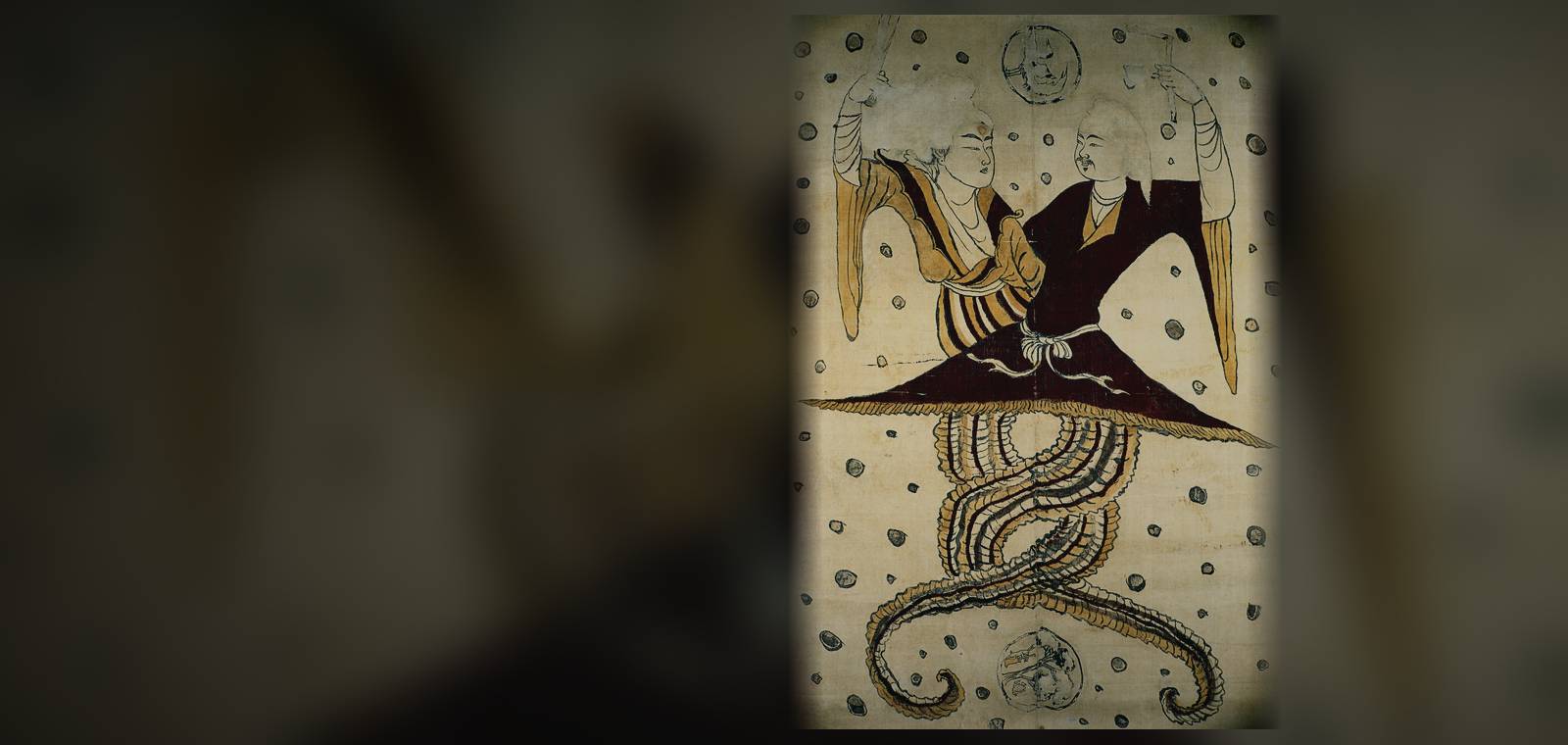
A fragment of the Fengsu Tongyi preserves the best-known version of the creation of humans by the goddess Nüwa: she shapes people from yellow earth by hand, then, tiring, drags a cord through mud and flicks off drops that become people. The text explains social rank by this difference, with nobles from the handmade figures and commoners from the mud drops.
Titles and honors
- Offices held
- Administrator of Taishan 189-194
- Colonel Advising the Army (under Yuan Shao)
The same story, told elsewhere
Shared story · Beginnings
Beings Who Taught Humanity the Arts
Fallen angels taught metalwork and makeup, a fish-man from the sea taught writing and law, Prometheus gave fire and numbers, and Thoth invented letters. Many cultures say civilization was a gift from outside.
Book of Changes (Yi Jing), Great Appendix is one telling. The same story is told 6 more times, in 4 parts of the world. Follow it:
- GreekAthens · c. 460-430 BCE · Ancient text
- Greek, about EgyptAthens, telling an Egyptian story · c. 370 BCE · Ancient text
- ChineseChina · c. 4th to 3rd century BCE · Ancient textTied to this page
- Jewish apocalyptic (Second Temple)Judea · c. 300-200 BCE · Ancient text
- Babylonian, retold in GreekBabylon · c. 280 BCE · Ancient text
- Jewish (Second Temple)Judea · c. 160-150 BCE · Ancient text
- IslamArabia · 7th century CE · Medieval text
The open question: Did people credit outsiders for their own inventions, or is there a reason so many say they were taught? Join the debate
Shared story · Beginnings
People Made From Clay: Adam, Nuwa, Prometheus and the Potter Gods
A god kneels in the mud, shapes a body with his hands and breathes it into life. That scene is told in Iraq, Israel, Egypt, Greece, China, Arabia, Guatemala, Sudan and New Zealand.
Fengsu Tongyi of Ying Shao (Nuwa shapes people), as retold by E. T. C. Werner is one telling. The same story is told 8 more times, in 6 parts of the world. Follow it:
- Babylonian (Akkadian)Mesopotamia · c. 1700 BCE · Ancient text
- Ancient EgyptianEgypt · c. 1215 BCE · Ancient text
- Hebrew BibleJudah · c. 900-450 BCE · Ancient text
- GreekGreece · 1st or 2nd century CE · Ancient text
- ChineseChina · c. 195 CE · Retold in EnglishTied to this page
- IslamArabia · 7th century CE · Medieval text
- K'iche' MayaHighland Guatemala · c. 1554-1558 · Retold in English
- Maori (New Zealand)Aotearoa · 19th century · Retold in English
- Shilluk (South Sudan)White Nile, South Sudan · 1911 · Retold in English
The open question: Did one old story about a potter god travel from people to people, or does anyone who works with clay end up imagining that we were made from it? Join the debate
Mentioned on these pages
Linked people and places
Where this comes from
Comes from Wikipedia, 'Ying Shao'. A free online encyclopedia written and edited by volunteers. It is a good starting point and usually lists its own sources, but anyone can change it, so we treat it as a guide to better sources, not the final word.
What this means
A real person with records. Sources are listed below.
For Ying Shao, the original record exists and is linked: Wikipedia, 'Ying Shao'. That tells you the record is real and what it says. It does not mean every claim in it is true.
Primary records exist: an original document, a published text, an official file or a dated report. We link to them. This level says the record exists and what it says, not that every claim in it is true.
Sources
- WikipediaA free online encyclopedia written and edited by volunteers. It is a good starting point and usually lists its own sources, but anyone can change it, so we treat it as a guide to better sources, not the final word.Wikipedia, 'Ying Shao'Reference Archived copy, 2026-09-02
- Encyclopaedia BritannicaAn encyclopedia first published in Scotland in 1768 and now online. Its articles are written and checked by named experts and editors, which makes it a reliable source for basic facts.Encyclopaedia Britannica, 'Nu Gua'Reference
No public-domain picture of this person yet. We do not show drawn or generated likenesses.