Credible Theories Sign in

The record

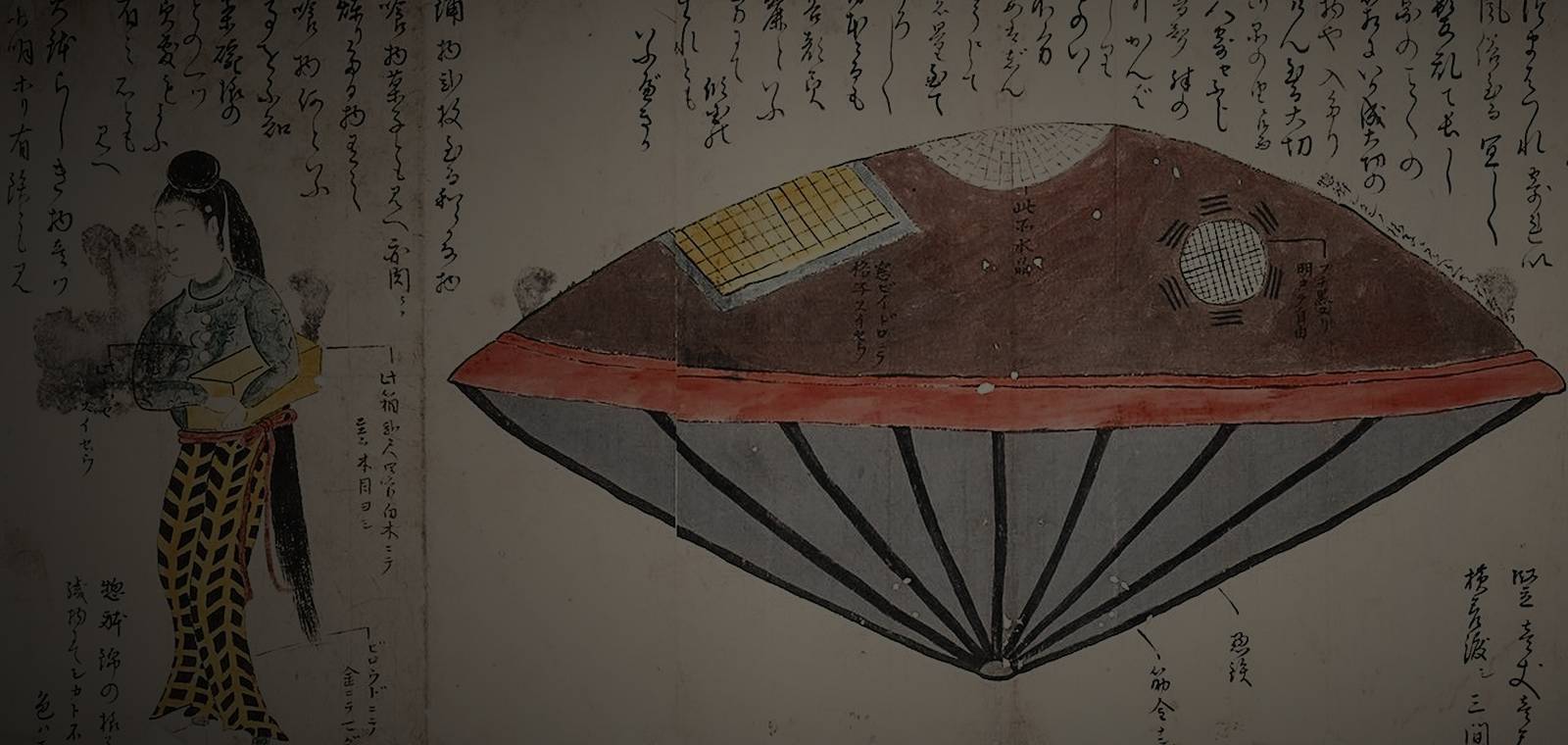
The utsuro-bune, "hollow ship", is a Japanese legend set on the coast of Hitachi Province, modern Ibaraki Prefecture, northeast of Edo (Tokyo). Four texts from 1815 to 1844 describe it, with the most detailed account in the Toen Shosetsu (1825), a collection of strange tales compiled by the writer Kyokutei Bakin and his circle.

According to these accounts, in 1803 fishermen saw a strange vessel drifting ashore and brought it to the beach. It was round, like a rice cooking pot, with a lacquered upper part, glass or crystal windows, and an iron-plated base. Inside was a young woman with pale skin and red hair and eyebrows, wearing unusual clothes, who spoke a language no one understood. She held a box about two feet long and would not let anyone touch it. Unknown symbols were written inside the vessel.

The villagers, told by an elder that she might be a foreign princess exiled for adultery, with her lover's head in the box, decided not to get involved with the authorities. They put her back in the vessel and pushed it out to sea. Some versions say this happened because the local authorities would have had to pay for an investigation. The woman's fate is not recorded.

Historians read the story as folklore shaped by Edo-period anxieties about foreign ships during Japan's closed-country policy, and by older tales of sacred beings arriving in hollow vessels. The symbols have been matched to ones used in Western-influenced texts of the period. In 2014 researcher Kazuo Tanaka found a document naming a real beach, now in Kamisu, suggesting the legend was tied to a specific place.
Questions people ask about Utsuro-bune (the hollow ship)

Who was the woman in the utsuro-bune?

No one knows, and no official record names her. The writer Bakin wondered in 1844 whether she might be a Russian, British or American princess. Researcher Kazuo Tanaka has suggested a European ship may have been wrecked with her aboard. Some UFO writers treat her as a visitor from another world, but no evidence supports that reading.

Is the utsuro-bune a real UFO case?

The evidence points to folklore. The famous folklorist Kunio Yanagita studied it in 1925, noting that round boats were common in Japan and that the oldest versions describe a simple log boat. He thought details like brass plates and glass windows were added later. Tanaka found that the place names in the early texts seem to be invented.

Where are the old utsuro-bune drawings kept?

Each of the four Edo-period texts has its own home. Bakin's Toen Shosetsu is held at a library in Machida, Tokyo. The Hyoryu Kishu of 1835 is at Tenri University's library in Nara Prefecture, and Ume-no-chiri of 1844 is at the Iwase Bunko library. Two rare printed sheets found in 2010 and 2012 tell a similar tale but place it at a different harbor.

The open question

Still strange: The villagers reportedly pushed her back out to sea rather than involve the authorities, and her fate is not recorded.

The Qigong Flying Cart: A Flying Machine in Ancient Chinese Texts →
  1. Step 1 of 4 · This fileUtsuro-bune
  2. Step 2 of 4 · The passageThe hollow ship of Hitachi, Utsuro-bune (Toen Shosetsu, 1825)
  3. Step 3 of 4 · Next fileThe Qigong Flying Cart: A Flying Machine in Ancient Chinese Texts
  4. Step 4 of 4 · Next fileLivy's Ships in the Sky: Rome's Strange Sighting of 218 BCE
About these videos

Found by a YouTube search for this topic, not checked by us. The player loads from YouTube only when you press play.

Where it turns up

Where this comes from

EvidenceMyth or legend

Comes from Toen Shosetsu (1825), compiled by Kyokutei Bakin and others, account of the utsuro-bune. A collection of strange stories gathered in 1825 by a literary club in Edo (now Tokyo) that included the novelist Kyokutei Bakin. It includes the utsuro-bune tale: a round boat that washed ashore in 1803 carrying a young woman who spoke no known language.

What this means

A Japanese folk story from 1803. No physical record has been found.

Utsuro-bune is known from stories, scripture or tradition. The texts are real and we quote them (for example Toen Shosetsu (1825), compiled by Kyokutei Bakin and others, account of the utsuro-bune), but nothing outside those texts shows that Utsuro-bune was real as described.

The page covers something known from myths, scripture or tradition. The texts are real and we quote them, but no independent record shows the events or beings were real.

See all five labels

Sources

  1. Toen Shosetsu (1825)A collection of strange stories gathered in 1825 by a literary club in Edo (now Tokyo) that included the novelist Kyokutei Bakin. It includes the utsuro-bune tale: a round boat that washed ashore in 1803 carrying a young woman who spoke no known language. Most historians treat it as folklore, not a report.Toen Shosetsu (1825), compiled by Kyokutei Bakin and others, account of the utsuro-bunePrimary text
  2. WikipediaA free online encyclopedia written and edited by volunteers. It is a good starting point and usually lists its own sources, but anyone can change it, so we treat it as a guide to better sources, not the final word.Wikipedia, "Utsuro-bune"Reference Archived copy, 2026-08-26
  3. WikipediaWikipedia, "Sakoku"Reference Archived copy, 2026-09-28
  4. Yashiro Hirokata, Hirokata zuihitsu, 'Utsuro-bune no banjo' (c. 1825), National Archives of Japan: a drawing of the same 1803 hollow-ship story recorded by a member of the Toen circlePrimary text

Quotations come from public-domain translations. A book in our Library links to its Library page; other links open the free online copy or the reference page.

Updated

Credible or not?

Tap one to see how other readers voted.

Discussion