How the rabbit hole works. Start with anything that grabs you, say UFOs. Every person, place and document a page mentions links to its own page, so a UFO file leads to a witness, the witness leads to the people who investigated the case, and it keeps going.
The path you take shows in the bar under the top menu on every page, so you can step back any time or climb out and start again.
This is a summary from the Fengsu Tongyi, a Chinese book of customs and legends written around 195 CE. In the story, the goddess Nüwa makes people by hand from yellow earth. That is too slow, so she drags a rope through mud, and every drop that falls becomes a person. The handmade people become nobles, and the rope-made ones become common people.
ReferenceFengsu Tongyi (Ying Shao)
Writtenc. 195 CE
SetCreation of humans
Nüwa made people by hand from yellow earth. The work was too slow, so she dragged a rope through the mud and every drop that fell became a person. The hand-made ones became the nobles, the rope-made ones the common people.
Documented · Retold in English, c. 195 CE Summary by the editors. Translation: Summary in my own words
AdvertisementAd space
Read it literally
Humans made from earth in two quality grades.
What scholars say
Han dynasty folklore collection; the passage survives through quotation.
A god kneels in the mud, shapes a body with his hands and breathes it into life. That scene is told in Iraq, Israel, Egypt, Greece, China, Arabia, Guatemala, Sudan and New Zealand.
Fengsu Tongyi of Ying Shao (Nuwa shapes people), as retold by E. T. C. Werner is one telling. The same story is told 8 more times, in 6 parts of the world. Follow it:
The open question: Did one old story about a potter god travel from people to people, or does anyone who works with clay end up imagining that we were made from it? Join the debate
Questions people ask about Fengsu Tongyi
Who was Ying Shao, and how did his book survive?
Ying Shao was an official and scholar of the late Eastern Han dynasty. His Fengsu Tongyi, a study of customs and popular beliefs, first had 30 chapters, but only 10 survive. The Nüwa creation story comes from a lost part and is known because the Song dynasty encyclopedia Taiping Yulan quoted it.
What other stories are told about Nüwa?
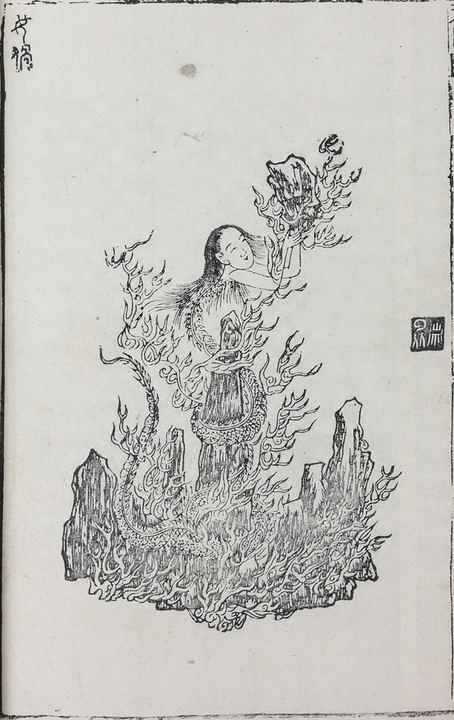
The best known appears in the Huainanzi, a Han dynasty book from the second century BCE. After the sky cracked in a great disaster, often blamed on a battle involving the god Gonggong, Nüwa heated five-colored stones and used them to mend the gap. She cut the legs off a giant turtle to prop up the four corners of the sky.
How are Nüwa and Fuxi connected?
In many traditions Nüwa and Fuxi are sister and brother, and also husband and wife, who restart the human race. Han tomb carvings and murals show them with human heads and snake-like lower bodies. From the middle of the Eastern Han period their tails are often shown twisted together, and they sometimes hold a compass and a carpenter's square.
Used on these files
Nüwa: The Goddess Who Made Humans and Repaired the SkyMyth or legendChinese myth says the goddess Nüwa made people from yellow earth, then mass-produced more by flicking a muddy rope, so nobles are hand-molded and commoners flung. Later she patched a broken sky with melted stones of five colors. Why did the sky break in the first place? The page tells both stories.
Where this comes from
EvidenceDocumented
Comes fromThe Fengsu Tongyi, Fengsu Tongyi (Ying Shao). A Chinese book on customs, beliefs and legends by Ying Shao, a Han dynasty official, written around AD 195. Much of it is lost; its story of the goddess Nüwa shaping the first humans from yellow earth survives through quotations in later books.
What this means
The text exists and is quoted from a published translation. What it describes is a separate question.
Primary records exist: an original document, a published text, an official file or a dated report. We link to them. This level says the record exists and what it says, not that every claim in it is true.
The HuainanziA Chinese book of philosophy, science and myth written by scholars at the court of Liu An, a prince of the Han dynasty, and presented to the emperor in 139 BC. It tells of Gonggong breaking the pillar that held up the sky and the goddess Nüwa mending the heavens.Huainanzi 6 (Lanming xun), c. 139 BCE, Chinese Text ProjectPrimary textArchived copy, 2026-10-03
Scholarly dates are rounded. The wording follows the named public-domain translation.
More from China
Two more stories, and what each shares with Nüwa shapes people from yellow earth.