












What is Rano Raraku known for?
Rano Raraku is a quarry on Rapa Nui, the island Europeans call Easter Island, in the Pacific. UNESCO calls the island "the most remote inhabited island on the planet," 3,700 kilometers from the coast of continental Chile, and says its people were "a small group of settlers from Eastern Polynesia."
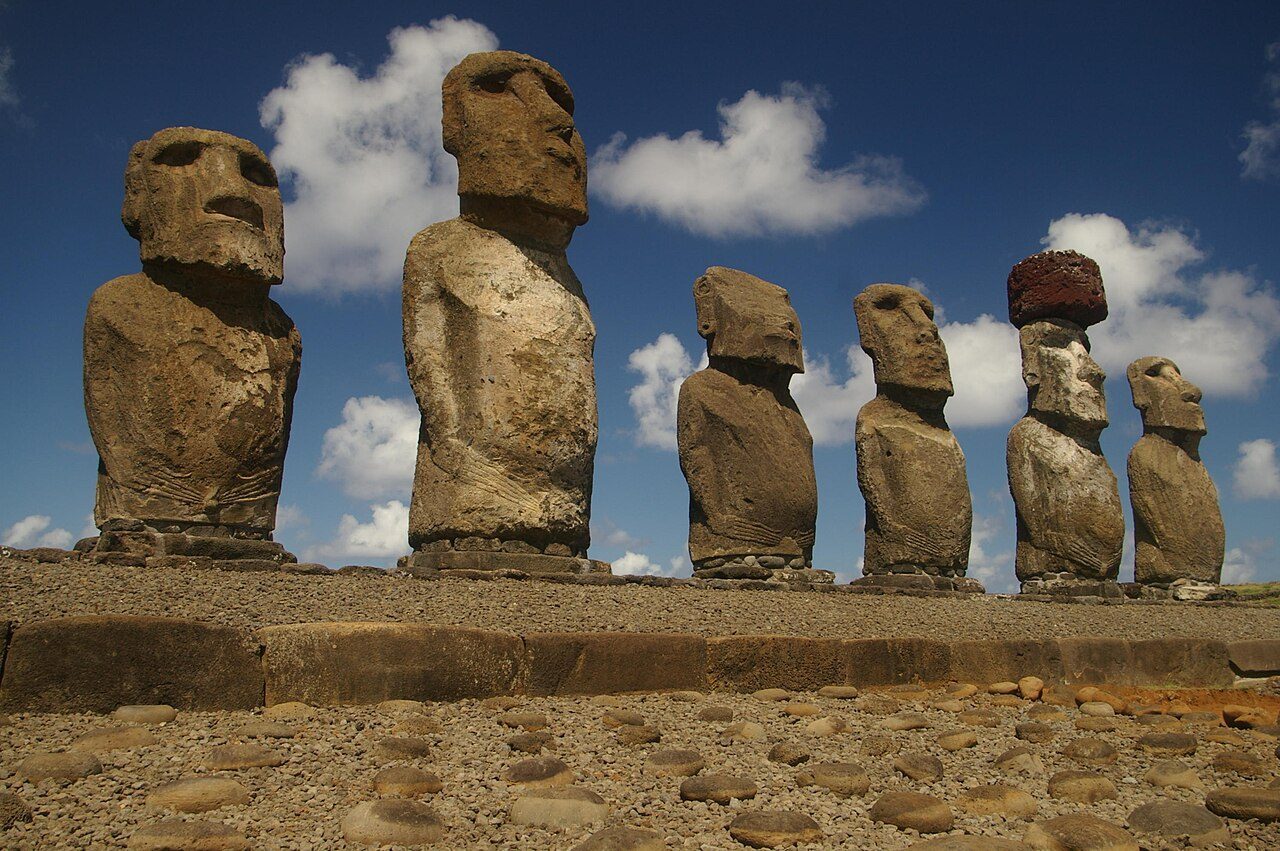
The island's giant stone figures, the moai, were carved from its volcanic tuff, and UNESCO says the quarries, "Rano Raraku and others," are "invaluable evidence of the process of their carving." It counts about 900 statues, from 2 to 20 meters tall, made between the 10th and 16th centuries.
Getting the statues from the quarry to their platforms along the coast has puzzled visitors since 1722. In 2025 Carl Lipo and Terry Hunt argued that the islanders walked them upright along prepared roads, rocking them from side to side with ropes.
Mentioned on these pages
Linked people and places
Where this comes from
Comes from Jacob Roggeveen's official log (1722), trans. Bolton Glanvill Corney, The Voyage of…. Internet Archive: A nonprofit digital library in San Francisco, founded in 1996, that holds millions of scanned books, papers and recordings. A scan there shows the pages of a real printed book or document.
What this means
A real place with records. Sources are listed below.
For Rano Raraku, the original record exists and is linked: Jacob Roggeveen's official log (1722), trans. Bolton Glanvill Corney, The Voyage of…. That tells you the record is real and what it says. It does not mean every claim in it is true.
Primary records exist: an original document, a published text, an official file or a dated report. We link to them. This level says the record exists and what it says, not that every claim in it is true.
Sources
- UNESCO World Heritage CentreThe official website of the World Heritage list kept by UNESCO, the United Nations agency for education, science and culture. Each place's page gives an expert-checked description of the site and why it matters.UNESCO World Heritage Centre, "Rapa Nui National Park" (site 715)
- "Easter Island's statues actually 'walked' - and physics backs it up", Binghamton University news (October 2025), on Lipo and Hunt in the Journal of Archaeological Science
- Internet ArchiveA nonprofit digital library in San Francisco, founded in 1996, that holds millions of scanned books, papers and recordings. A scan there shows the pages of a real printed book or document.Jacob Roggeveen's official log (1722), trans. Bolton Glanvill Corney, The Voyage of Captain Don Felipe Gonzalez ... to Easter Island in 1770-1, Hakluyt Society (1908), pp. 15-16Primary text
No public-domain picture of this place yet. We do not show drawn or generated likenesses.