The record
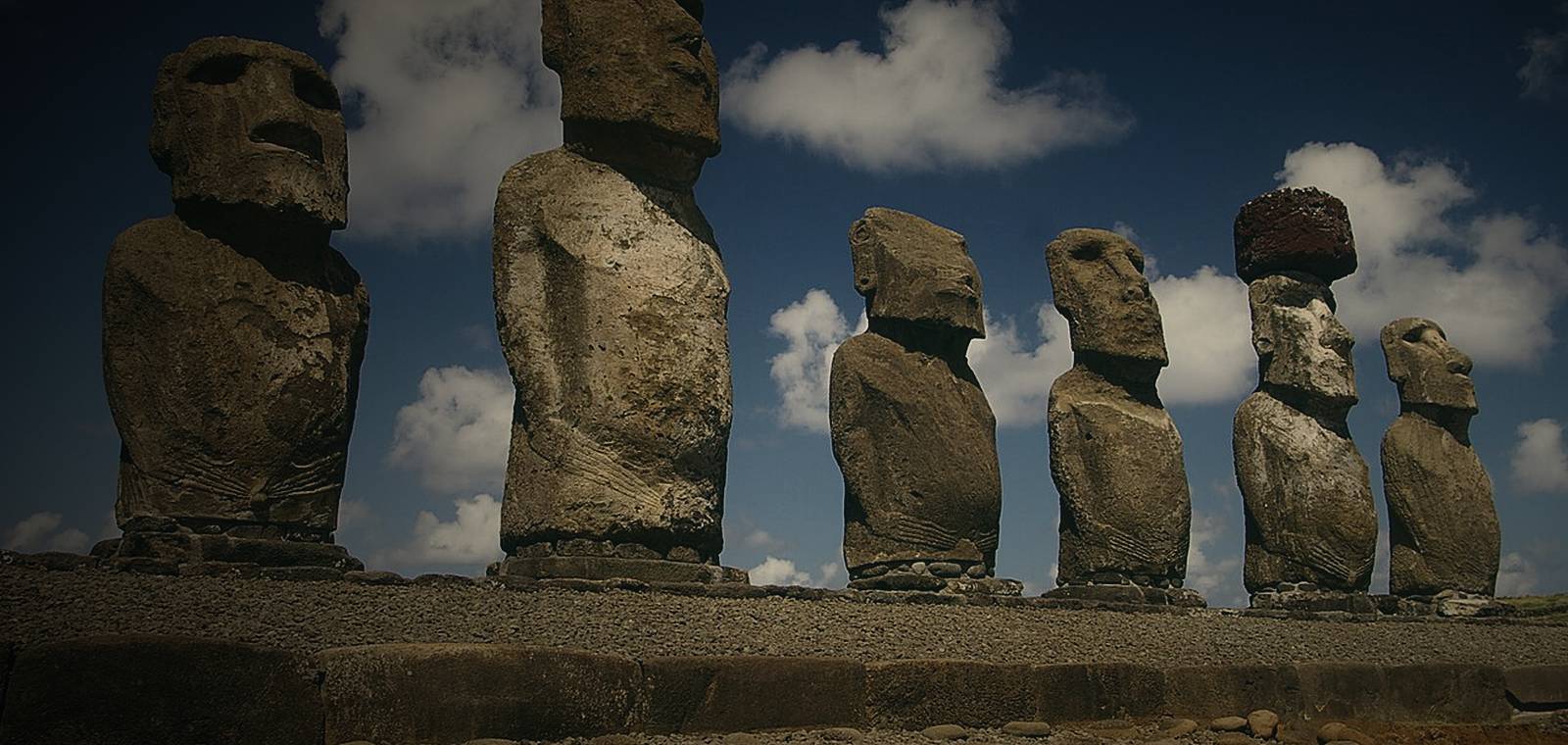
We noticed only that they kindle fire in front of certain remarkably tall stone figures they set up; and, thereafter squatting on their heels with heads bowed down, they bring the palms of their hands together and alternately raise and lower them. At first, these stone figures caused us to be filled with wonder, for we could not understand how it was possible that people who are destitute of heavy or thick timber, and also of stout cordage, out of which to construct gear, had been able to erect them; nevertheless some of these statues were a good 30 feet in height and broad in proportion.
Jacob Roggeveen, official log, April 1722 · Other traditions
Translation: Bolton Glanvill Corney, The Voyage of Captain Don Felipe Gonzalez ... to Easter Island in 1770-1, with Roggeveen's log (Hakluyt Society, 1908) · Public domain
Rapa Nui, which Europeans call Easter Island, is a small Pacific island belonging to Chile. Its people carved the moai, giant stone figures, mostly from yellow-brown lava tuff
at the Rano Raraku quarry. UNESCO says the island has about 900 statues, from 2 to 20 meters tall, made between the 10th and 16th centuries, and that the platform of Ahu Tongariki holds 15 of them in a row.
The Dutch commander Jacob Roggeveen reached the island on Easter Day 1722 and named it for that day. His log, translated by Bolton Glanvill Corney for the Hakluyt Society in 1908, says the islanders lit fires in front of certain remarkably tall stone figures.
He wrote: we could not understand how it was possible that people who are destitute of heavy or thick timber, and also of stout cordage, out of which to construct gear, had been able to erect them; nevertheless some of these statues were a good 30 feet in height and broad in proportion.
His puzzle ended, he thought, when his men broke off a piece and decided they were made of clay. They are in fact carved stone.
How the statues reached their platforms from the quarry was argued over for centuries. In 2025 Carl Lipo of Binghamton University and Terry Hunt, writing in the Journal of Archaeological Science, used 3D models of nearly 1,000 moai and field tests to argue that the islanders "walked" them upright with ropes, rocking them in a zig-zag along roads built for the purpose. In an earlier test, 18 people moved a 4.35-ton copy 100 meters in 40 minutes.