Credible Theories Sign in

The record

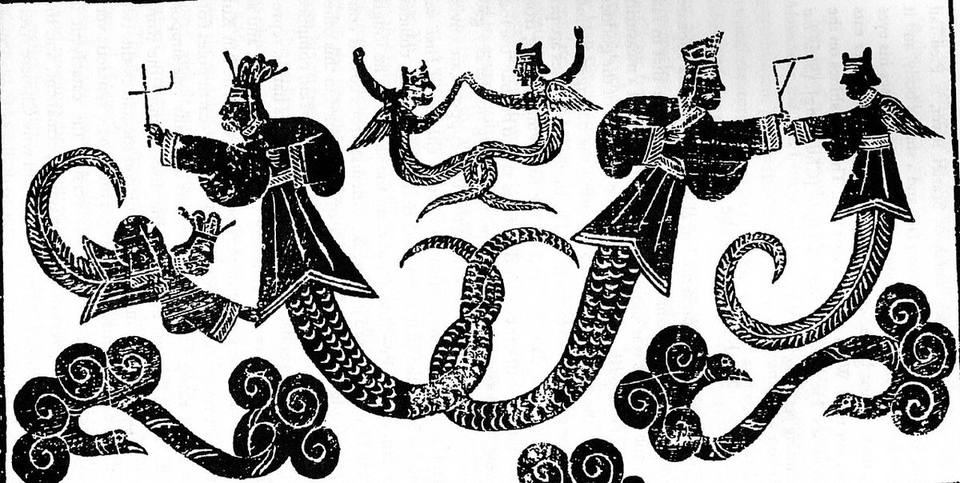
Gonggong is a destructive water god in Chinese mythology, usually described with a human head, red hair and the body of a serpent. He is linked with floods and chaos, and in many stories he works with his nine-headed minister Xiangliu, whose poison fouls the land. He appears in several early texts, including the Shan Hai Jing and the Huainanzi.

His most famous act comes from the Huainanzi, chapter 3. Gonggong fought the ruler Zhuanxu for the right to be emperor. In his rage he butted his head against Mount Buzhou, one of the pillars that held up the sky. The pillar broke and the cords holding the earth snapped. Heaven tilted toward the northwest, so the sun, moon and stars moved in that direction, and the earth sank in the southeast, so water and silt flowed there.

The story is an explanation of real observations. In China, the celestial pole sits well above the northern horizon and the stars wheel around it, and the country's great rivers flow east and southeast to the sea. Later tradition merged Gonggong's damage with Nüwa's repair of the sky. In other texts he causes the great flood that the heroes Gun and Yu must control.

Scholars see him as one of several figures of cosmic disorder defeated by rulers in early Chinese myth. Catastrophe-minded readers note that his story joins a flood, a broken sky and a shift in the heavens into one event, the kind of sequence many cultures describe. His defeat is usually credited to rulers who restore order, a recurring pattern in Chinese political myth.
The same story, told elsewhere

Shared story · Floods and lost lands

Flood Stories Around the World

A god warns one good man, a boat is built, the world drowns and birds are sent out to find land. The same story turns up from Iraq to India to Greece, with cousins in China, Scandinavia and Guatemala.

Book of Documents (Shu Jing), Canon of Yao is one telling. The same story is told 9 more times, in 6 parts of the world. Follow it:

  1. Vedic IndiaNorthern India · c. 800-600 BCE · Ancient text
  2. Babylonian (Akkadian)Mesopotamia · 7th century BCE · Ancient text
  3. Hebrew BibleJudah / Babylon · c. 600-400 BCE · Ancient text
  4. ChineseYellow River valley, China · 1st millennium BCE · Ancient textTied to this page
  5. Zoroastrian (Persian)Iran / Central Asia · 1st millennium BCE · Ancient text
  6. Babylonian, retold in GreekBabylon · c. 280 BCE · Ancient text
  7. GreekGreece · 1st or 2nd century CE · Ancient text
  8. IslamArabia · 7th century CE · Medieval text
  9. NorseIceland · c. 1220 CE · Medieval text
  10. K'iche' MayaHighland Guatemala · c. 1554-1558 · Retold in English

The open question: One real flood remembered by many peoples, or many different floods that each people told in its own way? Join the debate

Questions people ask about Gonggong

Is the dwarf planet Gonggong named after the water god?

Yes. The distant dwarf planet once known as 2007 OR10 was officially named Gonggong in 2020, after a public vote run by its discoverers. Its small moon was named Xiangliu, after the god's nine-headed helper. The names fit because the world is reddish and has water ice on its surface, echoing the red-haired god of water.

Why did Gonggong hit Mount Buzhou?

In the best-known version from the Huainanzi, he lost a struggle for the throne against Zhuanxu and rammed the mountain in fury. Other early texts give him a different rival: some say he fought the fire god Zhurong, setting water against fire. Either way, his defeat leaves the sky tilted and the land sloping.

Does the Gonggong myth describe a real event?

No physical event is needed to explain it. China's land really does slope from west to east, since the Yellow River and the Yangtze both rise on the high Tibetan Plateau and run to the eastern seas. The myth turns that lasting shape of the land, and the turning sky, into a single dramatic cause.

The open question

Still strange: He is described with a human head, red hair and a snake's body, and he has a helper with nine heads.

Nüwa: The Goddess Who Made Humans and Repaired the Sky →
  1. Step 1 of 4 · This fileGonggong
  2. Step 2 of 4 · The passageThe sky breaks and Nüwa repairs it, Huainanzi 6; 3
  3. Step 3 of 4 · Next fileNüwa: The Goddess Who Made Humans and Repaired the Sky
  4. Step 4 of 4 · Next fileYu the Great: The Engineer-King Who Tamed China's Great Flood
About these videos

Found by a YouTube search for this topic, not checked by us. The player loads from YouTube only when you press play.

Where it turns up

Where this comes from

EvidenceMyth or legend

Comes from Huainanzi 3 (Tianwen xun), c. 139 BCE, Chinese Text Project. The Huainanzi: A Chinese book of philosophy, science and myth written by scholars at the court of Liu An, a prince of the Han dynasty, and presented to the emperor in 139 BC. It tells of Gonggong breaking the pillar that held up the sky and the goddess Nüwa mending the heavens.

What this means

A story or tradition. It is documented as a story; nothing independent shows it happened.

Gonggong is known from stories, scripture or tradition. The texts are real and we quote them (for example Huainanzi 3 (Tianwen xun), c. 139 BCE, Chinese Text Project), but nothing outside those texts shows that Gonggong was real as described.

The page covers something known from myths, scripture or tradition. The texts are real and we quote them, but no independent record shows the events or beings were real.

See all five labels

Sources

  1. The HuainanziA Chinese book of philosophy, science and myth written by scholars at the court of Liu An, a prince of the Han dynasty, and presented to the emperor in 139 BC. It tells of Gonggong breaking the pillar that held up the sky and the goddess Nüwa mending the heavens.Huainanzi 3 (Tianwen xun), c. 139 BCE, Chinese Text ProjectPrimary text Archived copy, 2026-04-22
  2. The Shan Hai Jing (Classic of Mountains and Seas)An ancient Chinese book describing mountains, rivers, strange creatures and far-off peoples, some real and many legendary. It was put together over several centuries, roughly 400 BC to AD 100, and is a key source for Chinese myth.Shan Hai Jing (Classic of Mountains and Seas), Chinese Text ProjectPrimary text Archived copy, 2026-08-28
  3. WikipediaA free online encyclopedia written and edited by volunteers. It is a good starting point and usually lists its own sources, but anyone can change it, so we treat it as a guide to better sources, not the final word.Wikipedia, "Gonggong"Reference Archived copy, 2026-08-26
  4. WikipediaWikipedia, "Mount Buzhou"Reference Archived copy, 2026-09-02

Quotations come from public-domain translations. A book in our Library links to its Library page; other links open the free online copy or the reference page.

Updated

Credible or not?

Tap one to see how other readers voted.

Discussion