How the rabbit hole works. Start with anything that grabs you, say UFOs. Every person, place and document a page mentions links to its own page, so a UFO file leads to a witness, the witness leads to the people who investigated the case, and it keeps going.
The path you take shows in the bar under the top menu on every page, so you can step back any time or climb out and start again.
This is a summary from the Secret Book of John, an early Christian text from the Gnostics, written around 150 to 200 CE and found in Egypt in 1945. In it, a flawed creator named Yaldabaoth and his rulers, called archons, build a human body but cannot make it move. After a higher power is breathed into Adam, they grow jealous and lock him in a heavier body.
ReferenceApocryphon of John (Nag Hammadi Codex II)
Writtenc. 150–200 CE
SetCreation
The flawed creator Yaldabaoth and his rulers (archons) build a human body, each forming one part, but cannot make it move. They are tricked into breathing a higher power into it. Jealous of what they made, they lock Adam into a heavier material body. Later they send their angels to the daughters of men.
Documented · Retold in English, c. 150–200 CE Summary by the editors. Translation: Summary in my own words
AdvertisementAd space
Read it literally
The makers of humans are not the highest beings, and they fear their own creation. A two-level hierarchy of visitors.
What scholars say
Found in Egypt in 1945. Gnostic Christians saw the creator of the material world as a flawed lesser god.
Themes Council of gods Looks like technology Giants and hybrids
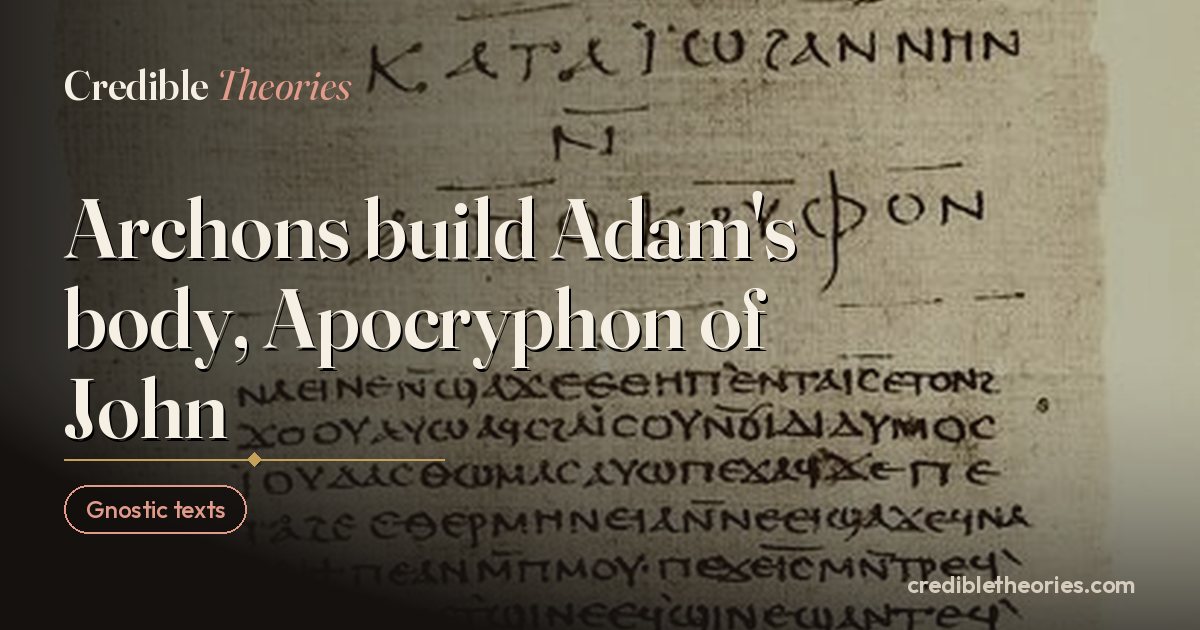
Four ancient copies survive, all in Coptic. Three sit among the Nag Hammadi codices (books II, III and IV), unearthed by farmers near the town of Nag Hammadi in Upper Egypt. A fourth is in the Berlin Codex (Papyrus Berolinensis 8502), bought in Cairo in 1896. The copies come in a shorter and a longer version.
How old is the Apocryphon of John?
The surviving copies were made in the fourth and fifth centuries, translated from a lost Greek original. Scholars think an earlier form existed by about 180 CE, because the church writer Irenaeus summarized a myth very close to its opening in his book Against Heresies. The text presents itself as a secret teaching the risen Jesus gave to John, son of Zebedee.
How many angels help make Adam in the Apocryphon of John?
The longer version lists 365 angels, each assigned a body part from the head down to the toenails, and it cites a lost Book of Zoroaster for the details. The finished Adam lies still until Yaldabaoth blows into his face the power he had taken from his mother, Sophia. Adam then becomes brighter and wiser than his makers.
Used on these files
Yaldabaoth: The Gnostic Creator Who Thought He Was the Only GodMyth or legendGnostic texts describe the creator of our world as a lion-faced serpent who boasts he is the only god, not knowing that he has a mother above him. His names include Saklas, meaning fool, and Samael, god of the blind. A voice answers his boast with a rebuke. Why would early Christians tell the Genesis story this way?
Where this comes from
EvidenceDocumented
Comes fromThe Secret Book of John (Apocryphon of John), Apocryphon of John (Nag Hammadi Codex II). An early Christian text in which Jesus tells John a secret story of creation involving a flawed lesser god. It comes from the Gnostics, groups who taught that secret knowledge saves, and a version was known by about AD 180.
What this means
The text exists and is quoted from a published translation. What it describes is a separate question.
Primary records exist: an original document, a published text, an official file or a dated report. We link to them. This level says the record exists and what it says, not that every claim in it is true.
The Secret Book of John (Apocryphon of John)An early Christian text in which Jesus tells John a secret story of creation involving a flawed lesser god. It comes from the Gnostics, groups who taught that secret knowledge saves, and a version was known by about AD 180. Copies were among the books found buried near Nag Hammadi, Egypt, in 1945.Apocryphon of John (Nag Hammadi Codex II,1), trans. Frederik WissePrimary textArchived copy, 2026-08-10
Scholarly dates are rounded. The wording follows the named public-domain translation.
More from Gnostic texts
Two more stories, and what each shares with Archons build Adam's body.