How the rabbit hole works. Start with anything that grabs you, say UFOs. Every person, place and document a page mentions links to its own page, so a UFO file leads to a witness, the witness leads to the people who investigated the case, and it keeps going.
The path you take shows in the bar under the top menu on every page, so you can step back any time or climb out and start again.
This is a summary from the Epic of Gilgamesh, the story of a king of Uruk, written down between about 1800 and 1000 BCE. The god Enlil sets a guardian named Humbaba over the Cedar Forest, home of the gods. Humbaba wears seven terrifying glowing auras, and Gilgamesh and his friend Enkidu strip them off one by one before killing him.
ReferenceGilgamesh, tablets II–V
Writtenc. 1800–1000 BCE
SetThe Cedar Forest (Lebanon)
Enlil sets Humbaba to guard the Cedar Forest, the dwelling of the gods. He wears seven terrifying radiances (melammu). Gilgamesh and Enkidu strip them off one by one before killing him.
Documented · Retold in English, c. 1800–1000 BCE Summary by the editors. Translation: Summary in my own words
AdvertisementAd space
Read it literally
A guardian with layered shields, protecting a site near Hermon. Tie it to the Watchers' landing zone.
What scholars say
The Cedar Forest is in the same region as Mount Hermon.
Questions people ask about Gilgamesh, tablets II–V
Why do Gilgamesh and Enkidu go to the Cedar Forest?
Gilgamesh wants to win lasting fame, knowing he cannot escape death. He also plans to cut down the great cedars, which were rare and valuable in treeless Mesopotamia. With help from the sun god Shamash, who sends winds to pin Humbaba down, the heroes win. They then cut a cedar to make a huge door for Enlil's temple at Nippur.
What happens after Humbaba is killed?
Back in Uruk, the goddess Ishtar offers to marry Gilgamesh, and he insults her. In anger she sends the Bull of Heaven, which the two friends also kill. The gods then decide one of them must die for killing Humbaba and the Bull, and Enkidu falls ill and dies. His death drives Gilgamesh's search for immortality.
Was a new piece of the Humbaba story found recently?
Yes. In 2011 the Sulaymaniyah Museum in Iraqi Kurdistan bought a tablet that turned out to be part of tablet V. Published by Farouk Al-Rawi and Andrew George, it adds about twenty lines describing the forest as noisy with monkeys, birds and insects, almost like a jungle.
Used on these files
Enlil: Why Did the King of the Gods Send the Flood?Myth or legendThe king of the gods grew so annoyed by the noise of multiplying humans that he sent plague, then drought, then the Flood. Yet in one Sumerian myth the other gods arrest Enlil himself and expel him from his own city for ritual impurity. Why did the most powerful god in Sumer end up exiled?
Gilgamesh: Was the King of Uruk Real, and Why Is He a Giant?Myth or legendAmong the Dead Sea Scrolls, Gilgamesh turns up as one of the giants born to the fallen Watchers. That is odd for a king of Uruk who was, in his own epic, two-thirds divine and one-third human, and probably a real ruler; historians say the scrolls borrowed his name for effect. Why would giants need it?
Humbaba: The Cedar Forest Guardian Gilgamesh KilledMyth or legendBabylonian fortune-tellers made clay masks of Humbaba whose faces were formed from a single coiled intestine. In the epics he guards the Cedar Forest: his roar is the flood, his mouth is fire, his breath is death; Gilgamesh and Enkidu killed him against the will of the gods. Why strike down a god's own guard?
Mount Hermon: Where the Watchers Swore Their OathDocumentedThe story says two hundred angels landed on this mountain and swore an oath, and that the peak got its name from that very oath. In Hebrew, Hermon sounds like a word for a ban or curse. It is a real snowy summit that feeds the Jordan River. Did the legend explain the name, or the name the legend?
The Watchers: Who Were the Fallen Angels of Enoch?Myth or legendThe story says some angels who never sleep came down to a real mountain summit, picked up human wives, and taught people metalworking, spells and astronomy. Their leaders are named, each in charge of ten others. The same word shows up in the Book of Daniel as a heavenly council. So who exactly were the Watchers?
Where this comes from
EvidenceDocumented
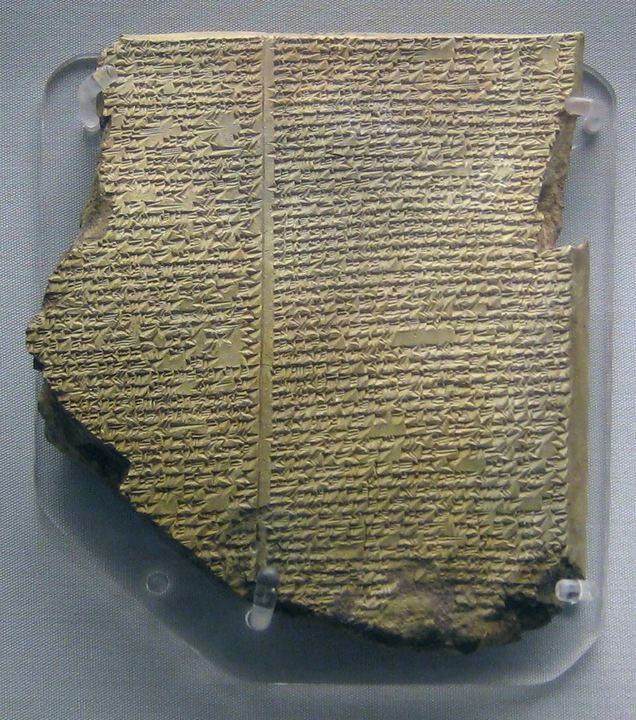
Comes fromThe Epic of Gilgamesh, Gilgamesh, tablets II–V. The story of Gilgamesh, king of Uruk, who tries to escape death; tablet XI has a flood story much like Noah's. The oldest versions date from about 1800 BC. The best-known one was found at Nineveh, in today's Iraq, in 1853, and George Smith noticed its flood story in 1872.
What this means
The text exists and is quoted from a published translation. What it describes is a separate question.
Primary records exist: an original document, a published text, an official file or a dated report. We link to them. This level says the record exists and what it says, not that every claim in it is true.
Enlil and NinlilA Sumerian myth about Enlil, the chief god of the city of Nippur, who is banished for wronging the young goddess Ninlil, and about the gods born to them. It survives on clay tablets copied in about 1900 to 1600 BC. Oxford University's ETCSL project gives it in English.Enlil and Ninlil, ETCSL t.1.2.1, University of OxfordPrimary textArchived copy, 2026-03-26
The Epic of GilgameshThe story of Gilgamesh, king of Uruk, who tries to escape death; tablet XI has a flood story much like Noah's. The oldest versions date from about 1800 BC. The best-known one was found at Nineveh, in today's Iraq, in 1853, and George Smith noticed its flood story in 1872.Epic of Gilgamesh, Tablet I, trans. R. Campbell Thompson (1928)Primary textArchived copy, 2026-10-03
The Book of Enoch (1 Enoch)Jewish writings about Enoch, Noah's great-grandfather, the oldest parts from about 300 to 200 BC. It tells of angels called Watchers who came down to earth. Full copies survived only in Ethiopia, whose church still counts it as scripture. Pieces in Aramaic were found among the Dead Sea Scrolls in 1952.1 Enoch 6:6, trans. R. H. Charles, The Book of Enoch (1917)Online copyPrimary textArchived copy, 2026-09-03
Scholarly dates are rounded. The wording follows the named public-domain translation.
More from Sumer and Babylon
The story before and after this one, and what each shares with Humbaba and the seven auras.