Credible Theories Sign in

The record

What the photos show. On 25 July 1976 the Viking 1 orbiter photographed the Cydonia region of Mars while searching for a landing site for Viking 2. NASA's caption for frame 35A72, issued on 31 July, said: The huge rock formation in the center, which resembles a human head, is formed by shadows giving the illusion of eyes, nose and mouth. The feature is 1.5 kilometers (one mile) across, with the sun angle at approximately 20 degrees. Viking 1 caught the hill again on 30 August 1976 in frame 70A13. Both pictures show about 50 meters of ground in each pixel.

What was claimed. Malin Space Science Systems, which later ran a camera at Mars for NASA, wrote in 1995 that some people have argued, mostly in the lay literature, that the face-like hill is artificially shaped, and that the argument grew to take in a host of nearby features. The German Aerospace Center lists them: potential pyramids and even a ruined city. In 1988 Mark Carlotto published an analysis in the journal Applied Optics that rebuilt the hill in three dimensions from the Viking image and reported that the impression of facial features persists over a wide range of illumination and viewing conditions. A NASA camera team noted in 2000 that the film Mission to Mars took the idea as part of its premise.

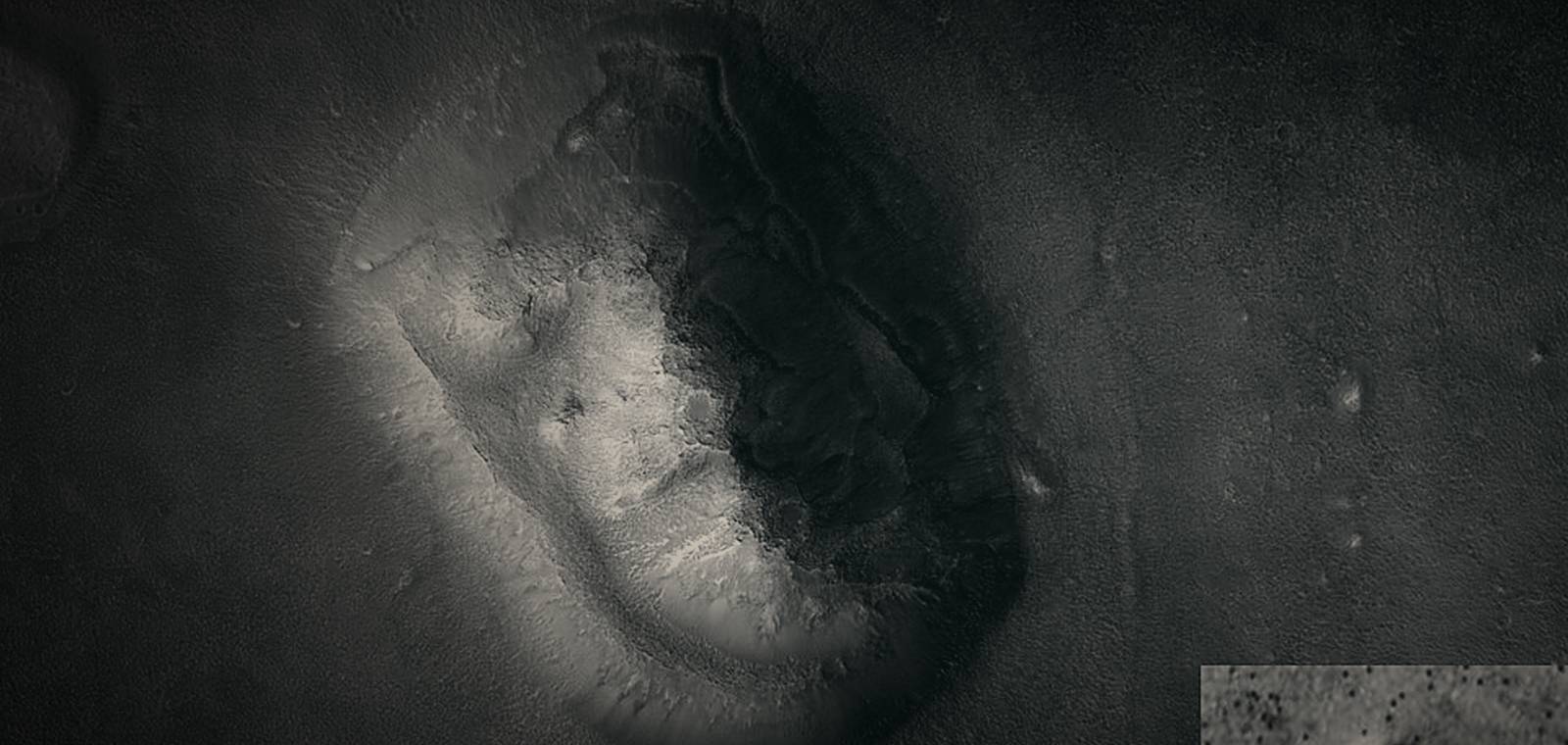
What later photos show. Mars Global Surveyor turned its camera to the Face on 5 April 1998, at 4.3 meters per pixel, ten times sharper than Viking. On 8 April 2001 it looked again at about 2 meters per pixel, sharp enough, the team said, to make out objects the size of a passenger jet. ESA's Mars Express photographed Cydonia in 3D on 22 July 2006, and NASA's HiRISE camera imaged the hill on 5 April 2007 at about 30 centimeters per pixel. None of these pictures shows a face. HiRISE's team describes an eroded mesa made famous by its similarity to a human face in a Viking Orbiter image with much lower spatial resolution and a different lighting geometry.

Questions people ask about The Face on Mars and the Cydonia pyramids

Where is the Face on Mars?

In the Cydonia region of Mars at about 40.8 degrees north, 9.6 degrees west, in the strip of buttes and mesas between the cratered southern uplands and the smooth northern plains.

Why was Viking photographing Cydonia?

Viking 1 was looking for a landing site for Viking 2 in Mars's northern latitudes. The Face turned up in one of those search pictures; NASA's caption said Viking 2 was due in Mars orbit on 7 August 1976.

What is the sharpest picture of the Face?

The HiRISE camera on Mars Reconnaissance Orbiter imaged it on 5 April 2007 from about 300 kilometers up, at about 30 centimeters per pixel, enough to resolve objects about 90 centimeters across.

The open question

Still strange: The face NASA pointed out.

One line in a landing-site press release grew into decades of books and a film about monuments on Mars.

Zecharia Sitchin: Where the Anunnaki Alien Theory Came From →
  1. Step 1 of 4 · This fileThe Face on Mars and the Cydonia pyramids
  2. Step 2 of 4 · Next fileZecharia Sitchin: Where the Anunnaki Alien Theory Came From
  3. Step 3 of 4 · Next fileThe Black Knight satellite
  4. Step 4 of 4 · Next fileNASA's 2023 UAP Study: What the UFO Report Found
About these videos

Found by a YouTube search for this topic, not checked by us. The player loads from YouTube only when you press play.

Where this comes from

EvidenceDocumented

Comes from NASA Viking News Center, photo caption P-17384 (frame 35A72), 31 July 1976, as…. Malin Space Science Systems: A San Diego company that built the Mars Orbiter Camera for NASA's Mars Global Surveyor and operated it from its own offices. Its web pages carry the camera team's own image releases and the original Viking captions they reproduced.

What this means

The hill and every photograph of it are NASA and ESA records; the face is an effect of light in the 1976 images, and no later image shows one.

For The Face on Mars and the Cydonia pyramids, the original record exists and is linked: NASA Viking News Center, photo caption P-17384 (frame 35A72), 31 July 1976, as…. That tells you the record is real and what it says. It does not mean every claim in it is true.

Primary records exist: an original document, a published text, an official file or a dated report. We link to them. This level says the record exists and what it says, not that every claim in it is true.

See all five labels

Sources

  1. Malin Space Science SystemsA San Diego company that built the Mars Orbiter Camera for NASA's Mars Global Surveyor and operated it from its own offices. Its web pages carry the camera team's own image releases and the original Viking captions they reproduced.NASA Viking News Center, photo caption P-17384 (frame 35A72), 31 July 1976, as reproduced by Malin Space Science SystemsPrimary text
  2. Malin Space Science SystemsMalin Space Science Systems, "The 'Face on Mars'" (1995), with the list of every Viking Orbiter image of the featurePrimary text
  3. DOI link to a research paperA DOI is a permanent ID number for a published research paper or book. The link takes you to the paper on its publisher's website, even if that site moves. The paper itself is what we cite.Mark J. Carlotto, "Digital imagery analysis of unusual Martian surface features", Applied Optics 27, no. 10 (15 May 1988), pp. 1926-1933Primary text
  4. NASA Jet Propulsion LaboratoryThe official website of NASA's Jet Propulsion Laboratory in Pasadena, California, which builds and runs many of NASA's robotic space missions.NASA/JPL/Malin Space Science Systems, PIA01439, "Mars Orbiter Camera Views the 'Face on Mars' - Best View from Viking" (April 1998), NASA PhotojournalPrimary text
  5. Malin Space Science SystemsMalin Space Science Systems, "Cydonia: Two Years Later", MGS MOC Release No. MOC2-222 (5 April 2000)Primary text
  6. NASA Jet Propulsion LaboratoryNASA/JPL/Malin Space Science Systems, PIA03225, "Highest-Resolution View of 'Face on Mars'", MGS MOC Release No. MOC2-283 (24 May 2001), NASA PhotojournalPrimary text
  7. German Aerospace Center (DLR)Germany's national center for aeronautics and space research. It built and runs the High Resolution Stereo Camera on the European Space Agency's Mars Express, and its releases describe that camera's own images.German Aerospace Center (DLR), "The Cydonia Region - The 'Face On Mars'", Mars Express HRSC release (21 September 2006)Primary text
  8. HiRISE, University of ArizonaThe University of Arizona team that operates HiRISE, the high-resolution camera on NASA's Mars Reconnaissance Orbiter. Each image page gives the date, the camera settings and a caption written by a team scientist.Alfred McEwen, "Popular Landform in Cydonia Region", HiRISE image PSP_003234_2210, University of Arizona (11 April 2007)Primary text

Quotations come from public-domain translations. A book in our Library links to its Library page; other links open the free online copy or the reference page.

Updated

Credible or not?

Tap one to see how other readers voted.

Discussion