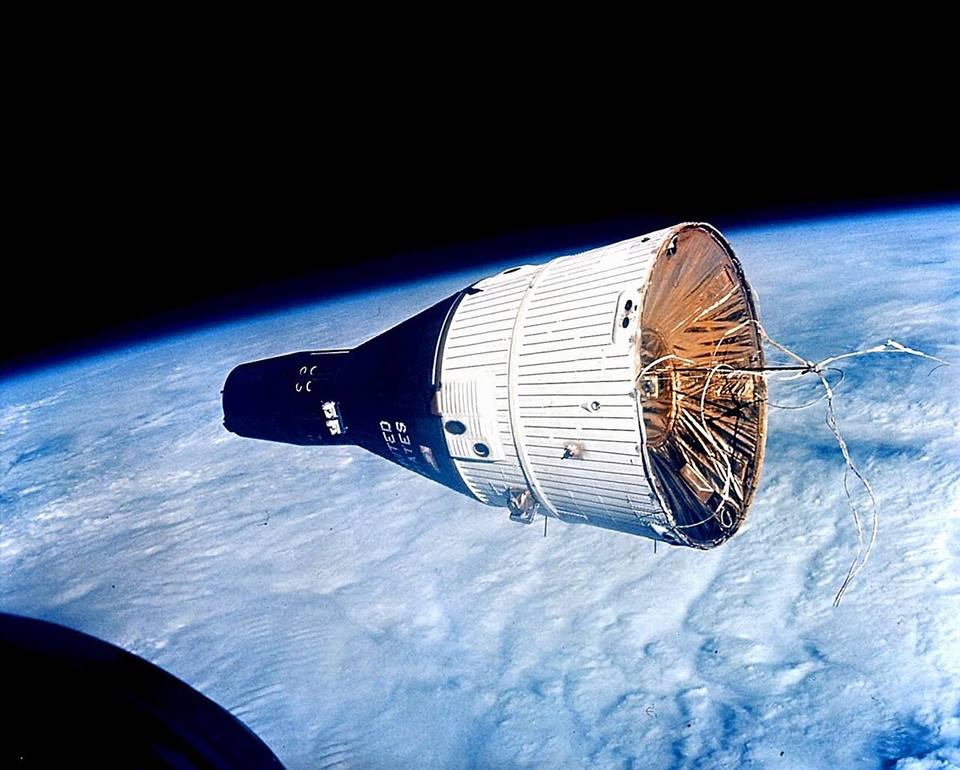
Strangest fact
The transcript does not fit neatly with Borman's later memory. On the tape the crew mention a 'bogey' and then, separately, say they 'also' have the booster in sight. So either the bogey was another piece of launch debris, or two descriptions of the same rocket got mixed together in the excitement.
Gemini 7 launched on December 4, 1965, carrying Frank Borman and Jim Lovell on a flight of nearly 14 days. At the start of the second orbit, the crew reported something outside. The Condon Report of 1968 reproduces the air-to-ground transcript.
The spacecraft says: Bogey at 10 o'clock high.
Houston asks: Is that the booster or is that an actual sighting?
The crew answers: We have several, looks like debris up here. Actual sighting,
and adds We also have the booster in sight.
They describe very, very many, look like hundreds of little particles
passing on the left, which they thought were in a polar orbit. Lovell then says the booster is on his side, a brilliant body in the sun, against a black background with trillions of particles on it.
Franklin Roach, who wrote the Condon Report's chapter on astronaut sightings, listed the 'bogey' as one of three astronaut cases not adequately explained. He noted that the bogey and particles might have been fragments from the launch, but that this seemed impossible if they really were in a polar orbit as the crew thought.
Borman later rejected the UFO reading. In a 1998 interview with Air & Space magazine he said 'bogey' was an old fighter pilot term
and that he had been calling the booster a bogey while flying formation with it. When Unsolved Mysteries invited him on to discuss his 'UFO' and he said he would explain it was not one, he recalled the producer replying, Well, I'm not sure we want you on the program.
James Oberg wrote in 1978 that Borman's 'bogie' described pieces of debris from the spacecraft's separation from its booster.