How the rabbit hole works. Start with anything that grabs you, say UFOs. Every person, place and document a page mentions links to its own page, so a UFO file leads to a witness, the witness leads to the people who investigated the case, and it keeps going.
The path you take shows in the bar under the top menu on every page, so you can step back any time or climb out and start again.
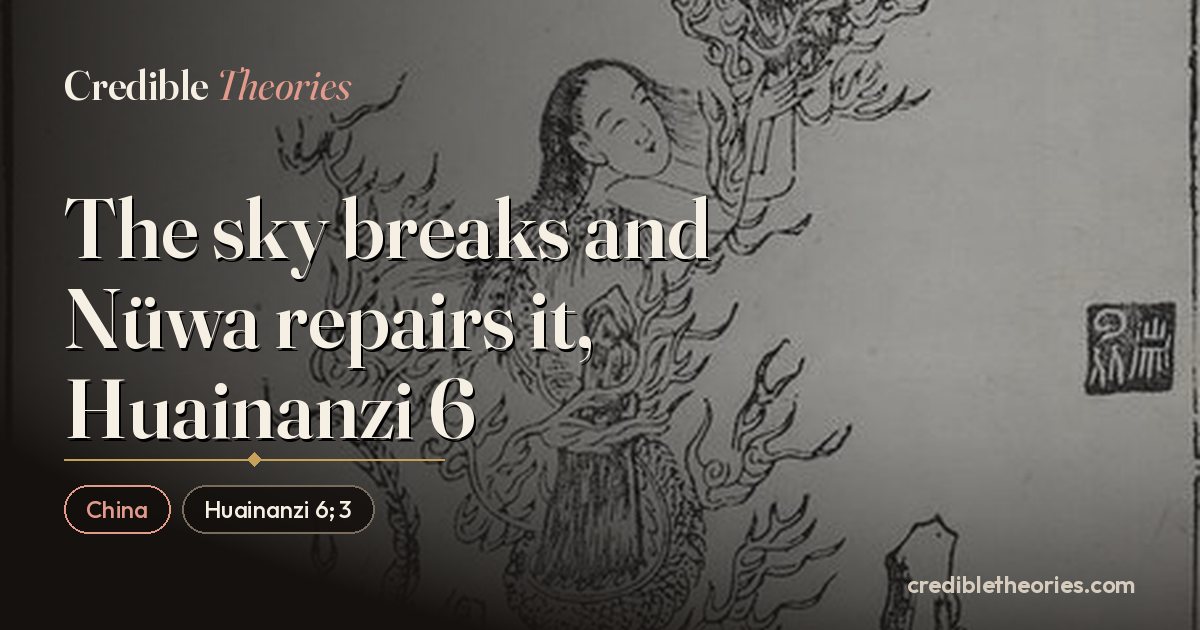
This is a summary from the Huainanzi, a Chinese book of philosophy, science and myth presented to the emperor in 139 BCE. In the story, the four pillars holding up the sky break, and fire and floods rage without end. The goddess Nüwa melts stones of five colors to patch the sky and uses a giant turtle's legs as new pillars.
ReferenceHuainanzi 6; 3
Writtenc. 139 BCE
SetHigh antiquity
The four pillars holding up the sky broke. Fire burned without stopping and water flooded without end. Nüwa melted stones of five colors to patch the sky and cut the legs off a giant turtle to set up new pillars. Elsewhere, Gonggong smashes Mount Buzhou and the sky tilts to the northwest.
Documented · Retold in English, c. 139 BCE Summary by the editors. Translation: Summary in my own words
AdvertisementAd space
Read it literally
A sky-and-flood disaster followed by a technical repair. The tilt explains why the stars wheel to the northwest.
What scholars say
A Han dynasty collection of older lore.
Themes From the sky Looks like technology Strange time
A god warns one good man, a boat is built, the world drowns and birds are sent out to find land. The same story turns up from Iraq to India to Greece, with cousins in China, Scandinavia and Guatemala.
Book of Documents (Shu Jing), Canon of Yao is one telling. The same story is told 9 more times, in 6 parts of the world. Follow it:
A god kneels in the mud, shapes a body with his hands and breathes it into life. That scene is told in Iraq, Israel, Egypt, Greece, China, Arabia, Guatemala, Sudan and New Zealand.
Fengsu Tongyi of Ying Shao (Nuwa shapes people), as retold by E. T. C. Werner is one telling. The same story is told 8 more times, in 6 parts of the world. Follow it:
The open question: Did one old story about a potter god travel from people to people, or does anyone who works with clay end up imagining that we were made from it? Join the debate
Questions people ask about Huainanzi 6
What is the Huainanzi?
It is a collection of essays put together at the court of Liu An, King of Huainan and a grandson of the first Han emperor. He presented it to Emperor Wu in 139 BCE. Its 21 chapters cover cosmology, government, warfare and Daoist thought. Liu An later took his own life after being accused of plotting a rebellion.
Did Nüwa also create humans?
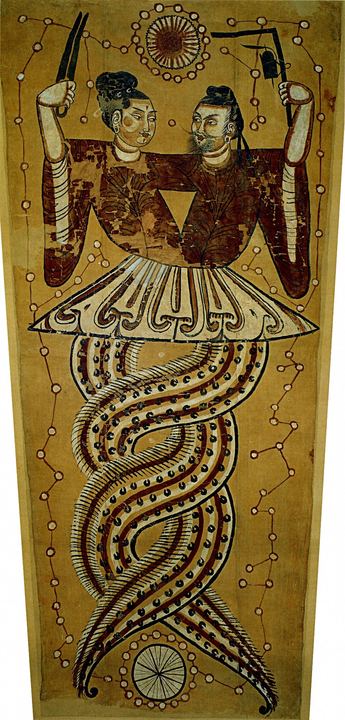
In another well-known myth, yes. A Han dynasty book by Ying Shao says Nüwa shaped the first people from yellow earth by hand. When this grew too tiring, she dragged a cord through mud and flung off drops that also became people. In art she is often shown with a snake's tail beside her partner Fuxi.
What does Gonggong breaking Mount Buzhou explain?
Huainanzi chapter 3 says that when Gonggong rammed the mountain, a pillar of heaven snapped, so the sky leaned toward the northwest while the land dropped in the southeast. The story was used to explain why the sun, moon and stars move toward the northwest, and why China's great rivers flow east and southeast to the sea.
Used on these files
Gonggong: The Water God Who Broke a Pillar of HeavenMyth or legendAccording to Chinese myth, a red-haired serpent god lost a fight for the throne and smashed his head against a pillar of heaven. The sky tilted northwest and the earth sank southeast. The story is said to explain why stars wheel one way and rivers run the other. Who fixed it, and how?
Nüwa: The Goddess Who Made Humans and Repaired the SkyMyth or legendChinese myth says the goddess Nüwa made people from yellow earth, then mass-produced more by flicking a muddy rope, so nobles are hand-molded and commoners flung. Later she patched a broken sky with melted stones of five colors. Why did the sky break in the first place? The page tells both stories.
Where this comes from
EvidenceDocumented
Comes fromThe Huainanzi, Huainanzi 6; 3. A Chinese book of philosophy, science and myth written by scholars at the court of Liu An, a prince of the Han dynasty, and presented to the emperor in 139 BC. It tells of Gonggong breaking the pillar that held up the sky and the goddess Nüwa mending the heavens.
What this means
The text exists and is quoted from a published translation. What it describes is a separate question.
Primary records exist: an original document, a published text, an official file or a dated report. We link to them. This level says the record exists and what it says, not that every claim in it is true.
The HuainanziA Chinese book of philosophy, science and myth written by scholars at the court of Liu An, a prince of the Han dynasty, and presented to the emperor in 139 BC. It tells of Gonggong breaking the pillar that held up the sky and the goddess Nüwa mending the heavens.Huainanzi 3 (Tianwen xun), c. 139 BCE, Chinese Text ProjectPrimary textArchived copy, 2026-04-22
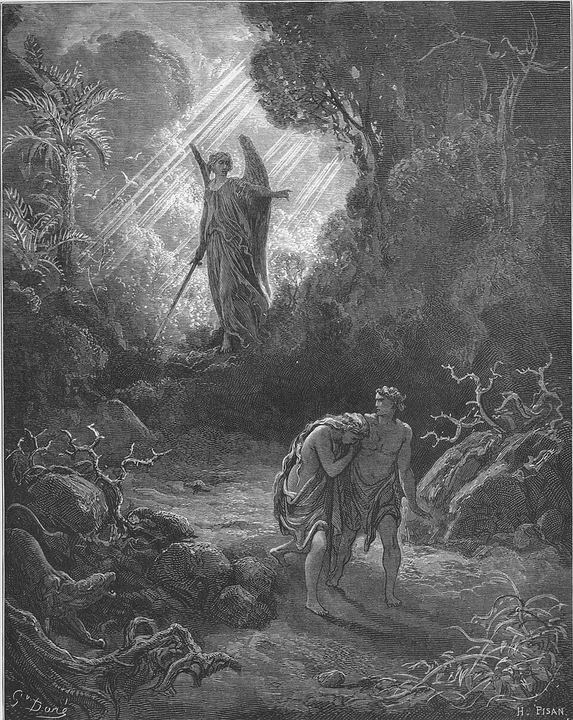
After God drives the first man out of the garden of Eden, the text says he places cherubim at its east side, along with a flaming sword that turns every way.
Same theme: From the skySame theme: Looks like technology