Credible Theories Sign in

The record

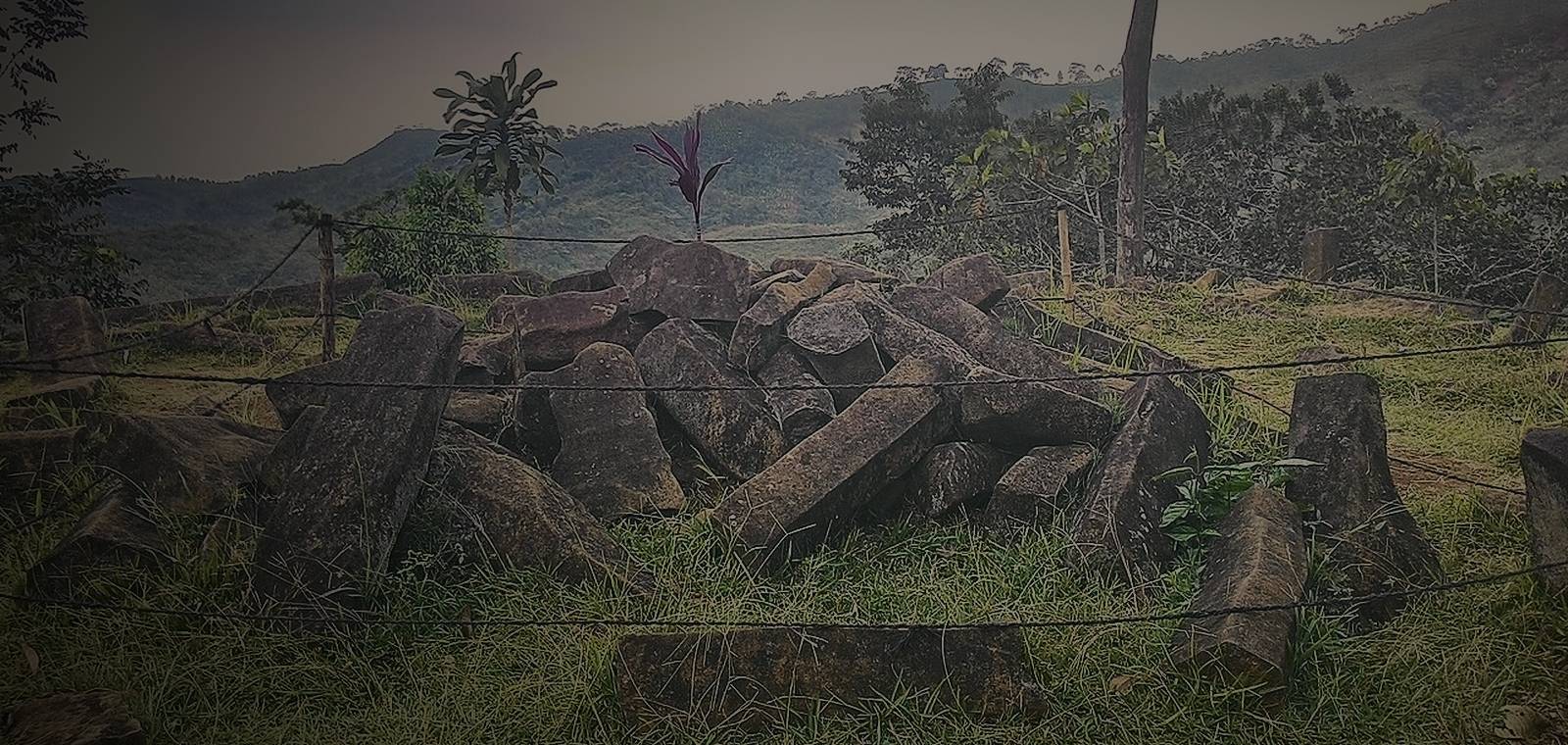
Gunung Padang is a hill in Cianjur, West Java, Indonesia, whose top is built up into five terraces of long, many-sided basalt stones laid in rows and walls. The Indonesian archaeologist Lutfi Yondri, writing in 2016 in the journal of the Bandung archaeology office, calls the stone terraces the largest megalithic building in the archipelago. He notes that the remains were recorded by the Dutch scholar N. J. Krom in a 1914 report of the antiquities service, and were found again in 1979 by three local farmers, Endi, Soma and Abidin. Since then the national antiquities office, archaeology institutes and the local government have studied the site, which is now a protected heritage site.

In October 2023 the journal Archaeological Prospection published a paper by the geologist Danny Hilman Natawidjaja and eleven co-authors. Using ground-penetrating radar, electric resistivity, seismic scans, trenches and drill cores, they argued that the hill holds multi-layer constructions 20 to 30 meters deep, with hidden chambers inside, and that radiocarbon dates of soil showed building stages going back thousands of years BCE, with the first phase in the Palaeolithic. The paper was reported around the world as evidence of the oldest pyramid on Earth.

On 18 March 2024 the journal retracted it. The notice from the editors and the publisher, Wiley, says experts in geophysics, archaeology and radiocarbon dating raised concerns, and that the article contains a major error missed in peer review: "the radiocarbon dating was applied to soil samples that were not associated with any artifacts or features that could be reliably interpreted as anthropogenic or "man-made."" It concludes that the reading of the site as a pyramid built 9,000 or more years ago is incorrect. The notice also says that all of the authors disagree with the retraction.

In 2025 one of the journal's editors, Eileen Ernenwein, wrote a separate account of the affair in the journal ArchéoSciences, describing how the claim was published and what it showed about peer review. What is not in dispute is the stonework on the hilltop itself, which is real, old and still being studied. What is in dispute is everything said to lie under it, and how old it is.
Questions people ask about Gunung Padang

Is Gunung Padang the oldest pyramid in the world?

That was the claim of a 2023 paper, but the journal retracted it in March 2024, saying the dated soil samples were not tied to any man-made features. The terraces on top are real megalithic work.

Why was the Gunung Padang paper retracted?

The retraction notice says radiocarbon dates were taken from soil not associated with artifacts or features that could be read as man-made, so the conclusion that a pyramid was built 9,000 or more years ago was incorrect.

Who found Gunung Padang?

N. J. Krom recorded it in a 1914 Dutch antiquities report, and three local farmers, Endi, Soma and Abidin, found it again in 1979, according to the archaeologist Lutfi Yondri.

The open question

Still strange: A peer-reviewed journal published scans and dates said to show a buried pyramid older than farming, then took the paper back because the dated soil may never have been touched by people.

Göbekli Tepe: Who Built It 11,000 Years Ago, and Why? →
  1. Step 1 of 4 · This fileGunung Padang
  2. Step 2 of 4 · Next fileGöbekli Tepe: Who Built It 11,000 Years Ago, and Why?
  3. Step 3 of 4 · Next fileThe Younger Dryas: What Caused the Big Freeze 12,900 Years Ago?
  4. Step 4 of 4 · Next fileDerinkuyu underground city
About these videos

Found by a YouTube search for this topic, not checked by us. The player loads from YouTube only when you press play.

Where this comes from

EvidenceSpeculation

Comes from Danny Hilman Natawidjaja and others, "Geo-archaeological prospecting of Gunung Padang…. DOI link to a research paper: A DOI is a permanent ID number for a published research paper or book. The link takes you to the paper on its publisher's website, even if that site moves.

What this means

The terraces are documented; the buried pyramid and its Ice Age date come from a paper the journal retracted in 2024.

For Gunung Padang, the idea goes beyond what the evidence shows. We cover it because people ask about it. The main problem: The radiocarbon dates came from soil, and the journal found no link between that soil and any human work, so the dates say how old the dirt is, not the building.

An idea or reading that goes beyond what the evidence shows. We include it because people ask about it, and we mark it so it never gets mixed in with the record.

See all five labels

Sources

  1. DOI link to a research paperA DOI is a permanent ID number for a published research paper or book. The link takes you to the paper on its publisher's website, even if that site moves. The paper itself is what we cite.Danny Hilman Natawidjaja and others, "Geo-archaeological prospecting of Gunung Padang buried prehistoric pyramid in West Java, Indonesia", Archaeological Prospection (published online 20 October 2023; retracted)Primary text
  2. DOI link to a research paper"Retraction: Geo-Archaeological prospecting of Gunung Padang buried prehistoric pyramid in West Java, Indonesia", Archaeological Prospection (18 March 2024)Primary text
  3. DOI link to a research paperLutfi Yondri, "Konstruksi dan pola susun balok batu punden berundak Gunung Padang, Cianjur" (Construction and stacking patterns of stone blocks, Gunung Padang site), Purbawidya 2 (2016)Primary text
  4. DOI link to a research paperEileen G. Ernenwein, "Retraction and Reflection: The Gunung Padang Controversy and the Challenges of Peer Review in Archaeological Prospection", ArchéoSciences (2025)

Quotations come from public-domain translations. A book in our Library links to its Library page; other links open the free online copy or the reference page.

Updated

Credible or not?

Tap one to see how other readers voted.

Discussion