The record
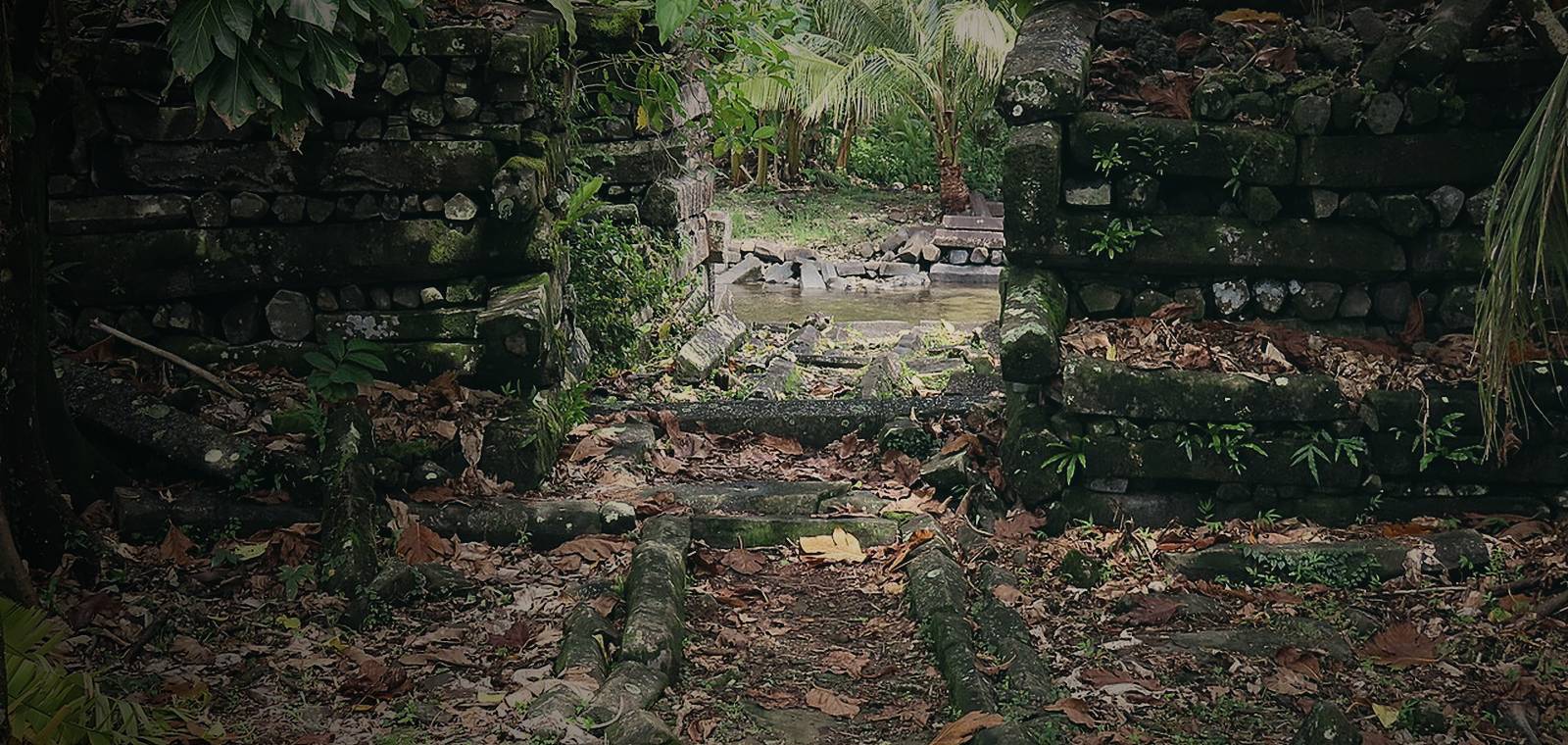
Nan Madol is a ruined city built on a coral reef off the island of Pohnpei, in the Federated States of Micronesia. UNESCO, which made it a World Heritage site in 2016, describes more than 100 islets
off the southeast coast, with walls of basalt and coral boulders
that were built between 1200 and 1500 CE.
It was the seat of the Saudeleur dynasty, which ruled Pohnpei. UNESCO also lists it as in danger, mainly because the channels between the islets are silting up.
The walls are made of long, many-sided basalt columns, stacked like logs. The English traveler F. W. Christian, who cleared plants from the ruins in the 1890s, described Nan-Tauach, the Place of Lofty Walls,
as a mighty wall formed of basaltic prisms laid alternately lengthwise and crosswise after the fashion of a chock and log fence.
He recorded the local account of how it was built: two brothers, Olo-chipa and Olo-chopa, raised the city, and By their magic spells one by one the great masses of stone flew through the air like birds, settling down into their appointed place.
In 2016 a team led by Mark McCoy of Southern Methodist University dated coral from the tomb of the first Saudeleur chief, reporting in the journal Quaternary Research. They found that by 1180 the great stones were being brought from a volcanic plug on the far side of the island, and that by 1200 the chief was buried there, about a century earlier than the city had been dated before. How the islanders moved columns this heavy across water is still studied.