Credible Theories Sign in

The record

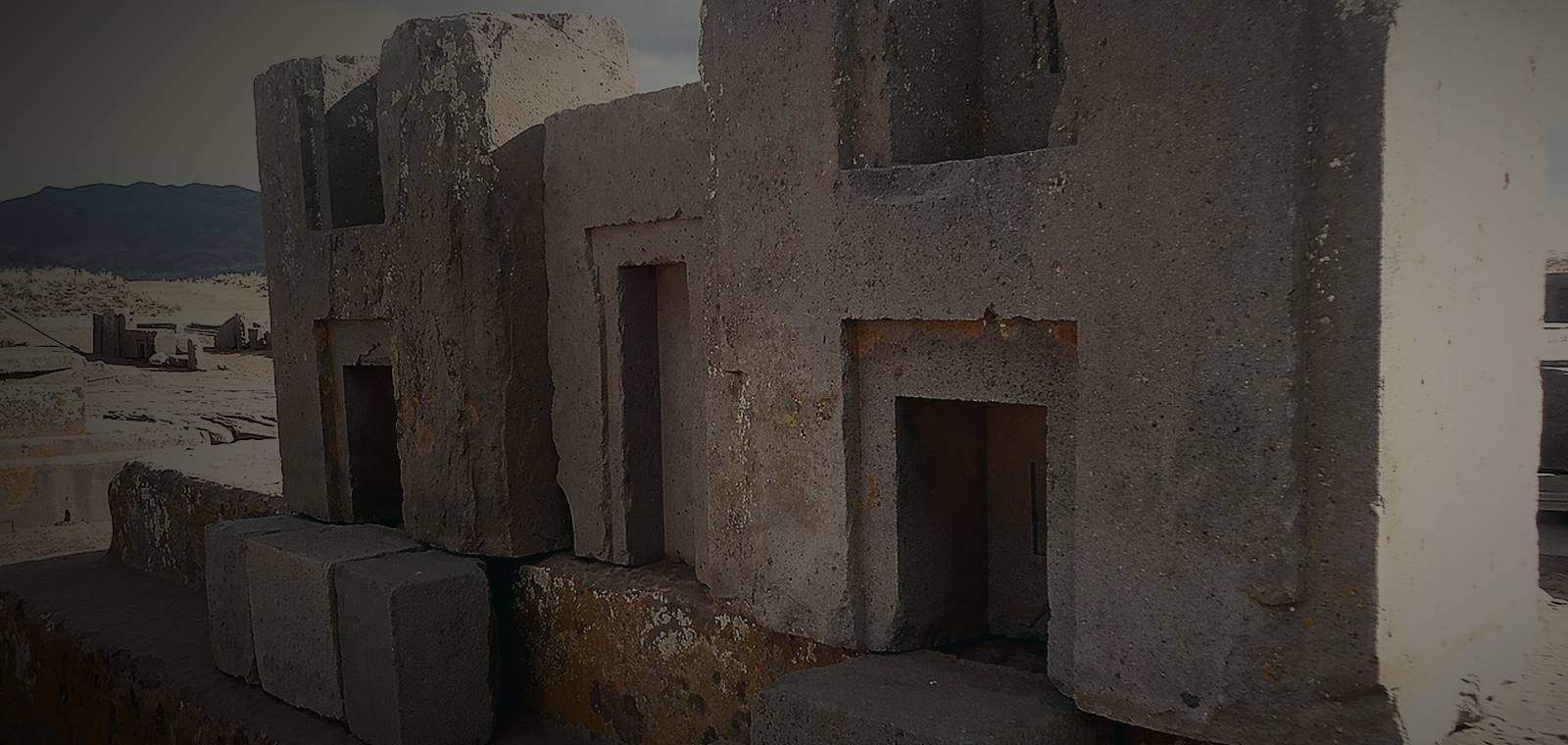
Puma Punku, also spelled Pumapunku, is a ruined building at Tiwanaku in Bolivia, near the southern shore of Lake Titicaca and nearly 13,000 feet above sea level. Tiwanaku was the center of an Andean culture that flourished from about 500 to 950 CE, long before the Inca. Today Puma Punku is a jumble of broken stones, because, as the archaeologist Alexei Vranich wrote in 2018, the site suffered intense looting during the colonial period that effectively demolished the site. None of its roughly 150 blocks are still where they were set.

What draws people to Puma Punku is the stonework. The building used sandstone slabs as its foundation and blocks of hard andesite above, shaped with grooves for metal clamps that once fastened them together. The famous "H" stones measure about 97 by 99 by 55 centimeters and weigh an estimated 600 kilograms. Vranich found that many of the blocks are perfect replicas of each other, including mirror-image left and right pieces, which suggests the builders worked from set patterns.

The Spanish soldier and writer Pedro Cieza de Leon walked these ruins in the late 1540s and described great doorways cut from single stones. In his Chronicle of Peru (1553) he wrote: For myself I fail to understand with what instruments or tools it can have been done. In 2018 Vranich fed measurements taken by nineteenth-century visitors into modeling software and printed the blocks at small scale, so the pieces could be fitted together by hand. The results suggest a building of repeated, matching parts, though how its full plan looked is still debated.
Questions people ask about Puma Punku

Where is Puma Punku?

It is part of the Tiwanaku ruins in western Bolivia, about twelve miles from the southern shore of Lake Titicaca and close to 13,000 feet above sea level.

What are the Puma Punku H blocks?

They are andesite blocks cut into a shape like the letter H. A 2018 study gives a typical size of about 97 by 99 by 55 centimeters and a weight of around 600 kilograms.

How did researchers rebuild Puma Punku?

They could not move the real stones, so they printed small 3D copies, at 4 percent of real size, from old measurements taken by visitors in 1848 and the 1890s, and fitted those copies together by hand to test how the building once looked.

The open question

Still strange: Stone blocks that look machine-made.

A Spanish traveler in the 1550s already wrote that he could not understand with what tools they were made.

The Nazca lines →
  1. Step 1 of 4 · This filePuma Punku
  2. Step 2 of 4 · Next fileThe Nazca lines
  3. Step 3 of 4 · Next fileGöbekli Tepe: Who Built It 11,000 Years Ago, and Why?
  4. Step 4 of 4 · Next fileVitrified Forts: The Hillforts With Walls Melted Into Glass
About these videos

Found by a YouTube search for this topic, not checked by us. The player loads from YouTube only when you press play.

Where this comes from

EvidenceDocumented

Comes from Alexei Vranich, "Reconstructing ancient architecture at Tiwanaku, Bolivia: the potential…. A research article: An article written by a researcher and published in a scholarly journal or book. Most such journals have other experts check a paper before it is printed, so it carries more weight than a news story, though later studies can still change the picture.

What this means

Records exist and are linked below. This page says what the records say.

For Puma Punku, the original record exists and is linked: Alexei Vranich, "Reconstructing ancient architecture at Tiwanaku, Bolivia: the potential…. That tells you the record is real and what it says. It does not mean every claim in it is true.

Primary records exist: an original document, a published text, an official file or a dated report. We link to them. This level says the record exists and what it says, not that every claim in it is true.

See all five labels

Sources

  1. A research articleAn article written by a researcher and published in a scholarly journal or book. Most such journals have other experts check a paper before it is printed, so it carries more weight than a news story, though later studies can still change the picture.Alexei Vranich, "Reconstructing ancient architecture at Tiwanaku, Bolivia: the potential and promise of 3D printing", Heritage Science 6 (2018), CC BY 4.0Primary text
  2. Internet ArchiveA nonprofit digital library in San Francisco, founded in 1996, that holds millions of scanned books, papers and recordings. A scan there shows the pages of a real printed book or document.Pedro de Cieza de Leon, Chronicle of Peru, part 1 (Seville, 1553), chapter 105, trans. Clements R. Markham, The Travels of Pedro de Cieza de Leon (Hakluyt Society, 1864), pp. 374-376Primary text
  3. Phys.orgA science news website that publishes summaries of new research, often based on universities' own press releases."3D-printed reconstructions provide clues to ancient site", University of Pennsylvania news release on Phys.org (December 2018)

Quotations come from public-domain translations. A book in our Library links to its Library page; other links open the free online copy or the reference page.

Updated

Credible or not?

Tap one to see how other readers voted.

Discussion