The record
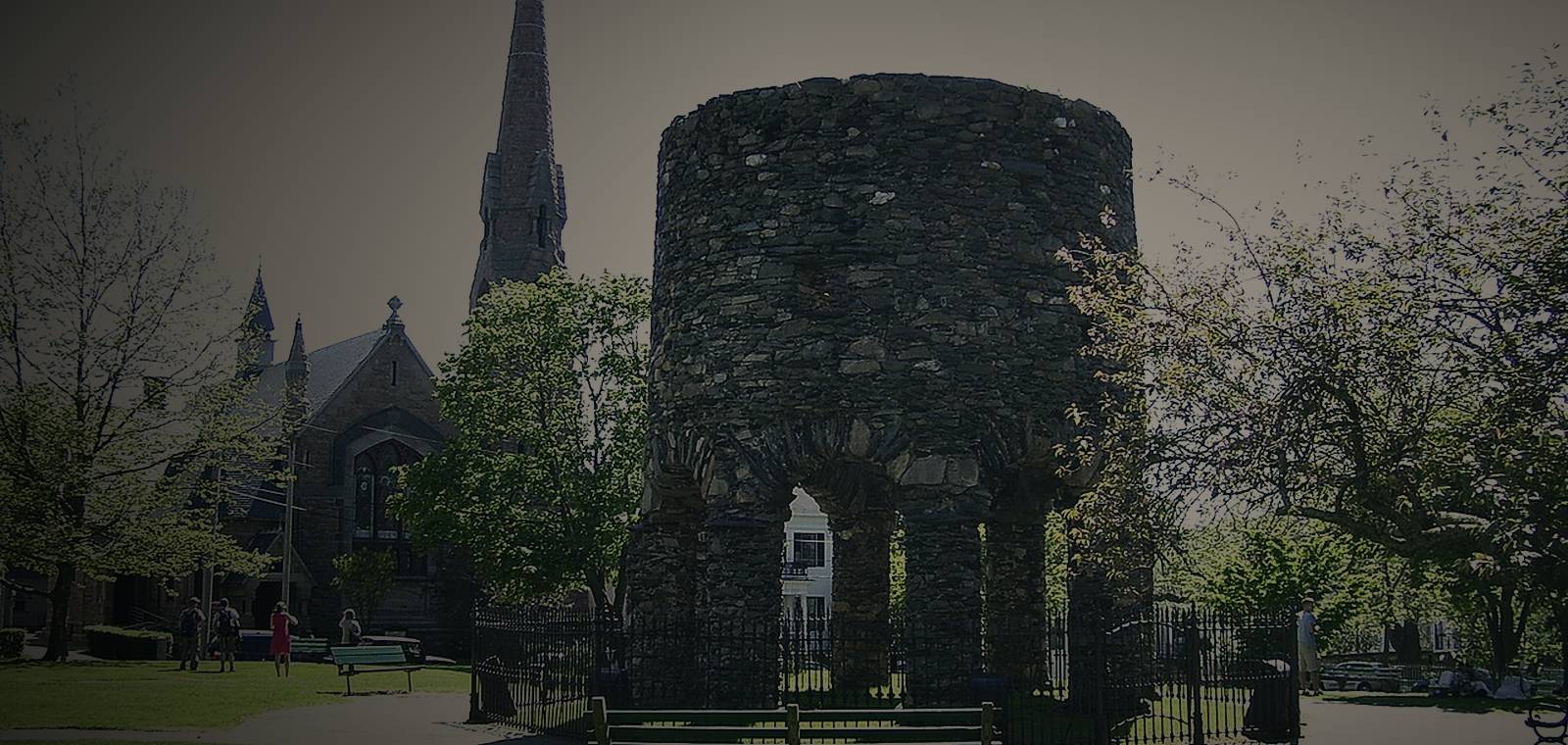
In Newport, Rhode Island, stands a round tower of rough stone raised on eight round pillars joined by arches. Its paper trail begins with Benedict Arnold, the colony's first governor under the charter of 1663. In his will of December 20, 1677, quoted in full in an 1851 book on the dispute, Arnold asks to be buried beside ye line or path from my dwelling house, leading to my Stone built Wind Mill,
and later leaves to his wife and daughter his house and lands, as also my Stone built Wind Mill.
He died the next year.
Until the nineteenth century the building was known as the old mill. Then the Danish scholar Charles Christian Rafn, who collected evidence of Norse voyages to America, was sent drawings of it, and a Norse origin began to be argued before the Royal Society of Copenhagen. Longfellow spread the idea in his ballad The Skeleton in Armor. In his note he says the poem came to him while riding on the sea-shore at Newport,
after a skeleton had been dug up at Fall River clad in broken and corroded armor,
and that he linked it with the round tower, generally known hitherto as the Old Windmill.
In 1884 the scientist and philosopher Charles Sanders Peirce measured it. I have not the slightest title to an opinion upon that subject, in which I have only a metrological concern,
he wrote. He found the diameters close to 24 and 18 feet, round numbers in either an English or a Scandinavian foot, and noted that The fireplace has two flues; and the windows formerly had frames, as if for holding glass.
Thinking of the mill theory, he asked, But would not a fire in a grist-mill be dangerous?
The archaeologist William S. Godfrey Jr. dug around its base and published the results in American Antiquity in 1951. He framed the question plainly: either the tower was built by unknown people before colonial times, or it was erected in Colonial times shortly before it is first mentioned in the documents,
and he noted that in 1677, three documents, including Arnold's own will, mentioned the tower,
while a clear line of legal papers traced it and its land to Governor Arnold up to about 1800.