Credible Theories Sign in

The record

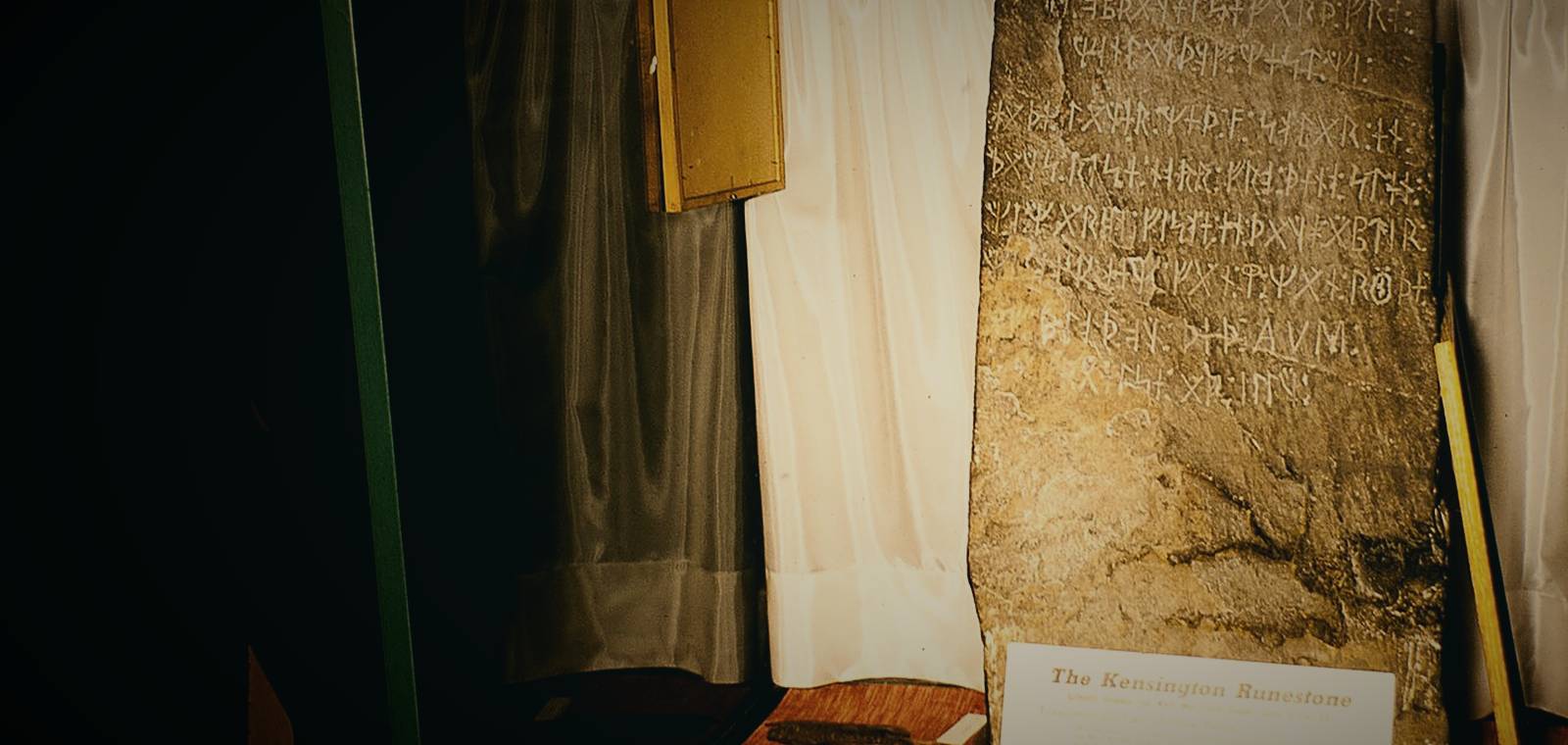
On November 8, 1898, Olof Ohman was having a patch of his farm in Solem township, near Kensington in Douglas County, Minnesota, cleared of timber when his men, grubbing out stumps, turned up a flat stone cut with runes on its face and one edge. The Minnesota Historical Society's committee later wrote that When the stone was found, its inscribed side was down, and about six inches of soil covered it, with a poplar or aspen tree growing above it whose roots ran around it. Witnesses' guesses at the tree's age ran from ten to about forty years.

The committee's translation reads: Eight Goths [Swedes] and twenty-two Norwegians upon a journey of discovery from Vinland westward. We had a camp by two skerries one day's journey north from this stone. We were out fishing one day. When we returned home we found ten men red with blood and dead. AVM [Ave, Virgo Maria], save us from evil. The edge adds that ten men were left by the sea to look after the ship, "Year 1362." If the stone is genuine, Norse explorers stood in Minnesota 130 years before Columbus sailed.

Its first reception was cold. The stone went to Professor O. J. Breda in Minneapolis and Professor George O. Curme in Evanston, and As they pronounced it fraudulent, it was returned to the finder in March, 1899. Ohman placed it carelessly in his yard, where it served as a stepping stone near his granary for eight years. In 1907 Hjalmar Rued Holand obtained it and brought it back before the public.

In 1910 two committees ruled within weeks of each other. On April 21 the Minnesota Historical Society's Museum Committee resolved that it renders a favorable opinion of the authenticity of the Kensington rune stone, on condition that a specialist in the Scandinavian languages verify its references; the Society's council printed the report but said it would reserve their conclusion until more agreement of opinions for or against the rune inscription may be attained. On May 3 a committee of seven at the University of Illinois, after hearing the linguist George T. Flom, found that the inscription is a forgery and (2) that its manufacture is recent. Holand kept defending it; in 1920 he argued that the term day's journey in the Middle Ages represented a unit or measure of distance.
Questions people ask about The Kensington Runestone

Where was the Kensington Runestone found?

On Olof Ohman's farm in Solem township, about three miles northeast of Kensington, Minnesota, on November 8, 1898, while stumps were being cleared.

What does the Kensington Runestone say?

In the Minnesota Historical Society's 1910 translation it tells of eight Swedes and twenty-two Norwegians on a journey of discovery from Vinland, ten of whom were found dead, and it ends with the year 1362.

Is the Kensington Runestone real?

It is disputed. A Minnesota Historical Society committee gave a favorable opinion in 1910, while a University of Illinois committee called it a recent forgery the same year, mainly on the language and the runes.

The open question

Still strange: Norse in Minnesota?.

It tells of Norse explorers in Minnesota 130 years before Columbus, and two committees in 1910 called it genuine and a forgery.

Dighton Rock: Who Carved the Writing Rock? →
  1. Step 1 of 4 · This fileThe Kensington Runestone
  2. Step 2 of 4 · Next fileDighton Rock: Who Carved the Writing Rock?
  3. Step 3 of 4 · Next fileThe Newport Tower: Who Built the Old Stone Mill?
  4. Step 4 of 4 · Next fileThe Cardiff Giant: How a Stone Man Fooled New York
About these videos

Found by a YouTube search for this topic, not checked by us. The player loads from YouTube only when you press play.

Where this comes from

EvidenceAlmost credible

Comes from Minnesota Historical Society Museum Committee (N. H. Winchell and others), "The…. Internet Archive: A nonprofit digital library in San Francisco, founded in 1996, that holds millions of scanned books, papers and recordings. A scan there shows the pages of a real printed book or document.

What this means

The stone and its finding are documented; whether the inscription dates from 1362 is disputed, and language experts have judged it modern.

For The Kensington Runestone, there is real evidence, but it does not settle the question (3 sources listed at the bottom of this page). The main doubt: Language experts found word forms and runes that belong to modern Swedish dialects, not to the fourteenth century; the Illinois committee called the inscription a recent forgery.

Serious people have done real work and there is real evidence for the idea, but it falls short of proof. We show what supports it, what is missing and who disagrees.

See all five labels

Sources

  1. Internet ArchiveA nonprofit digital library in San Francisco, founded in 1996, that holds millions of scanned books, papers and recordings. A scan there shows the pages of a real printed book or document.Minnesota Historical Society Museum Committee (N. H. Winchell and others), "The Kensington Rune Stone: Preliminary Report", Collections of the Minnesota Historical Society 15 (1915; report presented May 9, 1910), pp. 221-286Primary text
  2. Internet ArchiveGeorge T. Flom, The Kensington Rune-Stone: A Modern Inscription from Douglas County, Minnesota (Illinois State Historical Society, 1910)Primary text
  3. Internet ArchiveH. R. Holand, "Further Discoveries concerning the Kensington Rune Stone", The Wisconsin Magazine of History 3 (March 1920)Primary text

Quotations come from public-domain translations. A book in our Library links to its Library page; other links open the free online copy or the reference page.

Updated

Credible or not?

Tap one to see how other readers voted.

Discussion