Credible Theories Sign in

The record

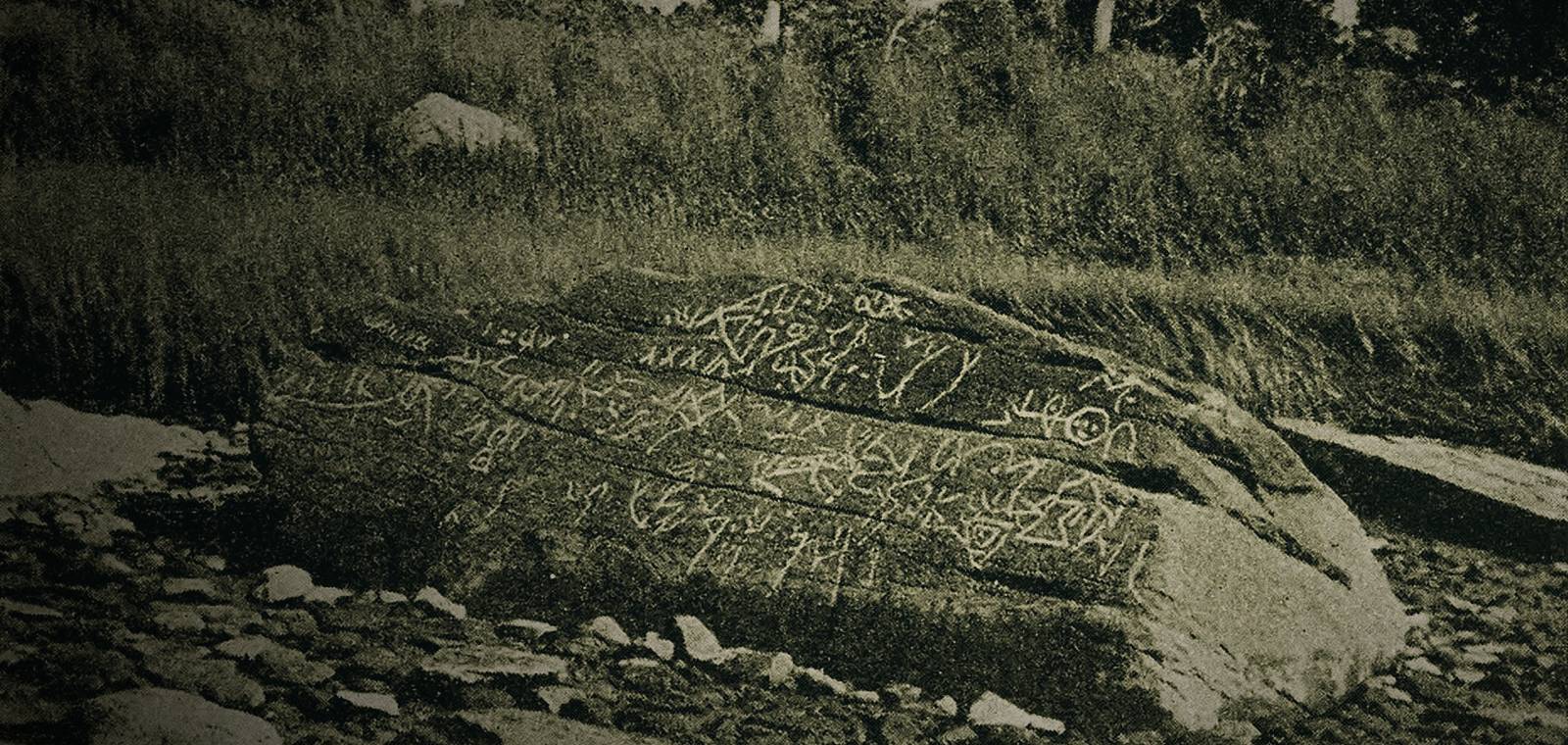
Dighton Rock sat on the bank of the Taunton River in southeastern Massachusetts, between high and low tide. The earliest printed description, by Cotton Mather in 1690, tells of a rock on which there are very deeply engraved, no man alive knows how or when, lines filled with strange characters. Edmund Burke Delabarre, who published a full study of it in 1928, estimated that the whole stone weighs not far from forty tons, most of it underground. The earliest known drawing of the marks was made by the Reverend John Danforth in October 1680.

Mather's report to the Royal Society, printed in its Philosophical Transactions in 1714 with an inaccurate picture of the carving, made the rock famous. Every age then read it in its own way. In 1781 the French scholar Court de Gébelin published a translation that gave it to Phoenician adventurers from Carthage. In 1837 the Danish antiquarian Charles Christian Rafn claimed it for Thorfinn Karlsefne's Norse party, said to have tried to settle Vinland in 1007. Other writers saw the work of local Native Americans.

Delabarre made the boldest reading of all. Among the marks he found what he took to be the name of Miguel Corte-Real, a Portuguese captain who sailed to Newfoundland in 1502 and never came home, with the date 1511. Of the known explorers, he wrote, Caspar had explored Newfoundland and Labrador in 1501, Miguel in the following year, and both had unaccountably disappeared. He was careful about it: The strongest assertion that I am willing to make is that the name is almost surely there, but he also wrote that the evidence justified a strong conviction that the record was really carved by Miguel Cortereal in 1511.

Delabarre also corrected the place. The rock, he noted, is not in what is now known as Dighton, but across the Taunton river from that town, on land that once lay within the limits of Taunton and then of Dighton, which is how it got its name. Early observers called it the Dighton Writing Rock and, in his words, speculated vainly as to the 'how and when' of its unreadable characters. After his book, the argument over who carved it went on much as before.
Questions people ask about Dighton Rock

Where is Dighton Rock?

On the shore of the Taunton River in southeastern Massachusetts, across the river from the town of Dighton, between the high and low tide marks.

Who carved Dighton Rock?

No one knows for certain. It has been credited to Phoenicians, Norse settlers, Native Americans and the Portuguese captain Miguel Corte-Real, whose name Edmund Delabarre believed he could read with the date 1511.

When was Dighton Rock first recorded?

The earliest known drawing of its marks was made by the Reverend John Danforth in October 1680, and Cotton Mather described it in print in the 1690s.

The open question

Still strange: One boulder has been read as a Phoenician record, a Norse saga, a Native American picture-writing and the signature of a lost Portuguese captain, each by a serious scholar of his day.

The Newport Tower: Who Built the Old Stone Mill? →
  1. Step 1 of 4 · This fileDighton Rock
  2. Step 2 of 4 · Next fileThe Newport Tower: Who Built the Old Stone Mill?
  3. Step 3 of 4 · Next fileThe Kensington Runestone: Norse in Minnesota in 1362?
  4. Step 4 of 4 · Next fileThe Cardiff Giant: How a Stone Man Fooled New York
About these videos

Found by a YouTube search for this topic, not checked by us. The player loads from YouTube only when you press play.

Where this comes from

EvidenceDocumented

Comes from Edmund Burke Delabarre, Dighton Rock: A Study of the Written Rocks of New England (New…. Internet Archive: A nonprofit digital library in San Francisco, founded in 1996, that holds millions of scanned books, papers and recordings. A scan there shows the pages of a real printed book or document.

What this means

The rock and drawings of its marks since 1680 are documented; who carved the marks and when is still argued.

For Dighton Rock, the original record exists and is linked: Edmund Burke Delabarre, Dighton Rock: A Study of the Written Rocks of New England (New…. That tells you the record is real and what it says. It does not mean every claim in it is true.

Primary records exist: an original document, a published text, an official file or a dated report. We link to them. This level says the record exists and what it says, not that every claim in it is true.

See all five labels

Sources

  1. Internet ArchiveA nonprofit digital library in San Francisco, founded in 1996, that holds millions of scanned books, papers and recordings. A scan there shows the pages of a real printed book or document.Edmund Burke Delabarre, Dighton Rock: A Study of the Written Rocks of New England (New York, 1928)Primary text
  2. DOI link to a research paperA DOI is a permanent ID number for a published research paper or book. The link takes you to the paper on its publisher's website, even if that site moves. The paper itself is what we cite.Cotton Mather, "An extract of several letters from Cotton Mather, D. D. to John Woodward, M. D. and Richard Waller, Esq; S. R. Secr.", Philosophical Transactions of the Royal Society 29 (1714)Primary text
  3. Internet ArchiveGeorge T. Flom, The Kensington Rune-Stone: A Modern Inscription from Douglas County, Minnesota (Illinois State Historical Society, 1910)Primary text

Quotations come from public-domain translations. A book in our Library links to its Library page; other links open the free online copy or the reference page.

Updated

Credible or not?

Tap one to see how other readers voted.

Discussion