The record
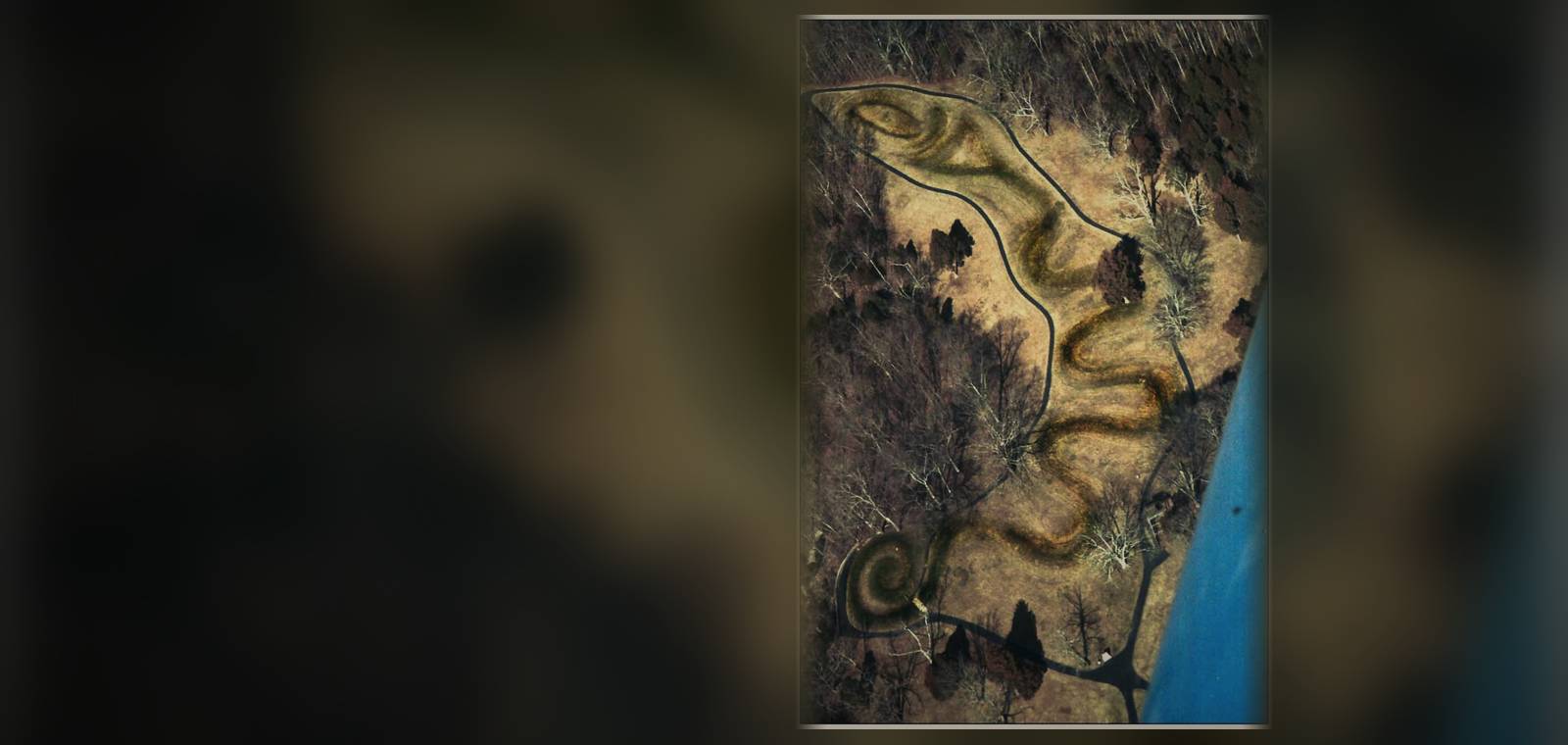
Serpent Mound is a low bank of earth shaped like a giant snake, on a ridge above Brush Creek in Adams County, Ohio. Its first published description came from two American surveyors, Ephraim Squier and Edwin Davis, in 1848. They called it probably the most extraordinary earthwork thus far discovered at the West.
Its head rests near the tip of the ridge, and its body winds back for seven hundred feet, in graceful undulations, terminating in a triple coil at the tail.
Stretched out, they wrote, it would be at least a thousand feet long. The bank was more than five feet high and thirty feet wide at the middle of the body. An oval shape sits in the open jaws.
HISTORY gives its length today as about 1,348 feet. The first scientific digs were made between 1887 and 1889 by Frederic Ward Putnam of Harvard, who credited the snake to the earlier of two peoples who had lived there. Archaeologists now name those two cultures Adena, from about 500 BCE to 200 CE, and Fort Ancient, from about 1000 to 1650 CE.
The age is still a live argument. In 2014 Edward Herrmann and colleagues dated soil from cores taken along the mound and concluded it was initially constructed 2,300 years ago during the Early Woodland (Adena) period.
In 2020 the Ohio archaeologist Bradley Lepper replied that dates on bulk soil can come out too old, and that they show only that the mound could have been constructed any time after 300 BC,
possibly a thousand years later. Why the builders shaped a snake, and what its oval was meant to be, has no written answer.