Credible Theories Sign in

The record

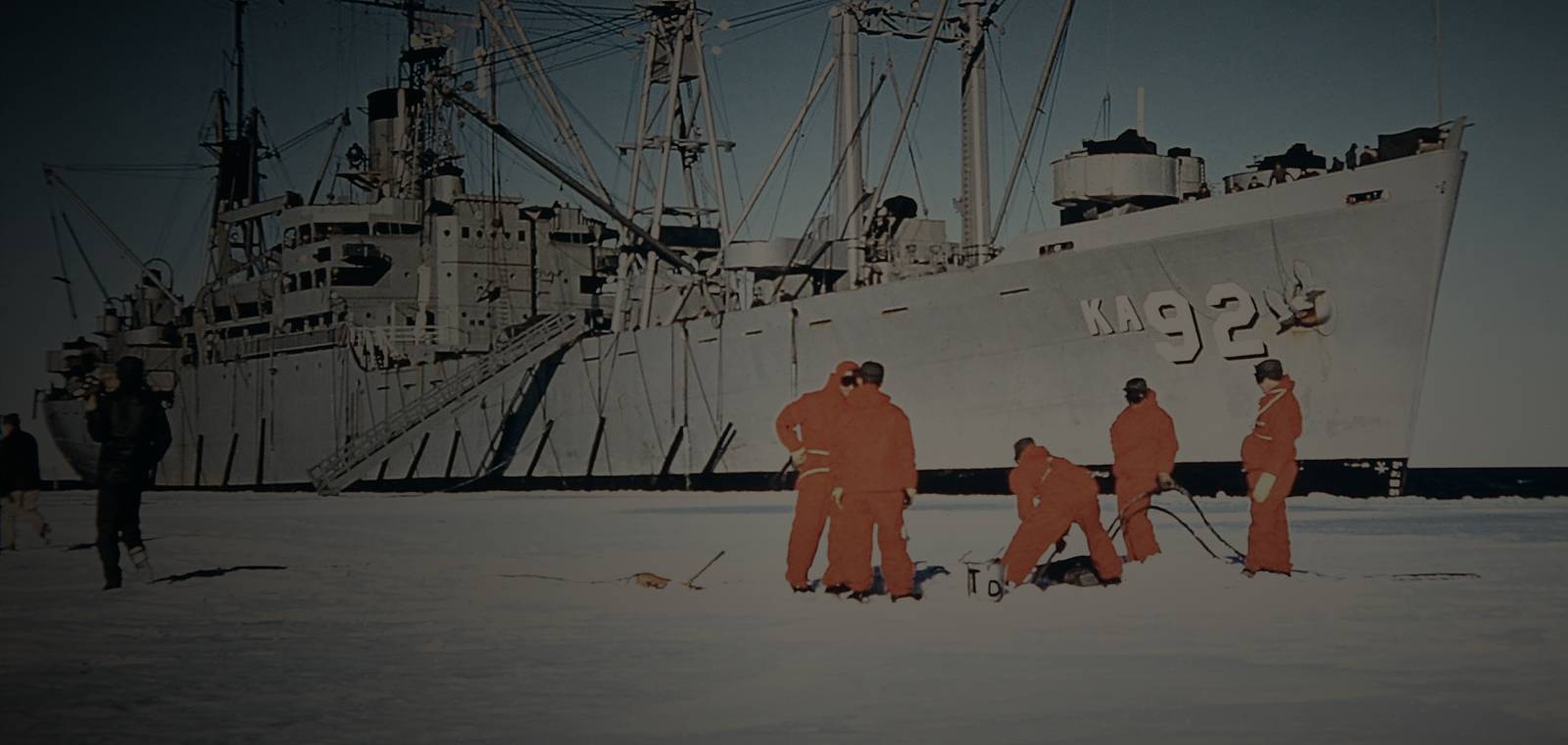
Operation Deep Freeze was the name the U.S. Navy gave its Antarctic support missions, numbered by season. A Navy medical report from 1962 sums up how it began: The United States began in 1955 to build several permanent stations in the Antarctic, one of which was located at the geographical South Pole. By 1957 this country operated seven such stations as a participant nation in the International Geophysical Year. The Navy's job was support: to assist the Office of Antarctic Programs, it contributed equipment and personnel for support in the form of transportation, supply, construction, and maintenance.

Each season got its own number. The Navy Hydrographic Office's report on the 1959-1960 season opens: DEEP FREEZE 60 was the sixth consecutive United States expedition in support of Antarctic research. Its oceanographers worked from icebreakers of Task Force 43, supported by the National Science Foundation, and took stations during the first successful penetration into the previously unexplored Bellingshausen Sea. Near the Ross Ice Shelf every reading was below freezing, and in McMurdo Sound the water reached as low as -1.93°C near the bottom of the deeper stations.

Life on the ice was a study in itself. The same Navy medical report, written for a World Health Organization conference in Geneva, describes outdoor temperatures from 30 to -100 degrees Fahrenheit, stations as high as 9,600 feet, and winter darkness lasting approximately two to six months. Once winter came, except for radio communication the men at each station are isolated from the outside world for the following six months. Wintering crews ran from about fifteen men to one hundred and fifty, and at the small stations a Navy officer, in recent years usually a physician, served as station leader.

Behind the science sat the Cold War. A secret CIA report dated 28 February 1957 set out to test a rumor that the Soviet Union had built a submarine base in Antarctica. Its conclusion: available evidence does not support the report that a Soviet submarine base has been set up in Antarctica, though the estimate rested on a recognized deficiency in our on-site surveillance. The same report expected the Soviets to stay after the International Geophysical Year and to consider the establishment of settlements, and the possibility of constructing ports and airdromes. Moscow watched the Americans just as closely. A CIA note from December 1958 reported that in the Soviet press, Operations under the US Navy are particularly singled out as evidence of US military interests in Antarctica.

The answer was a treaty. The Antarctic Treaty was signed at Washington on 1 December 1959 by the twelve countries whose scientists had worked in Antarctica during the International Geophysical Year, and it came into force in 1961. Its first article reads: Antarctica shall be used for peaceful purposes only. It bans the establishment of military bases and fortifications and weapons testing, but adds that it shall not prevent the use of military personnel or equipment for scientific research or for any other peaceful purpose. That clause is what let Navy ships and crews keep supplying the science stations.

Questions people ask about Operation Deep Freeze

Who did the science at the stations?

At the smaller stations about half the men were civilian specialists in meteorology, physics, glaciology, geology and electronics; sailors filled the other jobs, from radio operator to cook.

Did the Soviets have a submarine base in Antarctica?

A CIA study in early 1957 checked that rumor and found no evidence for it, while admitting that American eyes on Soviet coastal camps were limited.

Why can soldiers work in Antarctica if military bases are banned?

The 1959 treaty forbids bases, fortifications, maneuvers and weapons tests, but it lets armed forces carry people and cargo for science or other peaceful work.

The open question

Still strange: While Navy icebreakers hauled supplies to science stations, the CIA was writing secret reports on whether the Soviets had a submarine base in Antarctica, and the Soviet press was calling the Navy's presence proof of American military plans.

Admiral Byrd: The Highjump Records, His Diaries and the Hollow Earth →
  1. Step 1 of 4 · This fileOperation Deep Freeze
  2. Step 2 of 4 · Next fileAdmiral Byrd: The Highjump Records, His Diaries and the Hollow Earth
  3. Step 3 of 4 · Next fileThe Antarctic Ice Wall: What Byrd Saw and What Is Beyond It
  4. Step 4 of 4 · Next fileThe Hollow Earth Theory: Where Did It Come From?
About these videos

Found by a YouTube search for this topic, not checked by us. The player loads from YouTube only when you press play.

Where this comes from

EvidenceDocumented

Comes from Paul D. Nelson, Human Adaptation to Antarctic Station Life, U.S. Navy Medical…. Internet Archive: A nonprofit digital library in San Francisco, founded in 1996, that holds millions of scanned books, papers and recordings. A scan there shows the pages of a real printed book or document.

What this means

Navy reports, declassified CIA papers and the treaty text document the operation and the Cold War worries around it.

For Operation Deep Freeze, the original record exists and is linked: Paul D. Nelson, Human Adaptation to Antarctic Station Life, U.S. Navy Medical…. That tells you the record is real and what it says. It does not mean every claim in it is true.

Primary records exist: an original document, a published text, an official file or a dated report. We link to them. This level says the record exists and what it says, not that every claim in it is true.

See all five labels

Sources

  1. Internet ArchiveA nonprofit digital library in San Francisco, founded in 1996, that holds millions of scanned books, papers and recordings. A scan there shows the pages of a real printed book or document.Paul D. Nelson, Human Adaptation to Antarctic Station Life, U.S. Navy Medical Neuropsychiatric Research Unit Report 62-12 (June 1962), DTIC AD0286493Primary text
  2. Internet ArchiveU.S. Navy Hydrographic Office, Operation Deep Freeze 60, 1959-1960: Oceanographic Survey Results, Technical Report TR-82 (June 1961)Primary text
  3. Internet ArchiveCentral Intelligence Agency, Office of Research and Reports, "An Appraisal of Soviet Plans to Remain in the Antarctic After the IGY and of the Reported Establishment of a Submarine Base", CIA/RR-GR-145 (28 February 1957; released 2013)Primary text
  4. Internet ArchiveCentral Intelligence Agency, "Soviet press raises hostile charges against US operations in the Antarctic" (16 December 1958), CIA-RDP61-00391R000100310001-5Primary text
  5. Secretariat of the Antarctic TreatyThe permanent office of the Antarctic Treaty countries. It publishes the treaty and the decisions of its member countries, so it is the official place to read what the treaty says.The Antarctic Treaty (signed at Washington, 1 December 1959), text from the Secretariat of the Antarctic TreatyPrimary text
  6. Secretariat of the Antarctic TreatySecretariat of the Antarctic Treaty, "The Antarctic Treaty" (signing, entry into force and Parties)

Quotations come from public-domain translations. A book in our Library links to its Library page; other links open the free online copy or the reference page.

Updated

Credible or not?

Tap one to see how other readers voted.

Discussion