The record
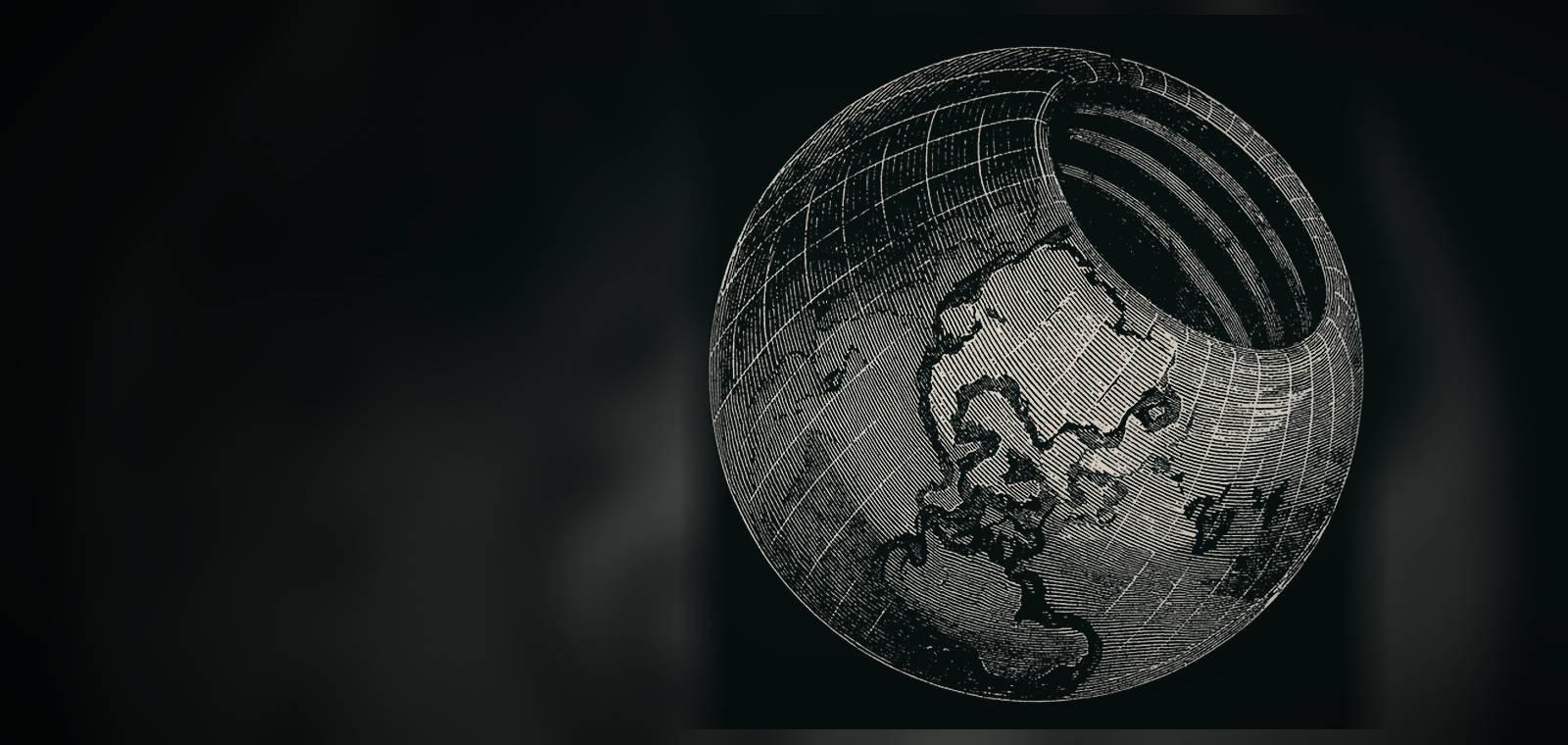
The idea did not start with cranks. It started with a problem about compasses. Edmond Halley was trying to explain why a compass needle's variation from true north slowly changes over the years, and why the needles behaved as if the Earth had four magnetic poles. His answer, printed in the Royal Society's Philosophical Transactions, was bold: we have adventured to make the Earth hollow and to place another Globe within it: and I doubt not but this will find Opposers enough.
If the exterior Shell of Earth be a Magnet
and the Internal Nucleus be likewise a Magnet,
and the inner one turned a little more slowly than the outer, he could account for four magnetic poles and for their slow drift.
Halley drew the scheme for his readers: the Earth as an outer circle and three inward Circles
sized nearly proportionable to the Magnitudes of the Planets Venus, Mars and Mercury.
He answered the obvious objections himself. The inner globes would be shut up in eternal Darkness, and therefore unfit for the Production of Animals or Plants
; he replied that the Medium it self may be always luminous.
Leaning on Newton's figure for the Moon's density, he suggested that four ninths of the globe might be cavity, and asked why such a space should not hold living creatures, since We our selves, in Cities where we are pressed for room, commonly build many Stories one over the other.
The American version came from John Cleves Symmes, a former army captain. James McBride, who heard his lectures, published the full account in 1826. Symmes's first circular, issued at St. Louis on April 10, 1818, asked for one hundred brave companions, well equipped, to set out from Siberia in autumn, with rein-deer and sleighs, to pass over the ice of the frozen sea.
He promised to find a warm, or at least a temperate country, of fertile soil, well stocked with animals and vegetables, if not men.
He mailed copies to learned institutions across the United States and to several in Europe. McBride admits that the reception was that of ridicule
and that the Academy of Sciences in Paris judged it unworthy of their consideration.
Symmes's Earth was bigger inside than Halley's. It was composed of at least five hollow concentric spheres,
each widely open at their poles,
and the opening in the north was believed to be about four thousand miles in diameter, and the southern above six thousand.
He lectured on it in Cincinnati in 1820 and later at Lexington and Frankfort in Kentucky and at Hamilton and Zanesville in Ohio, turning a wooden globe to show the route in. In 1822 he petitioned Congress for two vessels of two hundred and fifty, or three hundred, tons burthen.
The petition was presented in the Senate on March 7, 1822, and after a motion to send it to the Committee of Foreign Relations failed, it was laid on the table.
A petition to the Ohio General Assembly in January 1824 was postponed indefinitely.
Measurement settled the question. The U.S. Geological Survey notes that the Earth's size, about 12,750 kilometers (km) in diameter,
was known to the ancient Greeks, but it was not until the turn of the 20th century that scientists determined that our planet is made up of three main layers: crust, mantle, and core.
The core itself comes in two parts, a 2,200 km-thick liquid outer core and a 1,250 km-thick solid inner core,
and the Survey adds: As the Earth rotates, the liquid outer core spins, creating the Earth's magnetic field.
Halley's guess that something deep inside turns at its own pace and steers the compass has a modern echo. What turns is molten metal, not a second world.