Credible Theories Sign in

The record

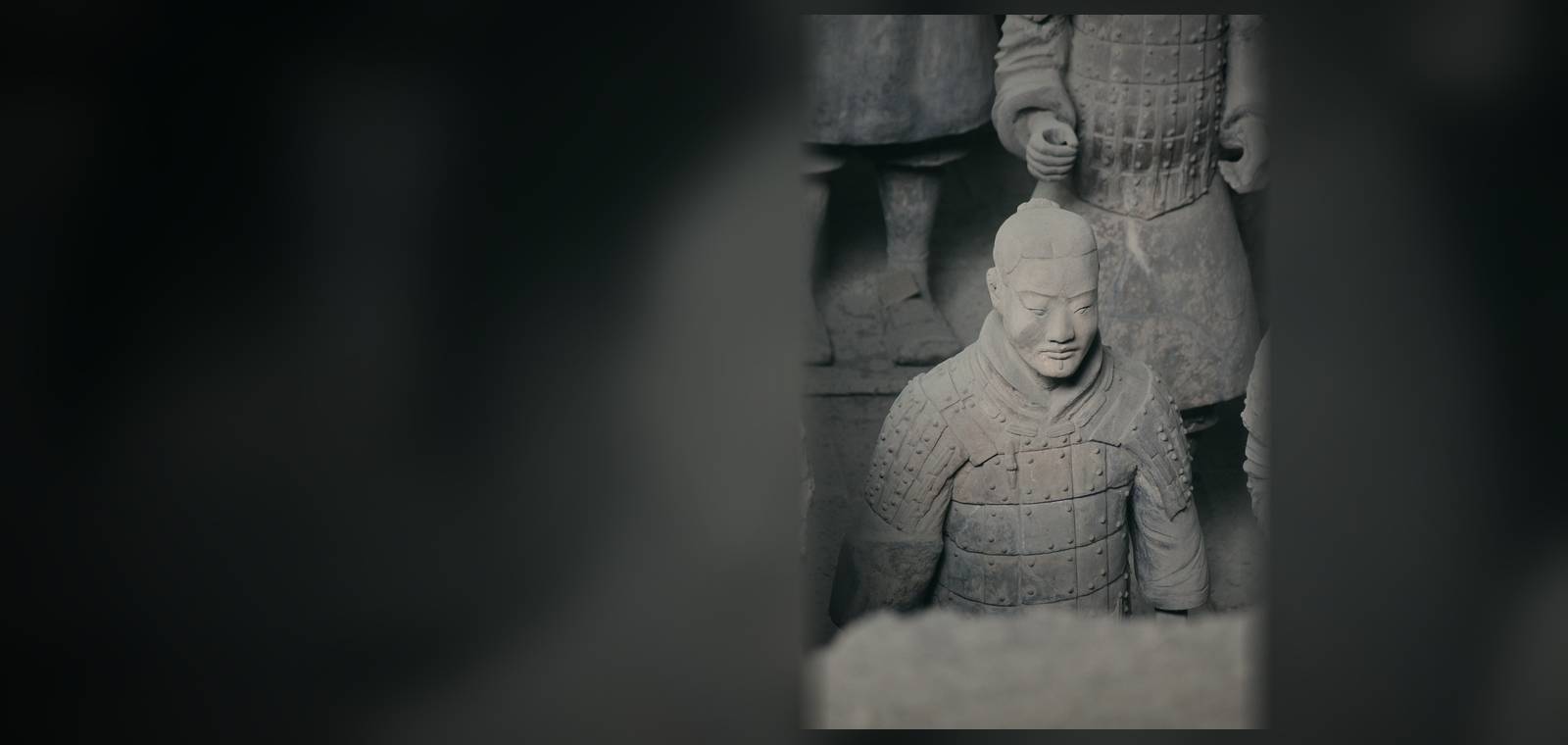
In 1974 local farmers sinking a well near Xi'an in China dug into pits full of broken clay figures. The Metropolitan Museum of Art says the first pit holds eleven parallel corridors containing more than 3,000 terracotta figures, life-size soldiers that were once painted to look like skin, hair, clothes and arms. UNESCO describes nearly 200 pits around the tomb, and thousands of statues still to be unearthed.

The soldiers guard the tomb of Qin Shi Huang, who died in 210 BCE and is remembered as the first unifier of China. UNESCO says his grave mound was begun in 246 BCE and still rises 51.3 meters inside a double-walled enclosure.

The mound itself has never been dug. The Han historian Sima Qian left the best-known account of what is inside. A 2020 study in Scientific Reports summarized it this way: the tomb chamber contained considerable amounts of liquid mercury, presumably forming rivers and lakes on a large-scale map of China.

That study, led by Guangyu Zhao with Sune Svanberg, tested the claim from the outside. The team aimed a laser across the mound from three places to measure mercury in the air. They found levels up to 27 nanograms per cubic meter, well above the area's normal pollution, with about 23 on the western slope near the top. Their suggestion is that highly volatile mercury may be escaping through cracks that formed in the structure over time.
Questions people ask about The Terracotta Army and the First Emperor's Tomb

How were the clay soldiers made?

The Metropolitan Museum reports that some scholars think the figures, or at least parts of them, were made in molds. The curator Zhixin Jason Sun describes the parts as made as separate modules and then joined with clay.

Are the soldiers portraits of real men?

No one knows. The Met notes their faces follow set types and asks whether they show individual soldiers or a single ideal.

How do you measure mercury without digging?

The 2020 team used laser radar, which measures mercury gas along the path of a laser beam. Besides the western slope, they found raised levels on the eastern slope, a little toward the south.

The open question

Still strange: Mercury over the emperor's tomb.

The tomb has never been dug, so the old account and the modern readings are all there is.

The Qigong Flying Cart: A Flying Machine in Ancient Chinese Texts →
  1. Step 1 of 4 · This fileThe Terracotta Army and the First Emperor's Tomb
  2. Step 2 of 4 · Next fileThe Qigong Flying Cart: A Flying Machine in Ancient Chinese Texts
  3. Step 3 of 4 · Next fileYu the Great: The Engineer-King Who Tamed China's Great Flood
  4. Step 4 of 4 · Next fileNüwa: The Goddess Who Made Humans and Repaired the Sky
About these videos

Found by a YouTube search for this topic, not checked by us. The player loads from YouTube only when you press play.

Where this comes from

EvidenceDocumented

Comes from Guangyu Zhao and others, "Mercury as a Geophysical Tracer Gas - Emissions from the…. A primary record: the document itself, not a retelling of it. Published at pmc.ncbi.nlm.nih.gov; it opens in a new tab.

What this means

Records exist and are linked below. This page says what the records say.

For The Terracotta Army and the First Emperor's Tomb, the original record exists and is linked: Guangyu Zhao and others, "Mercury as a Geophysical Tracer Gas - Emissions from the…. That tells you the record is real and what it says. It does not mean every claim in it is true.

Primary records exist: an original document, a published text, an official file or a dated report. We link to them. This level says the record exists and what it says, not that every claim in it is true.

See all five labels

Sources

  1. Guangyu Zhao and others, "Mercury as a Geophysical Tracer Gas - Emissions from the Emperor Qin Tomb in Xi'an Studied by Laser Radar", Scientific Reports 10, 10414 (2020)Primary text
  2. UNESCO World Heritage CentreThe official website of the World Heritage list kept by UNESCO, the United Nations agency for education, science and culture. Each place's page gives an expert-checked description of the site and why it matters.UNESCO World Heritage Centre, "Mausoleum of the First Qin Emperor" (site 441)
  3. Yiren Shen, "Making the Warrior: The Qin Terracotta Soldiers in Age of Empires", The Metropolitan Museum of Art (10 July 2017)

Quotations come from public-domain translations. A book in our Library links to its Library page; other links open the free online copy or the reference page.

Updated

Credible or not?

Tap one to see how other readers voted.

Discussion