How the rabbit hole works. Start with anything that grabs you, say UFOs. Every person, place and document a page mentions links to its own page, so a UFO file leads to a witness, the witness leads to the people who investigated the case, and it keeps going.
The path you take shows in the bar under the top menu on every page, so you can step back any time or climb out and start again.
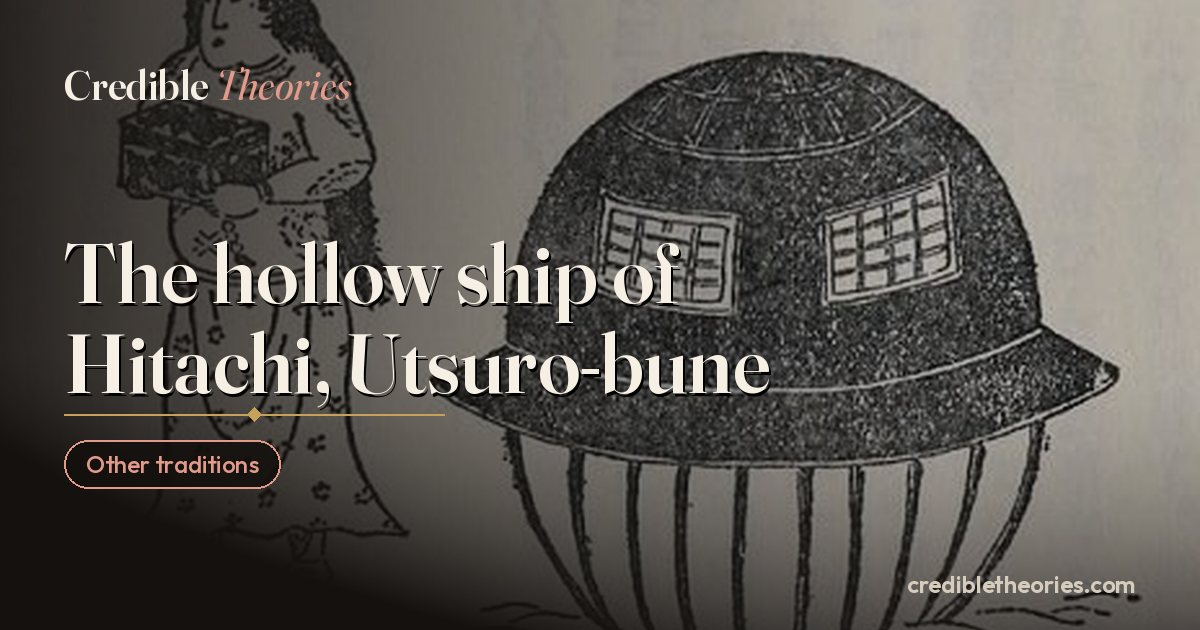
This is a summary of a tale from Toen Shosetsu, a collection of strange stories gathered in 1825 in Edo, now Tokyo. In the tale, set in 1803, fishermen on the Japanese coast find a round boat with glass windows. Inside is a young woman in strange clothes who speaks an unknown language and guards a box. They push the boat back out to sea.
ReferenceUtsuro-bune (Toen Shosetsu, 1825)
Written1825 CE
Set1803 CE, Japanese coast
Fishermen find a round vessel with glass windows. Inside is a young woman in strange clothes, holding a box she will not let anyone touch. She speaks a language no one knows. They push the vessel back out to sea.
Documented · Retold in English, 1825 CE Summary by the editors. Translation: Summary in my own words
AdvertisementAd space
Read it literally
A late echo that fits the pattern: a sealed box, a visitor, and a cover-up.
What scholars say
Folklore, not ancient, but recorded with drawings.
Themes From the sky Looks like technology
Questions people ask about Utsuro-bune
Who wrote down the Utsuro-bune story?
The best-known account is in Toen Shosetsu, a collection of strange tales gathered in 1825 by the popular novelist Kyokutei Bakin and his circle of writers. Other versions of the story exist from around the same time, including one in a book called Ume no chiri. They differ on details such as the name of the beach.
Where in Japan did the hollow ship come ashore?
Toen Shosetsu places it on a coast called Harayadori in Hitachi Province, which is now Ibaraki Prefecture. Another version names a place called Harato-no-hama. Neither name matches a known village, and the researcher Kazuo Tanaka reported in 2014 that an older document instead names a beach that corresponds to Sharihama in Hasaki.
What was inside the box the woman carried?
No one in the story finds out, because she would not let anyone touch it. One old villager guesses she may be a foreign noblewoman sent away for an affair, and that the box holds her dead lover's head. Researchers such as Kazuo Tanaka see the tale as a mix of folklore and imagination, perhaps with a real shipwreck behind it.
Where this comes from
EvidenceDocumented
Comes fromToen Shosetsu (1825), Utsuro-bune (Toen Shosetsu, 1825). A collection of strange stories gathered in 1825 by a literary club in Edo (now Tokyo) that included the novelist Kyokutei Bakin. It includes the utsuro-bune tale: a round boat that washed ashore in 1803 carrying a young woman who spoke no known language.
What this means
The text exists and is quoted from a published translation. What it describes is a separate question.
Primary records exist: an original document, a published text, an official file or a dated report. We link to them. This level says the record exists and what it says, not that every claim in it is true.