












Credible Theories Sign in

The record

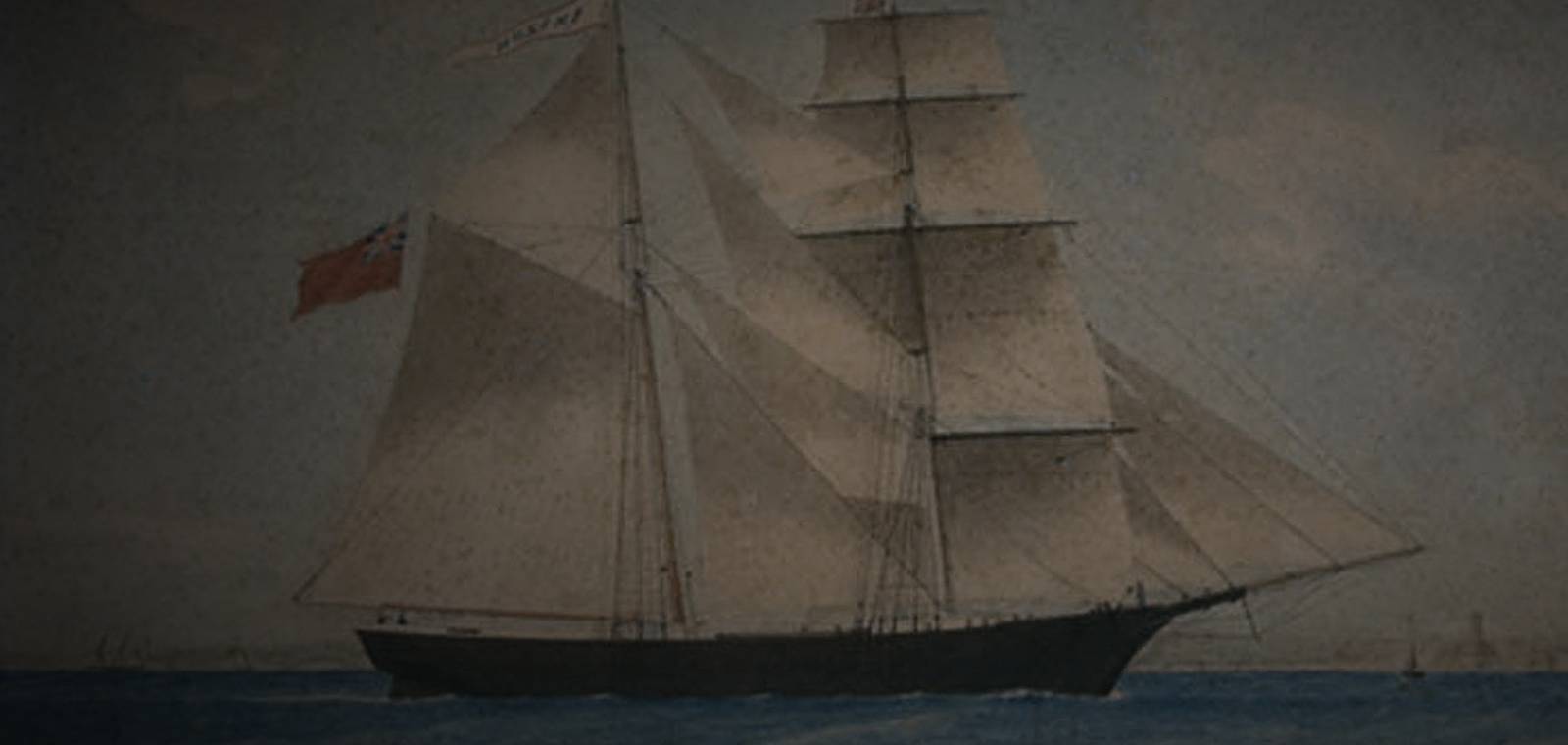
The Mary Celeste was a two-masted cargo ship built in Nova Scotia in 1861 under the name Amazon. On November 7, 1872, she left New York for Genoa, Italy, carrying about 1,700 barrels of strong industrial alcohol. On board were ten people: Captain Benjamin Briggs, his wife Sarah, their two-year-old daughter Sophia, and seven crewmen.

On December 4, 1872, the crew of another ship, the Dei Gratia, spotted the Mary Celeste moving oddly in the Atlantic near the Azores islands. When they went aboard, no one was there. Royal Museums Greenwich, which holds records of the case, lists what they found: some sails set, some rigging damaged, cargo hatches open, a little water in the hold, one pump partly taken apart with a sounding rod (a rod for measuring water in the hold) lying nearby, and the crew's belongings left in place. The lifeboat, the ship's papers and the captain's navigation instruments were gone. The last entry on the log slate was from the morning of November 25.

The Dei Gratia's crew sailed the ship to Gibraltar to claim salvage money, a reward for saving a ship. The court hearing ran from December 17, 1872 to February 25, 1873. Gibraltar's Attorney General, Frederick Solly-Flood, suspected that the salvagers or the Mary Celeste's own crew had committed murder, but no evidence of violence was found. The salvagers received about a sixth of the value of ship and cargo, which many read as a sign the court was not fully satisfied.

What the record says: the court's surveyor, John Austin, spent five hours aboard on 23 December 1872 and swore a long report. He found the hull, masts and deck house undamaged, the crew's sea chests dry, and concluded that the Vessel never encountered any such violence as a storm would cause. He found two fresh cuts on the bows, apparently done by a sharp cutting instrument. On the captain's sword he wrote that it appeared to me as if it had been smeared with blood and afterwards wiped. He searched for any sign of an explosion or a fire and did not discover the slightest trace of either. He called the ship thoroughly sound staunch and strong.

Those findings cut both ways. The sword stains, American Heritage reports, were later tested and found not to be blood, and the alcohol barrels showed no tampering, which weakened the murder theory. But Austin's sworn finding of no trace of fire or explosion is also the hardest fact for the popular idea that alcohol fumes scared the crew off the ship. The court awarded the Dei Gratia's crew £1,700 in March 1873 and gave no finding on what happened.

The story grew larger in fiction. In 1884 a young Arthur Conan Doyle, before he created Sherlock Holmes, published a made-up story called J. Habakuk Jephson's Statement about a ship he called the Marie Celeste. Details from the story are still repeated as if they were fact, and so is the wrong name.

The cargo gives one clue. When it was unloaded in Genoa, nine of the 1,701 barrels were found empty, through leaking or minor damage. A popular explanation is that Captain Briggs, worried by alcohol fumes, water in the hold or a fear that the ship was sinking, ordered everyone into the lifeboat to wait at a distance, and the boat was lost. The Mary Celeste herself sailed on for years. In 1885 her captain wrecked her on purpose off Haiti in an attempt at insurance fraud.
Questions people ask about The Mary Celeste ghost ship

Has the wreck of the Mary Celeste been found?

Probably not. In 2001 an expedition led by the novelist Clive Cussler reported finding a wreck on the Rochelois reef near Haiti's Gonâve Island, where the ship was lost in 1885. Tree-ring testing by Scott St. George of the Geological Survey of Canada later showed the wood came from trees still growing around 1894, so the remains likely belong to a different vessel.

Did Captain Briggs leave any children behind?

Yes. His son Arthur, about seven years old, stayed home in Massachusetts with his grandmother so he could attend school. He was the only member of the immediate family who was not on board. A popular story says Briggs had dined with the Dei Gratia's captain, David Morehouse, before sailing, but historians say the evidence for that friendship is thin.

Could the alcohol cargo have exploded?

An experiment suggests a mild blast was possible. In 2006 chemist Andrea Sella of University College London built a model of the hold, filled it with alcohol vapor and lit it. The flame front was a quick pressure wave that left the paper cargo boxes unburned. That would explain a frightened crew and an undamaged ship, though it cannot prove what happened.

The open question

Still strange: The ship that ten people abandoned in a hurry was in good enough shape that a few sailors from another ship sailed her hundreds of miles to Gibraltar. Whatever made the crew leave, it was not that the ship was sinking.

The Bermuda Triangle →
  1. Step 1 of 2 · This fileThe Mary Celeste ghost ship
  2. Step 2 of 2 · Next fileThe Bermuda Triangle
About these videos

Found by a YouTube search for this topic, not checked by us. The player loads from YouTube only when you press play.

Where this comes from

EvidenceDocumented

Comes from The mystery of the Mary Celeste, Royal Museums Greenwich. A primary record: the document itself, not a retelling of it. Published at rmg.co.uk; it opens in a new tab.

What this means

The Gibraltar court records and museum holdings document the abandoned ship; why the ten people left is unknown, and the best-known spooky details come from fiction.

For The Mary Celeste ghost ship, the original record exists and is linked: The mystery of the Mary Celeste, Royal Museums Greenwich. That tells you the record is real and what it says. It does not mean every claim in it is true.

Primary records exist: an original document, a published text, an official file or a dated report. We link to them. This level says the record exists and what it says, not that every claim in it is true.

See all five labels

Sources

  1. The mystery of the Mary Celeste, Royal Museums GreenwichPrimary text
  2. Lucy Davidson, Ghost Ship: What Happened to the Mary Celeste?, History Hit, November 8, 2022Reference
  3. Project GutenbergThe oldest digital library, started in 1971, with more than 70,000 free e-books whose copyright has run out. Volunteers type and check the texts against printed editions.Arthur Conan Doyle, J. Habakuk Jephson's Statement (1884), in The Captain of the Polestar, and Other Tales, Project Gutenberg (the fiction that spread the name 'Marie Celeste')Primary text
  4. The Mary Celeste: Facts not FictionA private website about the Mary Celeste that posts transcriptions of the original records, such as the 1872 Gibraltar court survey. We cite it only for those records, not its own views.John Austin, Surveyor of Shipping, sworn survey of the Mary Celeste for the Vice-Admiralty Court, Gibraltar (December 1872), as transcribed in Charles Edey Fay, Mary Celeste (1942)Primary text
  5. American HeritageA long-running US magazine of American history, founded in 1949, whose articles are written by historians and journalists.'The Mystery of the Mary Celeste', American Heritage, vol. 32, no. 2 (February 1981)Reference

Quotations come from public-domain translations. A book in our Library links to its Library page; other links open the free online copy or the reference page.

Updated

Credible or not?

Tap one to see how other readers voted.

Discussion