












What is Kisari Mohan Ganguli known for?
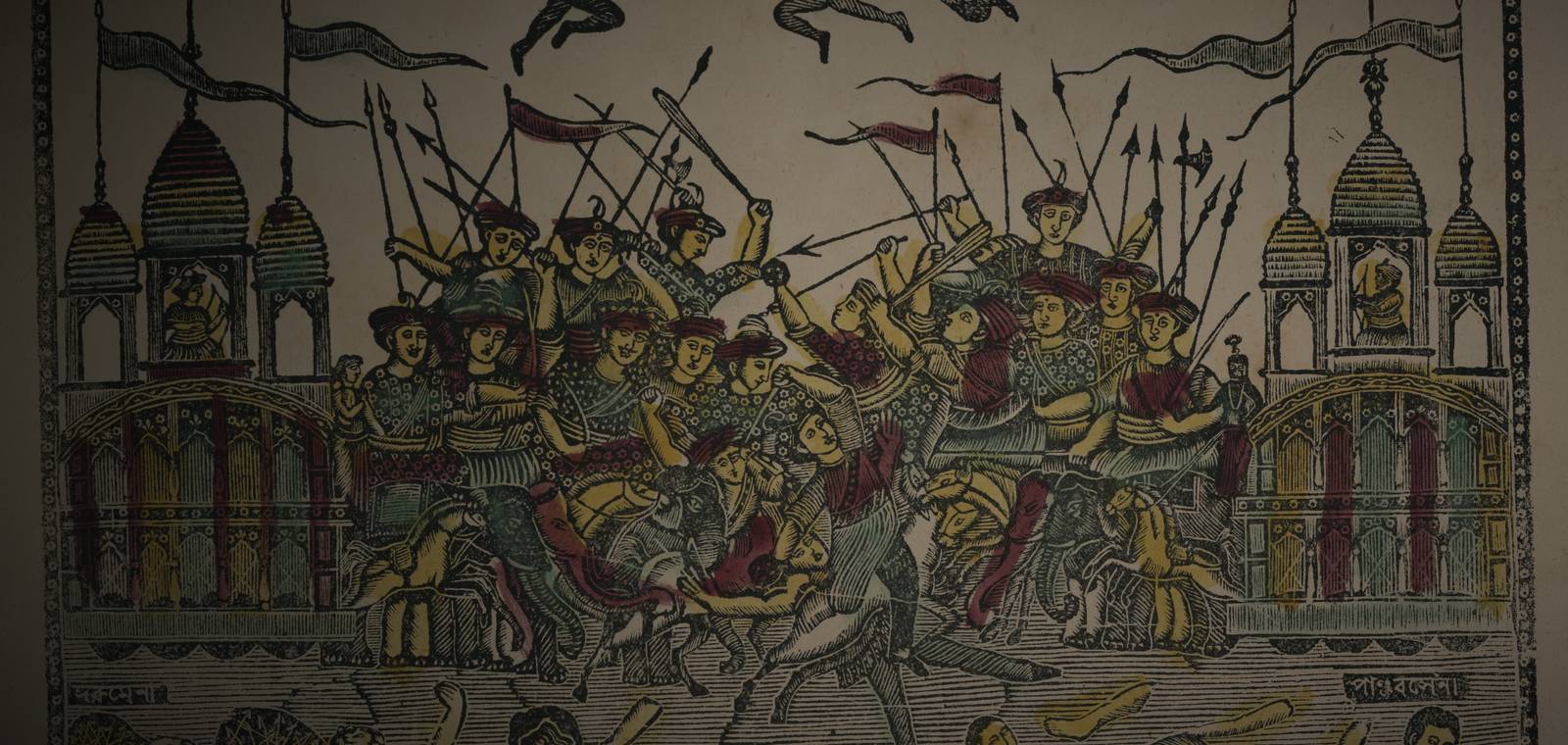
Kisari Mohan Ganguli was an Indian scholar who produced the first complete English translation of the Mahabharata, the vast Sanskrit epic of the war between the Pandavas and the Kauravas. It was published in Calcutta in instalments between 1883 and 1896 by the bookseller and printer Pratap Chandra Roy.
Ganguli at first asked to stay anonymous, partly because he doubted one person could finish such a huge task. His name was left off the early volumes, which led many readers, and later librarians, to credit the translation to Roy. His name was restored only after all eighteen books were complete, and modern scholars have worked to correct the attribution.
The Ganguli translation is still the only complete English Mahabharata in the public domain, so it is the version most online quotations claim to come from. It is useful for checking famous 'ancient nuclear war' quotes: several of them, including a line about the light of ten thousand suns, do not appear in it.
The same story, told elsewhere
Shared story · Births
Saved From the Water: Sargon, Moses and Karna
A mother seals her baby in a basket, tars the lid and lets the river take him. A stranger pulls him out, and the child grows up to rule. The same story is told of a king in Iraq, a prophet in Egypt and a warrior in India.
Mahabharata, Vana Parva (the birth of Karna) is one telling. The same story is told 8 more times, in 6 parts of the world. Follow it:
- ChineseYellow River valley, China · c. 1000-700 BCE · Ancient text
- Akkadian (Mesopotamia)Mesopotamia · c. 8th-7th century BCE · Ancient text
- Hebrew BibleJudah / Babylon · c. 600-400 BCE · Ancient text
- Persian (told by a Greek)Media and Persia · c. 430 BCE · Ancient text
- Hindu (Mahabharata)Northern India · c. 400 BCE · Ancient textTied to this page
- RomanRome, Italy · c. 27-25 BCE · Ancient text
- GreekGreece · 1st or 2nd century CE · Ancient text
- WelshWales · c. 1550 CE · Early modern text
- Maori (New Zealand)New Zealand · 1840 · Recorded folklore
The open question: Did one old Near Eastern story travel from people to people, or does every great leader's story end up with the same rescue from the river? Join the debate
Shared story · Death and return
Journey to the Underworld: Ishtar, Orpheus, Izanagi and Savitri
Someone they love has died, so they walk into the land of the dead to bring them back. In Greece, Japan and among the Cherokee one small broken rule ruins everything, while in India a wife talks Death himself into letting go.
Mahabharata, Vana Parva (Savitri and Yama) is one telling. The same story is told 7 more times, in 6 parts of the world. Follow it:
- Babylonian (Akkadian)Mesopotamia · c. 1000-600 BCE · Ancient text
- GreekIonia · c. 725-675 BCE · Ancient text
- Hindu (Sanskrit epic)Northern India · c. 400 BCE · Ancient textTied to this page
- RomanRome, Italy · 29-19 BCE · Ancient text
- Roman (Greek story)Rome, Italy · c. 8 CE · Ancient text
- Japanese (Shinto)Japan · 712 CE · Medieval text
- NorseIceland · c. 1220 CE · Medieval text
- Cherokee (North America)Eastern Cherokee, western North Carolina, USA · 1887-1890 · Recorded folklore
The open question: Did the story of the forbidden look back travel from people to people, or did people far apart each decide that the dead are lost through one small mistake? Join the debate
Shared story · Floods and lost lands
Lost Lands Under the Sea: Atlantis, Dvaraka and Ys
A rich city, a proud people and one terrible day when the sea comes in and never leaves. Greece, India, Egypt, Wales, Cornwall and Brittany all tell of a land that now lies under the waves.
Mahabharata, Mausala Parva (the end of Dvaraka) is one telling. The same story is told 8 more times, in 4 parts of the world. Follow it:
- Ancient EgyptianEgypt · c. 1900-1800 BCE · Ancient text
- Hindu (Sanskrit epic)Dvaraka · c. 400 BCE · Ancient textTied to this page
- Greek, retold in a Roman-era geographyHelike, on the Gulf of Corinth, Greece · 373 BCE · Ancient text
- GreekAthens · c. 360 BCE · Ancient text
- Tamil (South India)Tamil Nadu, southern tip of India · c. 5th-6th century CE · Ancient text
- WelshCardigan Bay, Wales · c. 1250 CE · Medieval text
- BretonBay of Douarnenez, Brittany, France · 15th century · Retold in English
- CornishBetween Land's End and the Isles of Scilly, Cornwall, England · c. 1478 · Medieval text
- Modern science (19th-century Europe)Germany and Britain · 1864 · Modern book
The open question: Do these stories keep real memories of lost coastlines, or is a drowned city simply a story people tell to warn against pride? Join the debate
Mentioned on these pages
Where this comes from
Comes from Internet Sacred Text Archive, 'The Mahabharata', tr. Kisari Mohan Ganguli. One of the two great Sanskrit epics of India, about a war between two branches of a royal family. With about 100,000 verses it is one of the longest poems ever made.
What this means
A real person with records. Sources are listed below.
For Kisari Mohan Ganguli, the original record exists and is linked: Internet Sacred Text Archive, 'The Mahabharata', tr. Kisari Mohan Ganguli. That tells you the record is real and what it says. It does not mean every claim in it is true.
Primary records exist: an original document, a published text, an official file or a dated report. We link to them. This level says the record exists and what it says, not that every claim in it is true.
Sources
- The MahabharataOne of the two great Sanskrit epics of India, about a war between two branches of a royal family. With about 100,000 verses it is one of the longest poems ever made. It was mostly put together between about 300 BC and AD 300. Kisari Mohan Ganguli made the first full English version, 1883 to 1896.Internet Sacred Text Archive, 'The Mahabharata', tr. Kisari Mohan Ganguli Online copyPrimary text Archived copy, 2026-10-03
- WikipediaA free online encyclopedia written and edited by volunteers. It is a good starting point and usually lists its own sources, but anyone can change it, so we treat it as a guide to better sources, not the final word.Wikipedia, 'Kisari Mohan Ganguli'Reference Archived copy, 2026-10-03
No public-domain picture of this person yet. We do not show drawn or generated likenesses.