How the rabbit hole works. Start with anything that grabs you, say UFOs. Every person, place and document a page mentions links to its own page, so a UFO file leads to a witness, the witness leads to the people who investigated the case, and it keeps going.
The path you take shows in the bar under the top menu on every page, so you can step back any time or climb out and start again.
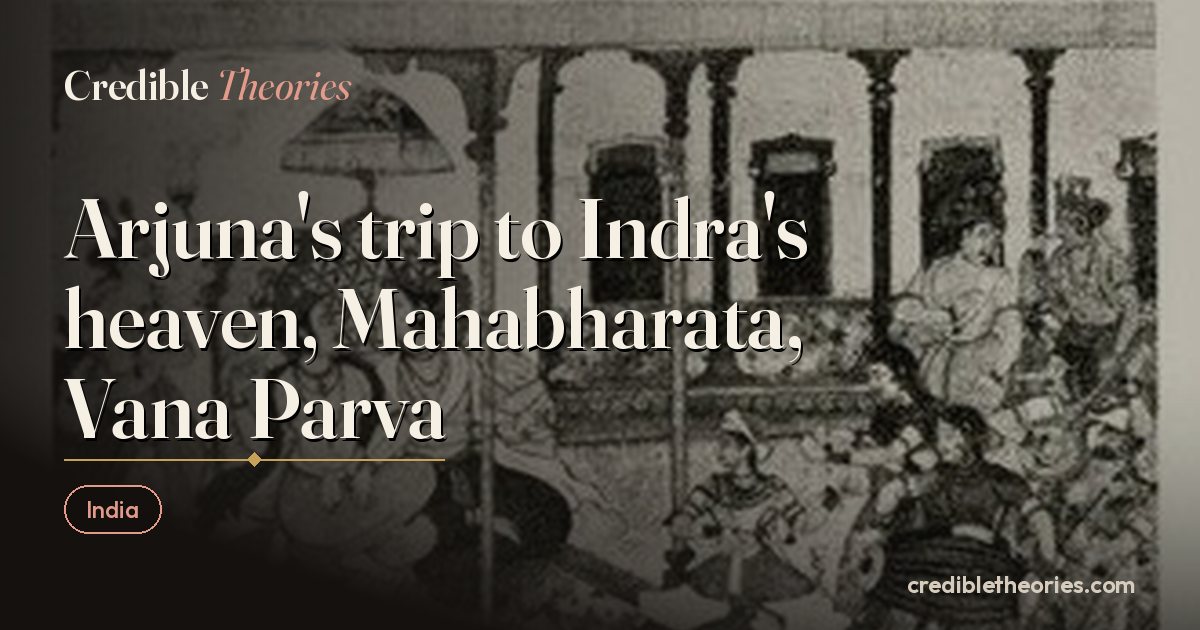
This is a summary from the Mahabharata, one of the two great Sanskrit epics of India, written around 400 BCE to 400 CE. The hero Arjuna rides up to the heaven of the god Indra in a flying car. On the way he sees thousands of cars in the sky and learns that stars are really huge bodies, the homes of good people.
ReferenceMahabharata, Vana Parva (Ganguli 42–43)
Writtenc. 400 BCE–400 CE
SetThe age of Krishna
Indra's driver Matali takes Arjuna up in a celestial car. As they rise, Arjuna sees thousands of cars in the sky, and learns that the lights that look like small stars from earth are really huge bodies, the homes of the righteous.
Documented · Retold in English, c. 400 BCE Summary by the editors. Translation: Summary in my own words
AdvertisementAd space
Read it literally
The narrator learns stars are enormous only by seeing them up close. Ancient astronomy told from a passenger seat.
What scholars say
Same epic.
Themes Taken up alive From the sky Looks like technology
A god or a hero faces a giant serpent that blocks the waters, eats the young or threatens the whole world, and cuts it down. The same fight is told in Babylon, India, Greece, Egypt, Iceland, Japan and medieval Europe.
Rig Veda, Book 1, Hymn 32 (Indra slays Vritra) is one telling. The same story is told 7 more times, in 6 parts of the world. Follow it:
The open question: Did one ancient story of a hero and a serpent spread across the world, or do people everywhere turn their fears into dragons on their own? Join the debate
Questions people ask about Mahabharata, Vana Parva
Who wrote the Mahabharata?
Hindu tradition names the sage Vyasa as its author, and he also appears as a character in the story. Scholars see it as a work that grew over many centuries. In its longest form it runs to about 100,000 couplets, making it one of the longest poems ever composed. The Vana Parva is the third of its eighteen books.
Why does Arjuna go to Indra's heaven?
During the Pandava brothers' twelve years of exile in the forest, Arjuna sets out to gain divine weapons for the war to come. After a contest with the god Shiva, who is disguised as a hunter, he receives the Pashupata weapon. Indra, his divine father, then brings him to his city of Amaravati, where Arjuna trains in weapons, music and dance.
Can I read the Ganguli Mahabharata for free?
Yes. Kisari Mohan Ganguli's English prose translation was published in parts between 1883 and 1896 and is now in the public domain. It was the first complete English version of the epic. The full text is free on Project Gutenberg and sacred-texts.com, where the Vana Parva is split into numbered sections.
Where this comes from
EvidenceDocumented
Comes fromThe Mahabharata, Mahabharata, Vana Parva (Ganguli 42–43). One of the two great Sanskrit epics of India, about a war between two branches of a royal family. With about 100,000 verses it is one of the longest poems ever made.
What this means
The text exists and is quoted from a published translation. What it describes is a separate question.
Primary records exist: an original document, a published text, an official file or a dated report. We link to them. This level says the record exists and what it says, not that every claim in it is true.