How the rabbit hole works. Start with anything that grabs you, say UFOs. Every person, place and document a page mentions links to its own page, so a UFO file leads to a witness, the witness leads to the people who investigated the case, and it keeps going.
The path you take shows in the bar under the top menu on every page, so you can step back any time or climb out and start again.
This is a summary of old Egyptian king lists: the Turin King List, a papyrus from about 1250 BCE, and the work of Manetho, an Egyptian priest writing around 280 BCE. Both say that before the first human pharaoh, Egypt was ruled by gods, then demigods, then spirits of the dead. Their reigns last thousands of years.
ReferenceTurin King List; Manetho
WrittenTurin list c. 1250 BCE; Manetho c. 280 BCE
SetBefore the first pharaoh
Before Menes, the lists give dynasties of gods, then demigods, then 'spirits of the dead', with reigns of thousands of years. Manetho's total runs to tens of thousands of years.
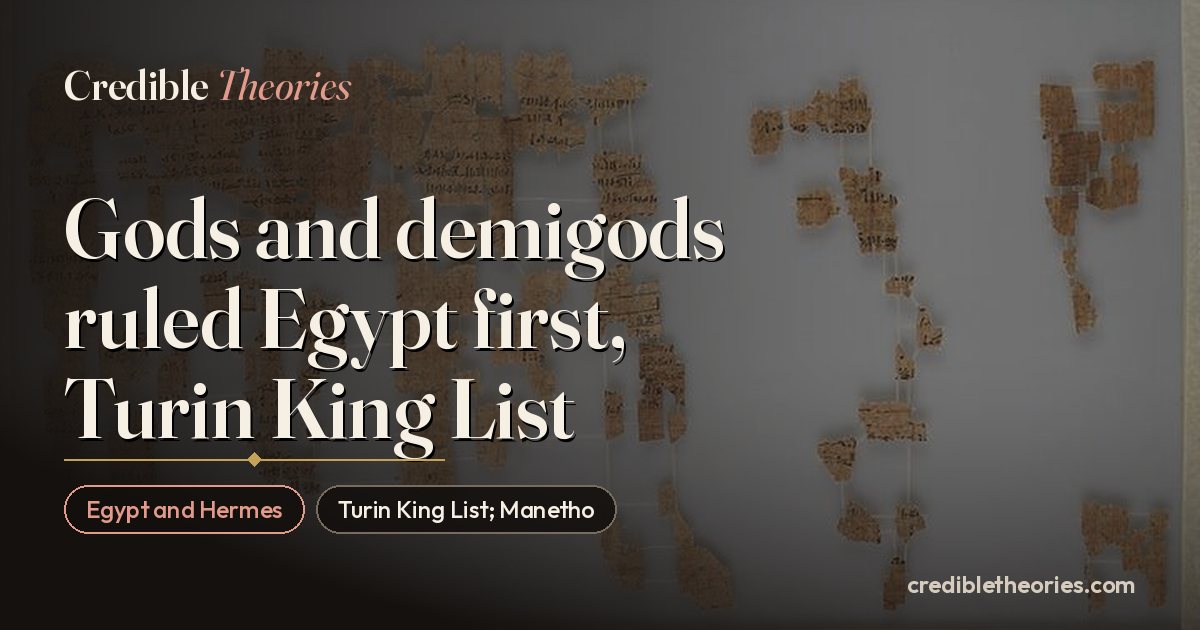
It is in the Museo Egizio, the Egyptian Museum in Turin, Italy. The papyrus was found at Luxor and brought to Turin in the 1820s, but it broke into many fragments on the way. Scholars from Champollion onward have tried to reassemble it. It is written in hieratic script, on the back of an old tax record.
How does the Turin King List compare with other Egyptian king lists?
The best-known rival is the Abydos King List, carved on a wall of the temple of Seti I. It names 76 kings but skips rulers later seen as illegitimate, such as the Hyksos and Akhenaten. The Turin papyrus is unusual because it gives reign lengths, often down to months and days, and includes many minor kings that other lists leave out.
Who was Menes, the first pharaoh?
Menes is the king Egyptian tradition named as the one who united Upper and Lower Egypt, around 3100 BCE. Historians often identify him with Narmer or with Hor-Aha, rulers known from early inscriptions. According to Manetho, Menes ruled for decades and was finally carried off and killed by a hippopotamus.
Used on these files
Berossus: The Babylonian Who Explained His World to the GreeksDocumentedBefore the Flood, ten kings ruled for 432,000 years, according to a Babylonian priest who wrote in Greek around 290 BCE. His flood hero was also ordered to bury written records of all things at Sippar and dig them up afterward; the book itself is lost. So how do we know any of this?
Manetho: Why Did Egypt's First Historian Begin With Gods?DocumentedEvery Egyptology textbook divides the pharaohs into thirty dynasties, and that scheme comes from a book nobody has read in full for well over a thousand years. Manetho, an Egyptian priest writing in Greek around 280 BCE, began with ages of gods and demigods. How do scholars rebuild a lost book from scraps?
Sumerian King List: Why Did Early Kings Reign for Millennia?DocumentedThe first eight kings in this cuneiform list reign for a combined 241,200 years, and one is credited with 43,200 years alone; kingship, it says, "descended from heaven" at Eridu, and later "the flood swept over." Historians read the numbers as symbols and the list as propaganda. Propaganda for whom?
Where this comes from
EvidenceDocumented
Comes fromThe Turin King List (Royal Canon of Turin), Turin King List; Manetho, read here in the I. P. Cory. A papyrus from the reign of Ramesses II, about 1250 BC, listing Egypt's rulers, starting with gods and spirits before the human kings. It reached Turin, Italy, from Egypt in the 1820s, broken into many pieces on the way, and is in the Museo Egizio there.
What this means
The text exists and is quoted from a published translation. What it describes is a separate question.
Primary records exist: an original document, a published text, an official file or a dated report. We link to them. This level says the record exists and what it says, not that every claim in it is true.
Cory's Ancient FragmentsA book by I. P. Cory, first published in 1826 and revised in 1832, that gathers quotations from lost ancient histories, such as those of Berossus of Babylon and Manetho of Egypt. The original books are gone; these quotes survive mainly through later Christian writers.I. P. Cory, Ancient Fragments (1832; 1876 ed.)Online copyPrimary textArchived copy, 2026-10-03
Berossus's History of Babylonia (Babyloniaca)A history of Babylon written in Greek by Berossus, a Babylonian priest, around 290 to 278 BC. It told of Oannes, a fish-man who taught people how to live in cities, and of ten kings before the Flood. The book is lost; only quotations by later writers survive.Berossus, fragments via Alexander Polyhistor, in I. P. Cory, Ancient Fragments (1832)Online copyPrimary text
Manetho's History of Egypt (Aegyptiaca)A history of Egypt written in Greek by Manetho, an Egyptian priest, in the early 200s BC. His grouping of the pharaohs into dynasties is still used today. The book itself is lost; it survives only in quotations by later writers such as Josephus.Manetho, Aegyptiaca fragments, trans. W. G. Waddell, Manetho (Loeb Classical Library, 1940)Primary text