How the rabbit hole works. Start with anything that grabs you, say UFOs. Every person, place and document a page mentions links to its own page, so a UFO file leads to a witness, the witness leads to the people who investigated the case, and it keeps going.
The path you take shows in the bar under the top menu on every page, so you can step back any time or climb out and start again.
This is a short passage from Psalms, a collection of 150 songs and prayers in the Bible, from a poem of David written around 900 to 600 BCE that also appears in 2 Samuel 22. It says God bent the heavens and came down, rode on a cherub, and flew on the wings of the wind. Scholars say this storm-god imagery also appears in poems about Baal.
ReferencePsalm 18:9–10 (also 2 Samuel 22)
Writtenc. 900–600 BCE
SetPoem of David
He bowed the heavens also, and came down: and darkness was under his feet. And he rode upon a cherub, and did fly: yea, he did fly upon the wings of the wind.
Documented · Ancient text, c. 900–600 BCE Translation: KJV
AdvertisementAd space
Read it literally
A cherub is something you ride. Vehicle, not only a being.
What scholars say
Storm-god imagery shared with Baal poems from Ugarit.
Almost the same poem appears as 2 Samuel 22, with only small differences in wording. Both are presented as a song David sang after God rescued him from his enemies and from Saul. Scholars think the poem circulated on its own and was placed in both books, making it a useful test case for comparing early copies of a text.
What does it mean that God rides a cherub?
In the Hebrew Bible, cherubim are linked with God's throne. Several passages call God the one enthroned between the cherubim, picturing the two golden figures on the Ark of the Covenant as his seat. Ezekiel 10 shows cherubim carrying God's throne-chariot. Riding a cherub fits this picture of a royal throne that moves through the sky.
How does Psalm 18 compare with Canaanite poems about Baal?
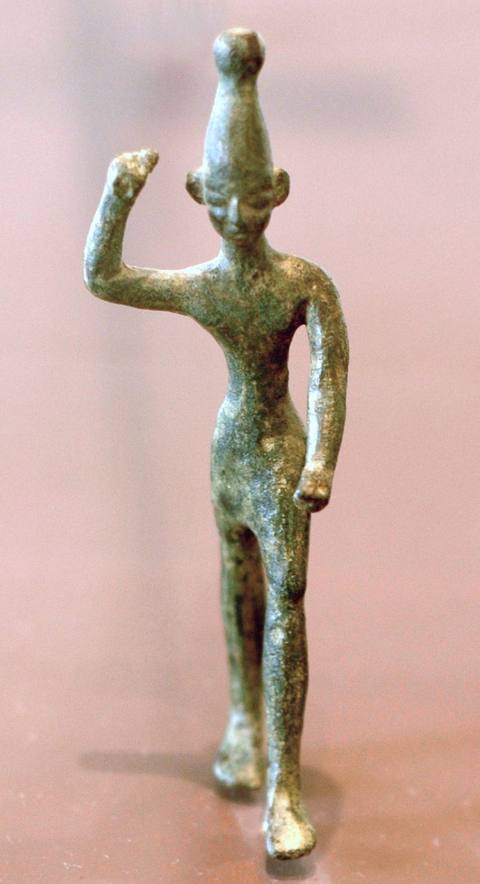
Clay tablets found from 1928 onward at Ras Shamra in Syria, the site of ancient Ugarit, call the storm god Baal the rider of the clouds. Psalm 68:4 uses a close match of that title for Israel's God. Scholars see Psalm 18's thunder, lightning, smoke and dark clouds as borrowed storm imagery applied to Yahweh.
Used on these files
Cherubim: What Did the Bible's Guardians Really Look Like?Myth or legendForget the chubby babies. The first angelic beings in the Bible are armed security, posted at the gate of Eden with a flaming sword that turned every way, to guard the road to the tree of life. Later, God is said to ride one. What were the cherubim really supposed to be?
Where this comes from
EvidenceDocumented
Comes fromThe Book of Psalms, Psalm 18:9–10 (also 2 Samuel 22), read here in the King James Version. A collection of 150 songs and prayers in the Bible, written over several centuries and long used in Jewish and Christian worship. Psalm 82 pictures God judging other 'gods' in a heavenly council.
What this means
The text exists and is quoted from a published translation. What it describes is a separate question.
Primary records exist: an original document, a published text, an official file or a dated report. We link to them. This level says the record exists and what it says, not that every claim in it is true.
The King James BibleThe English Bible made for King James I and first printed in 1611; the wording most people know comes from a 1769 update. It is out of copyright, which is why we quote it. The 1611 printing also had the Apocrypha, extra books kept in Catholic and Orthodox Bibles.King James Version (1611; standard 1769 text), with ApocryphaPrimary textArchived copy, 2026-10-03
The Book of GenesisThe first book of the Bible, telling of Creation, Adam and Eve, Noah's Flood and the families of Abraham, Isaac and Jacob. Scholars think it was written and edited over several centuries and finished by roughly 500 to 400 BC. The oldest surviving copies are pieces of the Dead Sea Scrolls.Genesis 3:24; Exodus 25:18–22, King James VersionOnline copyPrimary textArchived copy, 2026-10-03
Scholarly dates are rounded. The wording follows the named public-domain translation.
More from Hebrew Bible
Two more stories, and what each shares with He rode upon a cherub.













 Ugarit