How the rabbit hole works. Start with anything that grabs you, say UFOs. Every person, place and document a page mentions links to its own page, so a UFO file leads to a witness, the witness leads to the people who investigated the case, and it keeps going.
The path you take shows in the bar under the top menu on every page, so you can step back any time or climb out and start again.
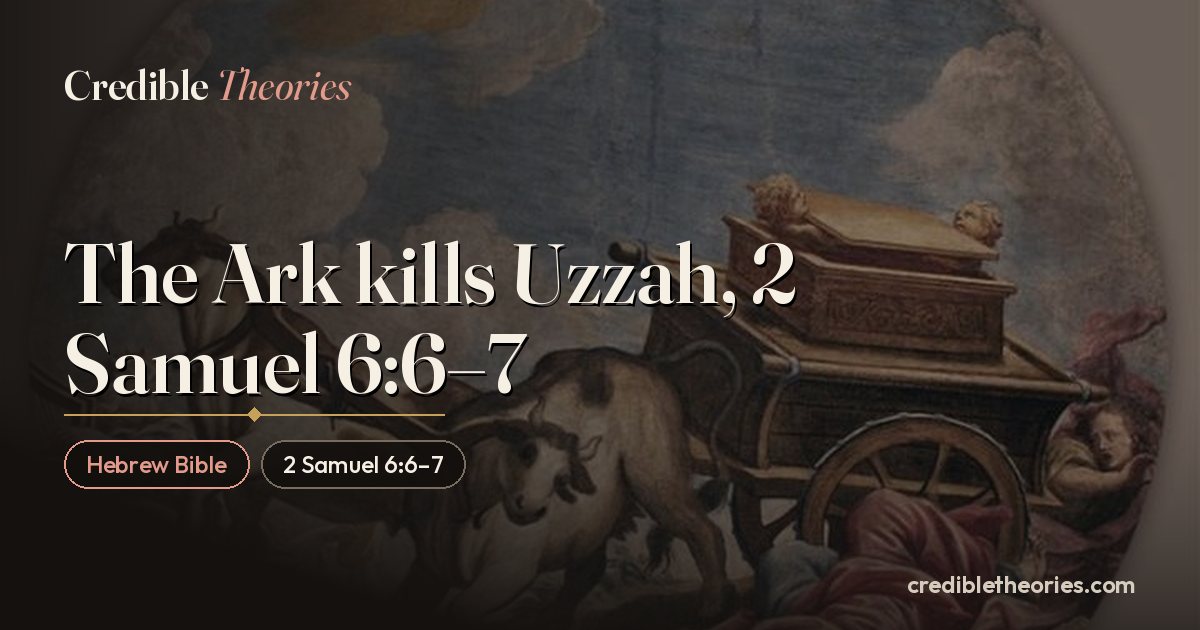
This is a short passage from 2 Samuel, a book of the Bible about King David, put together around 600 to 500 BCE. The Ark of the Covenant is a sacred box carried on poles. When the oxen shake it, a man named Uzzah takes hold of the Ark. The text says God was angry with him and struck him, and he died beside it.
Reference2 Samuel 6:6–7
Writtenc. 600–500 BCE
SetKing David, c. 1000 BCE
Uzzah put forth his hand to the ark of God, and took hold of it; for the oxen shook it. And the anger of the LORD was kindled against Uzzah; and God smote him there for his error; and there he died by the ark of God.
Documented · Ancient text, c. 600–500 BCE Translation: KJV
AdvertisementAd space
Read it literally
A gold-lined box that kills on contact, carried on poles, with special handling rules (Exodus 25). Also plagues the Philistines who capture it (1 Samuel 5). A device, not a relic.
What scholars say
Read as a story about ritual holiness and who may touch sacred objects.
Themes Looks like technology
Questions people ask about 2 Samuel 6:6–7
Where did the Ark go after Uzzah died?
David left it at the house of Obed-edom the Gittite, where it stayed three months. When David heard that God had blessed Obed-edom's whole household, he brought the Ark into Jerusalem with music and sacrifices, dancing before it. His wife Michal watched from a window and looked down on him for it.
Why did touching the Ark kill Uzzah?
Jewish and Christian readers often point to Numbers 4:15, which says only the Levite clan of Kohath may carry the holy objects, using poles, and must not touch them. Here the Ark rode on a new cart, as the Philistines had once sent it. In 1 Chronicles 15 David admits the Ark had not been carried the right way.
What does the place name Perez-uzzah mean?
David named the spot Perez-uzzah, meaning 'the breach' or 'outburst against Uzzah' (2 Samuel 6:8). The same story appears in 1 Chronicles 13, which calls the threshing floor where it happened Chidon instead of Nachon. David was angry and afraid after the death, which is why he stopped the journey.
Used on these files
Ark of the Covenant: Where Did It Go, and Why Did It Kill?Myth or legendBuilt to the exact measurements in Exodus and covered in gold, this chest could kill. When oxen stumbled and a man reached out to steady it, he was struck dead on the spot; one claim places it at Aksum, in Ethiopia. The only outside scholar known to have seen the object there called it an empty wooden box.
Uzzah: Why Did Touching the Ark of the Covenant Kill Him?Myth or legendThe Ark of the Covenant was rolling to Jerusalem when the oxen stumbled and Uzzah reached out to steady it. The text says he died on the spot. King David was so shaken he refused to take the Ark home and left it with a stranger for three months, just to see what would happen to him. Why?
Where this comes from
EvidenceDocumented
Comes fromThe Books of Samuel (1 and 2 Samuel), 2 Samuel 6:6–7, read here in the King James Version. Two books of the Bible about the prophet Samuel, King Saul and King David, including David and Goliath and the travels of the Ark of the Covenant. Scholars think they were put together from older sources in about the 600s to 500s BC.
What this means
The text exists and is quoted from a published translation. What it describes is a separate question.
Primary records exist: an original document, a published text, an official file or a dated report. We link to them. This level says the record exists and what it says, not that every claim in it is true.
The King James BibleThe English Bible made for King James I and first printed in 1611; the wording most people know comes from a 1769 update. It is out of copyright, which is why we quote it. The 1611 printing also had the Apocrypha, extra books kept in Catholic and Orthodox Bibles.King James Version (1611; standard 1769 text), with ApocryphaPrimary textArchived copy, 2026-10-03
The Book of ExodusThe second book of the Bible. It tells how Moses led the Israelites out of slavery in Egypt, how God gave the law at Mount Sinai, and how the Ark of the Covenant was made. Scholars think it reached its final form by roughly 500 to 400 BC.Exodus 25:10–22, King James VersionOnline copyPrimary textArchived copy, 2026-10-03
The Books of Samuel (1 and 2 Samuel)Two books of the Bible about the prophet Samuel, King Saul and King David, including David and Goliath and the travels of the Ark of the Covenant. Scholars think they were put together from older sources in about the 600s to 500s BC.2 Samuel 6:1–11, King James VersionOnline copyPrimary textArchived copy, 2026-10-03
Scholarly dates are rounded. The wording follows the named public-domain translation.
More from Hebrew Bible
The story before and after this one, and what each shares with The Ark kills Uzzah.