Credible Theories Sign in
The Americas · Pedro Cieza de León, Chronicle of Peru, part 1, chapter 105

Stones too fine for the tools of his day, Pedro Cieza de León, Chronicle of Peru, part 1, chapter 105

Share

In plain words

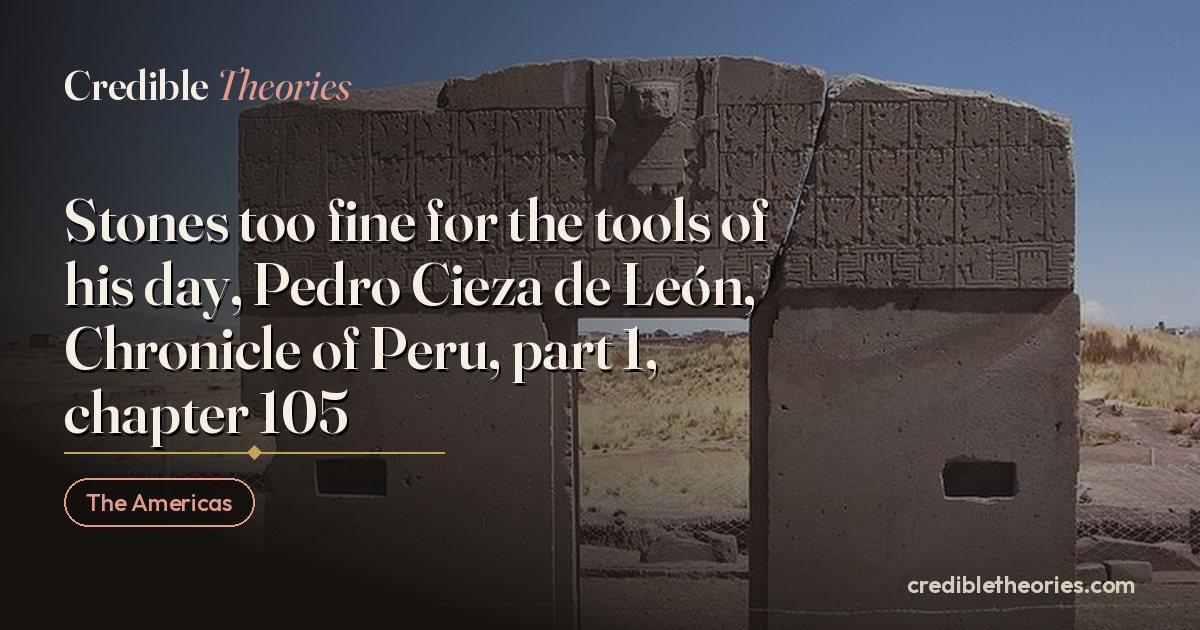
Pedro Cieza de León visited the ruins of Tiahuanaco, near Lake Titicaca, and wrote down what he saw; his chronicle was printed at Seville in 1553. He describes a doorway, with its jambs and lintel, cut from one single stone. He says he cannot understand what tools could have shaped such stones, and that they must have been better than the tools used by the people living there in his day.

ReferencePedro Cieza de León, Chronicle of Peru, part 1, chapter 105
WrittenPrinted at Seville in 1553, from notes Cieza made in Peru before he left in 1550
SetThe ruins of Tiahuanaco, near Lake Titicaca
The whole of this, with the doorway and its jambs and lintel, was all one single stone. The work is one of grandeur and magnificence, when well considered. For myself I fail to understand with what instruments or tools it can have been done; for it is very certain that before these great stones could be brought to perfection and left as we see them, the tools must have been much better than those now used by the Indians.

Documented · Early modern text, 1553 Translation: Clements R. Markham, 1864

Read it literally

One of the earliest written descriptions of the Tiwanaku stonework, and an early question about how it was cut. On the same page Cieza says the statues there were so large "they seem like small giants", and that the buildings looked unfinished.

What scholars say

An eyewitness account: Cieza says he wandered over the ruins writing down what he saw.
Themes Looks like technology Giants and hybrids
People and places herePedro Cieza de LeonTiwanaku

Questions people ask about Pedro Cieza de León, Chronicle of Peru, part 1, chapter 105

Why was Cieza at Tiahuanaco?

In 1549 he travelled to the silver province of Charcas, his translator Clements Markham says, with letters of introduction from President Gasca himself. Along Lake Titicaca he stopped to note what he learned about the local peoples, then visited the silver mines of Porco and Potosi.

How big were the stones he describes?

Cieza gives some of the slabs as thirty feet broad, fifteen or more long and six in thickness. In a footnote Markham adds that the Jesuit writer José de Acosta measured one stone at 38 feet long, 18 broad and 6 deep.

What happened to Cieza after Peru?

He finished his notes at Lima on 8 September 1550 and sailed for Spain after seventeen years in the Indies. Only the first part of his planned work came out in his lifetime, and he died around 1560.

Where this comes from

EvidenceDocumented

Comes from Clements R. Markham, Pedro Cieza de León, Chronicle of Peru, part 1, chapter 105. Internet Archive: A nonprofit digital library in San Francisco, founded in 1996, that holds millions of scanned books, papers and recordings. A scan there shows the pages of a real printed book or document.

What this means

The text exists and is quoted from a published translation. What it describes is a separate question.

Primary records exist: an original document, a published text, an official file or a dated report. We link to them. This level says the record exists and what it says, not that every claim in it is true.

See all five labels

Sources

  1. Internet ArchiveA nonprofit digital library in San Francisco, founded in 1996, that holds millions of scanned books, papers and recordings. A scan there shows the pages of a real printed book or document.Clements R. Markham, The Travels of Pedro de Cieza de León, A.D. 1532-50 (Hakluyt Society, 1864)Primary text

Scholarly dates are rounded. The wording follows the named public-domain translation.

More from The Americas

Two more stories, and what each shares with Stones too fine for the tools of his day.

Photo credits
‹ Before thisFour worlds destroyed, humans made from old bonesLegend of the Suns (Leyenda de los Soles)

It says four earlier worlds ended by jaguars, wind, a rain of fire and a flood.

Same theme: Looks like technology
Photo credits
RelatedOg's iron bedDeuteronomy 3:11

It says Og, king of Bashan, was the last of the giants.

Same theme: Looks like technologySame theme: Giants and hybrids

Updated

Discussion