How the rabbit hole works. Start with anything that grabs you, say UFOs. Every person, place and document a page mentions links to its own page, so a UFO file leads to a witness, the witness leads to the people who investigated the case, and it keeps going.
The path you take shows in the bar under the top menu on every page, so you can step back any time or climb out and start again.
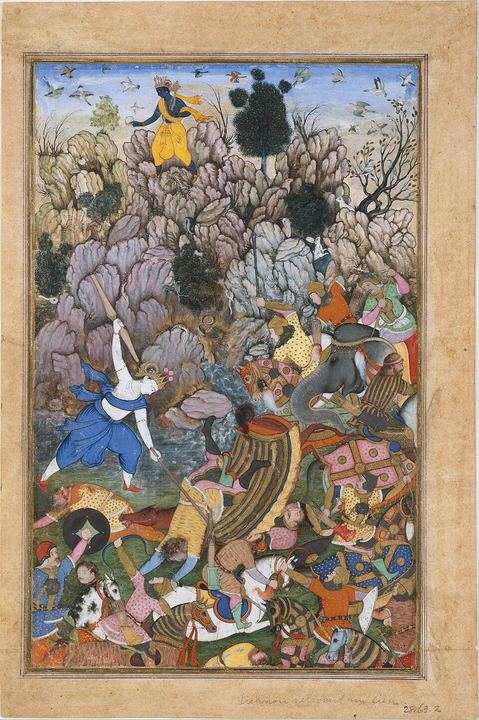
This is a summary from the Mahabharata, one of the two great Sanskrit epics of India, written around 400 BCE to 400 CE. At the end of a great war, two warriors fire a powerful weapon called the Brahmashira at each other. Wise men warn it would burn the world, so one sends his into the wombs of his enemies' women instead.
ReferenceMahabharata, Sauptika Parva
Writtenc. 400 BCE–400 CE
SetEnd of the Kurukshetra war
Ashvatthama launches the Brahmashira weapon. Arjuna answers with his own. The sages beg them to withdraw, because the clash would burn the world. Ashvatthama cannot recall his, so he redirects it into the wombs of the Pandava women; Krishna revives the stillborn Parikshit.
Documented · Retold in English, c. 400 BCE Summary by the editors. Translation: Summary in my own words
AdvertisementAd space
Read it literally
A weapon that cannot be recalled once fired and harms unborn children. Readers today hear radiation in that.
Questions people ask about Mahabharata, Sauptika Parva
Which part of the Mahabharata tells this story?
It comes from the Sauptika Parva, the tenth of the epic's eighteen books. Its name means 'Book of the Sleeping Warriors', because Ashvatthama raids the Pandava camp at night and kills Draupadi's sons and the commander Dhrishtadyumna in their sleep. He wanted revenge for the death of his father Drona, who had been tricked into laying down his arms.
What does Brahmashira mean?
The name means 'Brahma's head'. It is described as a divine weapon called up with a sacred formula, not a built device. Both Ashvatthama and Arjuna learned it from Drona, who was Ashvatthama's father and Arjuna's teacher. In the story Ashvatthama releases it from a simple blade of grass.
What happened to Ashvatthama after he fired the weapon?
Krishna curses him to roam the earth for three thousand years, sick, alone and with no one willing to speak to him. Ashvatthama must also hand over the jewel he wore on his forehead, which is given to Draupadi. Hindu tradition counts him among the chiranjivi, beings said to live until the end of this age.
Used on these files
Brahmashira: Was the Mahabharata's Weapon an Ancient Nuke?Myth or legendOnce fired, this weapon in the Mahabharata cannot be recalled, and it was turned against the unborn. When two heroes launch theirs at each other, sages step between them, warning that the clash would destroy the world; only one can call his back, and the one who cannot is cursed to live three thousand years. Who gets the curse?
Where this comes from
EvidenceDocumented
Comes fromThe Mahabharata, Mahabharata, Sauptika Parva. One of the two great Sanskrit epics of India, about a war between two branches of a royal family. With about 100,000 verses it is one of the longest poems ever made.
What this means
The text exists and is quoted from a published translation. What it describes is a separate question.
Primary records exist: an original document, a published text, an official file or a dated report. We link to them. This level says the record exists and what it says, not that every claim in it is true.
The MahabharataOne of the two great Sanskrit epics of India, about a war between two branches of a royal family. With about 100,000 verses it is one of the longest poems ever made. It was mostly put together between about 300 BC and AD 300. Kisari Mohan Ganguli made the first full English version, 1883 to 1896.The Mahabharata, trans. Kisari Mohan Ganguli (1883–1896)Online copyPrimary textArchived copy, 2026-10-03
Scholarly dates are rounded. The wording follows the named public-domain translation.
More from India
Two more stories, and what each shares with The Brahmashira burns the unborn.