












What is Krishna known for?
Krishna is one of the most widely worshipped Hindu gods, honored as the eighth avatar of Vishnu and, in some traditions, as the supreme god himself. Stories of his childhood among cowherds in Vrindavan appear in the Harivamsa and the Bhagavata Purana.
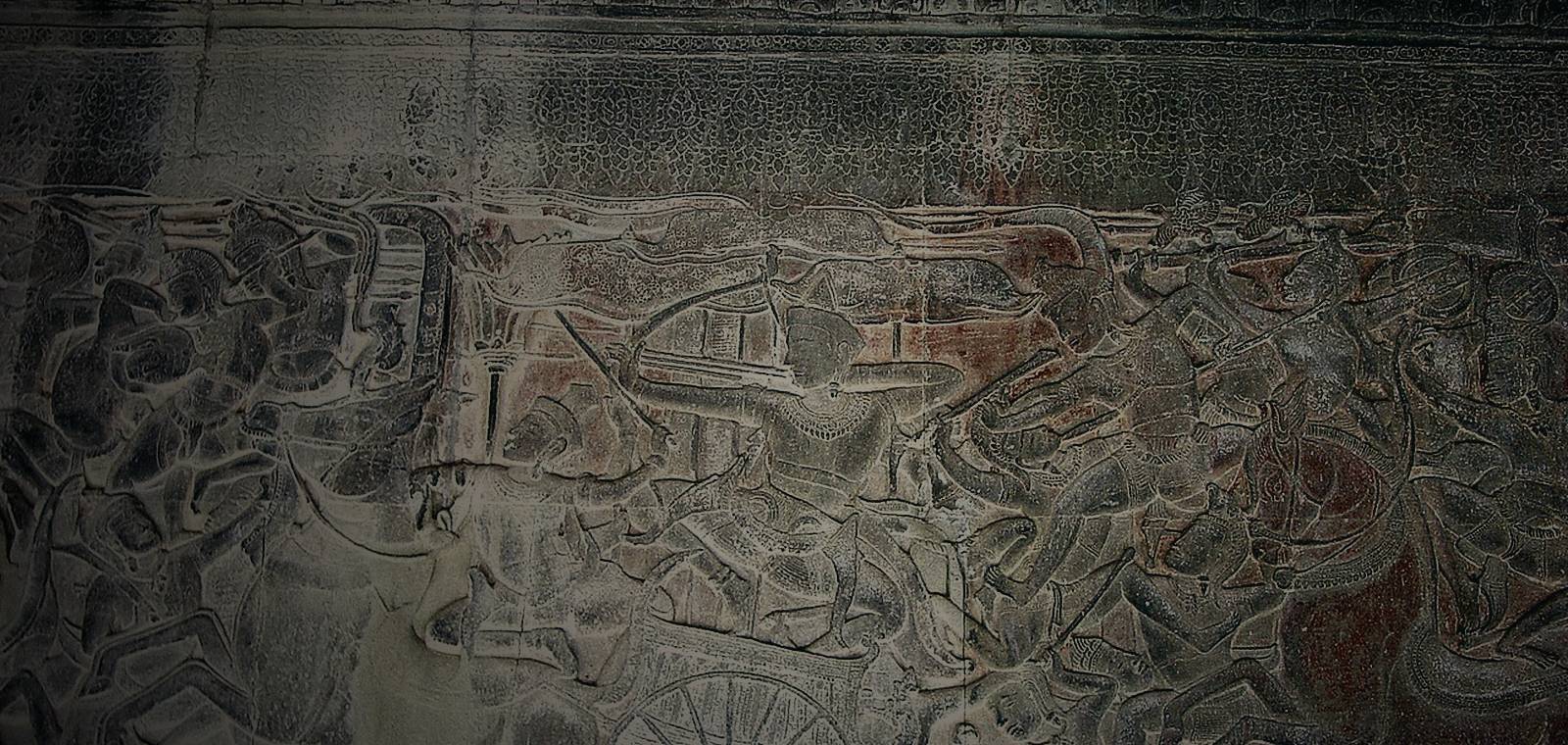
In the Mahabharata he is the cousin and ally of the Pandava brothers. He serves as Arjuna's charioteer at the battle of Kurukshetra, and their conversation before the battle is the Bhagavad Gita. He rules from the city of Dvaraka, which the epic says the sea swallowed after his death.
The Hindu tradition counts his death as the start of the Kali Yuga, the present age. On this site he appears in the Mahabharata stories of divine weapons, the flying city of Saubha, and Dvaraka's flooding.
Titles and honors
- Titles
- Eighth avatar of Vishnu (in Hindu tradition)
- Svayam Bhagavan in Krishnaism and Vaishnavism
The same story, told elsewhere
Shared story · Births
Born of a Virgin or a God: Miraculous Births Compared
Jesus is not the only hero said to be born of a maiden and a god. Rome, India, Greece and Persia tell it too, and Egypt and India tell the births of Horus and Krishna in their own ways.
Vishnu Purana, Book V (the birth of Krishna) is one telling. The same story is told 8 more times, in 4 parts of the world. Follow it:
- Hebrew BibleJerusalem, Kingdom of Judah · c. 740-700 BCE · Ancient text
- HinduNorthern India · c. 400 BCE · Ancient text
- GreekArgos, Greece · c. 1st-2nd century CE · Ancient text
- ChristianWritten in Greek, probably in Syria or Galilee · c. 80-90 CE · Ancient text
- RomanAlba Longa and Rome, Italy · c. 100 CE · Ancient text
- BuddhistLumbini, Nepal · c. 100 CE · Ancient text
- EgyptianEgypt · c. 100 CE · Ancient text
- HinduMathura and Gokula, northern India · first millennium CE · Medieval textTied to this page
- ZoroastrianIran · 9th century CE · Medieval text
The open question: Why do so many traditions give their great figures a birth unlike anyone else's? A shared pattern, or each people's own way of saying "this one is special"? Join the debate
Shared story · Death and return
Gods Who Die and Return: Osiris, Adonis, Persephone, Baldr and Jesus
A god dies, the land mourns, and the god comes back, at least for a season. Egypt, Syria, Greece and Scandinavia all tell it. How close are these stories to Easter, and how close are they really to each other?
Mahabharata, Mausala Parva (the death of Krishna) is one telling. The same story is told 7 more times, in 5 parts of the world. Follow it:
- GreekGreece · c. 650-550 BCE · Ancient text
- Mesopotamian (seen in Jerusalem)Jerusalem temple, seen in a vision · c. 593-571 BCE · Ancient text
- HinduDvaraka, western India · c. 400 BCE · Ancient textTied to this page
- ChristianWritten in Greek from Ephesus to Corinth · c. 53-55 CE · Ancient text
- EgyptianEgypt · c. 100 CE · Ancient text
- RomanRome · c. 100 CE · Ancient text
- Phoenician / SyrianByblos, Lebanon · c. 150 CE · Ancient text
- NorseIceland · c. 1220 CE · Medieval text
The open question: Is the death-and-return story one pattern across the ancient world, or are the stories too different to group together? Scholars still argue, so where do you land? Join the debate
Shared story · Death and return
Taken Up to Heaven: Ascension Stories Compared
Enoch, Elijah, Romulus, Heracles, Krishna and Jesus all leave the earth by going up: in a whirlwind, a cloud, a storm or a blaze of light. The stories quoted side by side.
Mahabharata, Mausala Parva (the end of Krishna) is one telling. The same story is told 6 more times, in 3 parts of the world. Follow it:
- Hebrew BibleJudah · c. 600-400 BCE · Ancient text
- Hebrew BibleNear the Jordan River, Israel · c. 600-550 BCE · Ancient text
- HinduDvaraka, western India · c. 400 BCE · Ancient textTied to this page
- GreekMount Oeta, central Greece · c. 1st-2nd century CE · Ancient text
- ChristianMount of Olives, Jerusalem · c. 80-90 CE · Ancient text
- RomanRome, near the Goat's Marsh · c. 100 CE · Ancient text
- IslamicMecca to Jerusalem · c. 620 CE · Medieval text
The open question: Why do so many stories end with a great figure leaving the earth alive instead of dying like everyone else? Join the debate
Shared story · Floods and lost lands
Lost Lands Under the Sea: Atlantis, Dvaraka and Ys
A rich city, a proud people and one terrible day when the sea comes in and never leaves. Greece, India, Egypt, Wales, Cornwall and Brittany all tell of a land that now lies under the waves.
Mahabharata, Mausala Parva (the end of Dvaraka) is one telling. The same story is told 8 more times, in 4 parts of the world. Follow it:
- Ancient EgyptianEgypt · c. 1900-1800 BCE · Ancient text
- Hindu (Sanskrit epic)Dvaraka · c. 400 BCE · Ancient textTied to this page
- Greek, retold in a Roman-era geographyHelike, on the Gulf of Corinth, Greece · 373 BCE · Ancient text
- GreekAthens · c. 360 BCE · Ancient text
- Tamil (South India)Tamil Nadu, southern tip of India · c. 5th-6th century CE · Ancient text
- WelshCardigan Bay, Wales · c. 1250 CE · Medieval text
- BretonBay of Douarnenez, Brittany, France · 15th century · Retold in English
- CornishBetween Land's End and the Isles of Scilly, Cornwall, England · c. 1478 · Medieval text
- Modern science (19th-century Europe)Germany and Britain · 1864 · Modern book
The open question: Do these stories keep real memories of lost coastlines, or is a drowned city simply a story people tell to warn against pride? Join the debate
Shared story · Death and return
The King Who Will Return: Arthur, Barbarossa and Kalki
He did not die. He sleeps inside a mountain, under a castle or on a far island, and when his people need him most he will wake. Britain, Germany, Denmark, Persia, India, Israel and Mexico all tell of a hero who is only waiting.
Vishnu Purana, Book IV, chapter 24 (the coming of Kalki) is one telling. The same story is told 7 more times, in 4 parts of the world. Follow it:
- Hebrew BibleIsrael and Judah · c. 600-550 BCE · Ancient text
- Hindu (Puranic)India · c. 300-500 CE · Ancient textTied to this page
- Zoroastrian (Persian)Iran · c. 9th century CE · Medieval text
- DanishKronborg castle, Helsingør · c. 1100 · Medieval text
- English (Anglo-Norman chronicle)Malmesbury Abbey, England · c. 1125 CE · Medieval text
- GermanKyffhäuser hills, Thuringia, Germany · 13th century · Retold in English
- English (Arthurian romance)England · c. 1470 · Medieval text
- Aztec (Nahua), as told by Spanish chroniclersCentral Mexico and the Gulf coast · c. 1550-1580 · Retold in English
The open question: Is the sleeping king a hope people invent whenever they lose a leader they loved, or one very old idea that has travelled from land to land? Join the debate
Shared story · Death and return
Sleepers Who Wake Years Later: Epimenides, Honi, the Seven Sleepers and Rip Van Winkle
A man lies down for a nap and wakes to find his brother old, his village gone and his coins worth nothing. The same story is told in Crete, Judea, Ephesus, Arabia, India, Japan, Ireland and New York.
Vishnu Purana (King Muchukunda sleeps in a cave) is one telling. The same story is told 8 more times, in 6 parts of the world. Follow it:
- GreekCrete · c. 200-250 CE · Ancient text
- Hindu (Puranic)India · c. 300-500 CE · Ancient textTied to this page
- Jewish (Babylonian Talmud)Judea · c. 500-600 CE · Medieval text
- Christian (Seven Sleepers of Ephesus)Ephesus · c. 500 CE · Medieval text
- IslamArabia · 7th century CE · Medieval text
- IslamArabia · 7th century CE · Medieval text
- JapaneseJapan · c. 759 CE · Medieval text
- IrishIreland · c. 1750 · Early modern text
- AmericanCatskill Mountains, New York · 1819 · Recorded folklore
The open question: Is the long sleep a story people passed along from Crete to Ephesus to New York, or does every culture invent it because everyone fears coming home to a world that has moved on? Join the debate
Mentioned on these pages
- FileBrahmashira
- FileKakudmi and Revati
- FileKali Yuga
- FileSaubha, the flying city
- PassageSaubha, the flying city (Mahabharata, Vana Parva)
- PassageThe Brahmashira burns the unborn (Mahabharata, Sauptika Parva)
- PersonArjuna
- PersonAshvatthama
- PersonBalarama
- PersonJ. Robert Oppenheimer
- PersonKing Salva (Shalva)
- PersonPandavas
- PersonParikshit
- PersonVyasa
- PersonYudhishthira
- PlaceDwaraka
- PlaceKurukshetra
Linked people and places
Where this comes from
Comes from The Mahabharata, trans. Kisari Mohan Ganguli (1883–1896). One of the two great Sanskrit epics of India, about a war between two branches of a royal family. With about 100,000 verses it is one of the longest poems ever made.
What this means
A story or tradition. It is documented as a story; nothing independent shows it happened.
Krishna is known from stories, scripture or tradition. The texts are real and we quote them (for example The Mahabharata, trans. Kisari Mohan Ganguli (1883–1896)), but nothing outside those texts shows that Krishna was real as described.
The page covers something known from myths, scripture or tradition. The texts are real and we quote them, but no independent record shows the events or beings were real.
Sources
- Encyclopaedia BritannicaAn encyclopedia first published in Scotland in 1768 and now online. Its articles are written and checked by named experts and editors, which makes it a reliable source for basic facts.Encyclopaedia Britannica, 'Krishna'Reference
- The MahabharataOne of the two great Sanskrit epics of India, about a war between two branches of a royal family. With about 100,000 verses it is one of the longest poems ever made. It was mostly put together between about 300 BC and AD 300. Kisari Mohan Ganguli made the first full English version, 1883 to 1896.The Mahabharata, trans. Kisari Mohan Ganguli (1883–1896) Online copyPrimary text Archived copy, 2026-10-03
- WikipediaA free online encyclopedia written and edited by volunteers. It is a good starting point and usually lists its own sources, but anyone can change it, so we treat it as a guide to better sources, not the final word.Wikipedia, 'Krishna'Reference
No public-domain picture of this person yet. We do not show drawn or generated likenesses.