Credible Theories Sign in
Egypt and Hermes · Sphinx Stela of Thutmose IV, lines 9 to 10

The statue that asked for the sand to be cleared, Sphinx Stela of Thutmose IV, lines 9 to 10

Share

In plain words

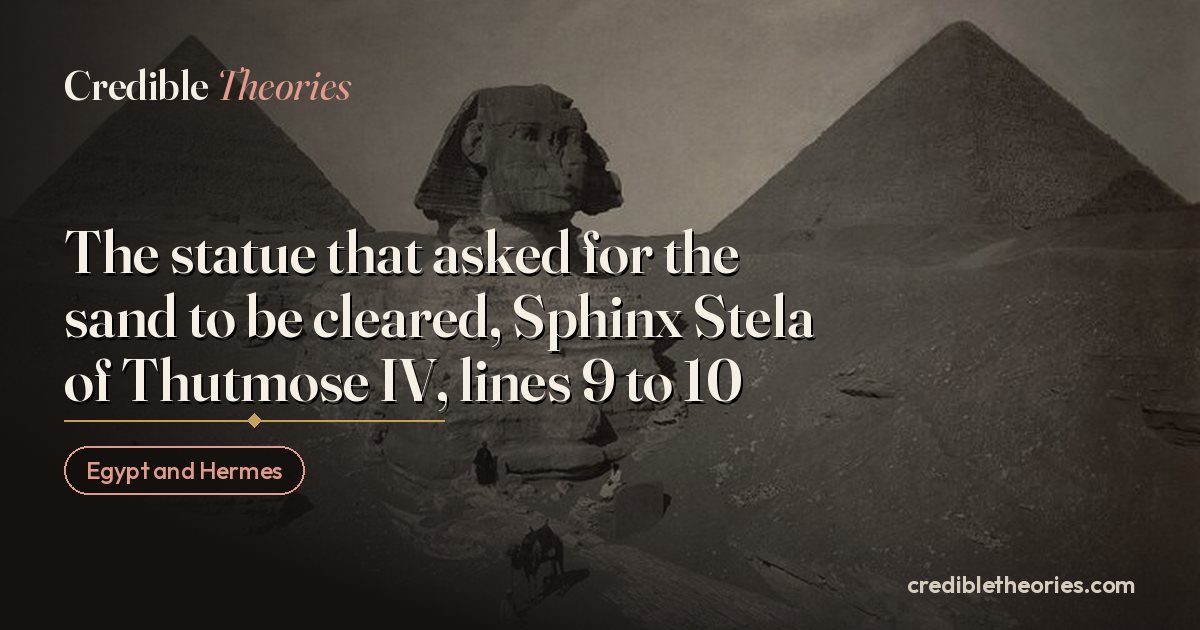
A tablet between the paws of the Great Sphinx names King Thutmose IV and tells a story from his youth. Out hunting, the prince slept at noon in the Sphinx's shadow and dreamed that the god spoke to him like a father to a son. The god promised him the white crown and the red crown and the throne of the land.

ReferenceSphinx Stela of Thutmose IV, lines 9 to 10
WrittenCarved on a granite tablet between the Sphinx's paws; it names Thutmose IV (about 1400 BCE), but Breasted and Erman judge it a later restoration
SetGiza, in the shadow of the Great Sphinx, at noon
Behold thou me! See thou me! my son Thutmose. I am thy father, Harmakhis-Khepri-Re-Atum, who will give to thee my kingdom on earth at the head of the living. Thou shalt wear the white crown and the red crown upon the throne of Keb, the hereditary prince.

Documented · Ancient text, 1400 BCE Translation: James Henry Breasted, 1906

Read it literally

The god of the Sphinx speaks to a sleeping prince, promises him the throne and then complains that the desert sand has reached him. It is the oldest text found at the Sphinx, and the Great Sphinx file sets it beside Pliny's description.

What scholars say

The stone names Thutmose IV, but Breasted and Erman read it as a later restoration in the form of a folk-tale.

Themes Council of gods
People and places herePliny the Elder
Questions people ask about Sphinx Stela of Thutmose IV, lines 9 to 10

Where is the Dream Stela now?

It still stands between the front paws of the Great Sphinx at Giza, where Giovanni Caviglia uncovered it in 1818. It is about 11 feet 10 inches high and 7 feet 2 inches wide.

Is the Dream Stela really from Thutmose IV's time?

Breasted and Erman doubted it. They pointed to spelling mistakes and oddities not expected in a royal monument, and Erman dated the present text centuries later, while Spiegelberg argued it could be an early copy repaired after damage.

Used on these files

  • The Great Sphinx of Giza DocumentedA lion with a human head, carved out of the living rock beside the pyramids. A granite tablet between its paws tells how the sand had buried it and how it spoke to a sleeping prince.

Where this comes from

EvidenceDocumented

Comes from James Henry Breasted, Sphinx Stela of Thutmose IV, lines 9 to 10. Internet Archive: A nonprofit digital library in San Francisco, founded in 1996, that holds millions of scanned books, papers and recordings. A scan there shows the pages of a real printed book or document.

What this means

The text exists and is quoted from a published translation. What it describes is a separate question.

Primary records exist: an original document, a published text, an official file or a dated report. We link to them. This level says the record exists and what it says, not that every claim in it is true.

See all five labels

Sources

  1. Internet ArchiveA nonprofit digital library in San Francisco, founded in 1996, that holds millions of scanned books, papers and recordings. A scan there shows the pages of a real printed book or document.James Henry Breasted, Ancient Records of Egypt, vol. 2 (University of Chicago Press, 1906)Primary text
  2. Internet ArchiveJames Henry Breasted, Ancient Records of Egypt, vol. 2 (University of Chicago Press, 1906), sections 810-815, the Sphinx Stela of Thutmose IVPrimary text

Scholarly dates are rounded. The wording follows the named public-domain translation.

More from Egypt and Hermes

Two more stories, and what each shares with The statue that asked for the sand to be cleared.

Photo credits
‹ Before thisThe Emerald Tablets of Thoth the AtlanteanDoreal, 'The Emerald Tablets of Thoth-the-Atlantean'

It claims Thoth, a priest-king of Atlantis, escaped its sinking, built the Great Pyramid, and wrote thirteen emerald tablets.

Also about Giza and the Great Pyramid
Photo credits
RelatedOfferings wrapped in wheat strawHerodotus, Histories 4.33

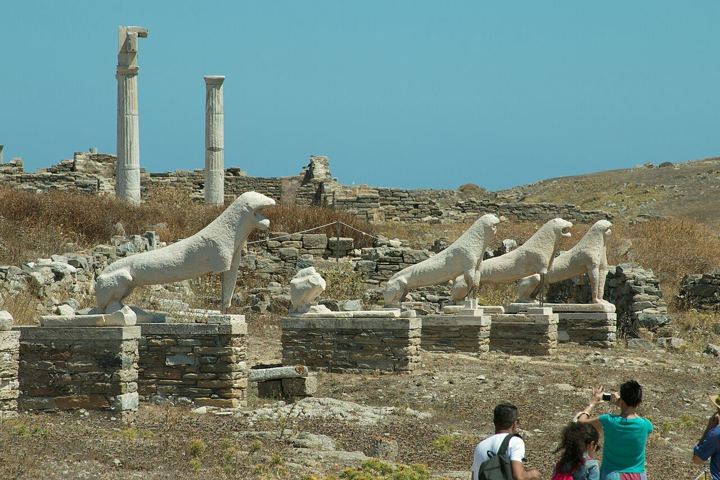
The Delians told Herodotus that offerings wrapped in wheat straw came from the Hyperboreans.

Also about Pliny the ElderSame theme: Council of gods

Updated

Discussion