Credible Theories Sign in
Hebrew Bible · Daniel 7:9–10

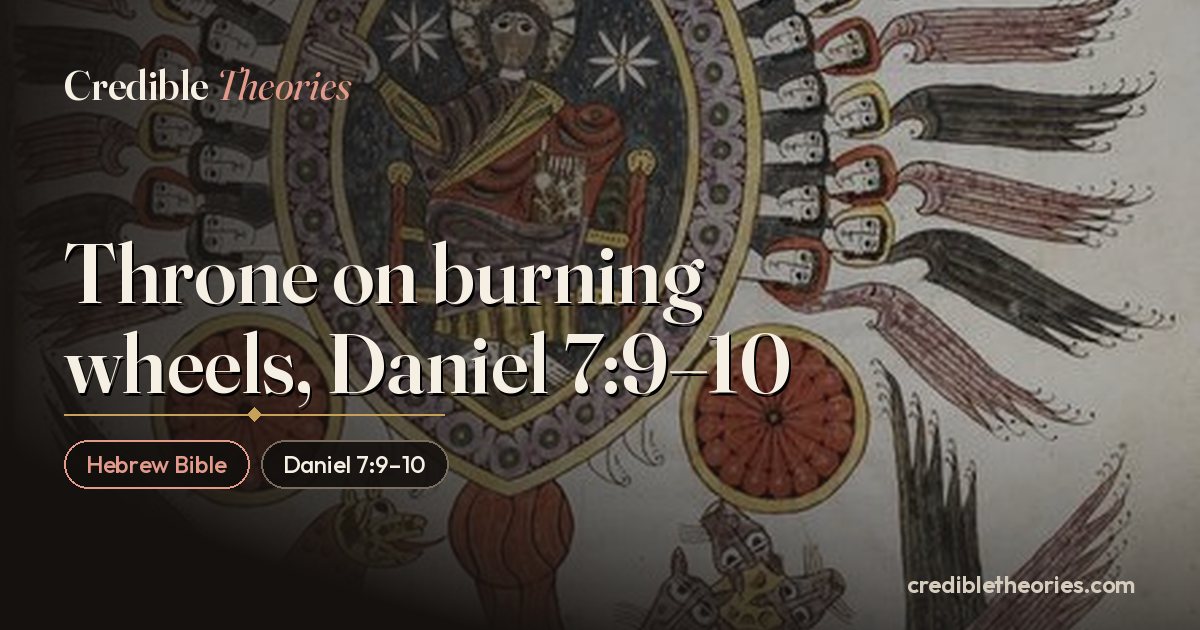
Throne on burning wheels, Daniel 7:9–10

Share

In plain words

This is a short passage from Daniel, a book of the Bible with visions of angels and future kingdoms, probably written around 165 BCE. In a vision, a throne appears like fiery flame, with wheels of burning fire. A stream of fire flows out in front of it, and thousands upon thousands serve the one seated there. Scholars read it as a vision about the future.

ReferenceDaniel 7:9–10
Writtenc. 165 BCE
SetBabylonian era
His throne was like the fiery flame, and his wheels as burning fire. A fiery stream issued and came forth from before him: thousand thousands ministered unto him.

Documented · Ancient text, c. 165 BCE Translation: KJV

Read it literally

A mobile throne with wheels, and a crew of a million.

What scholars say

Apocalyptic vision.

Themes Looks like technology From the sky
Questions people ask about Daniel 7:9–10

Who is the Ancient of Days in Daniel 7?

The Ancient of Days is a title for God seated as judge, with clothing white as snow. After the court sits, 'one like the Son of man' comes with the clouds of heaven and receives a kingdom that will never end. Christians see Jesus in this figure, and Jesus uses the phrase in the Gospels. Jewish readers have seen the Messiah or the faithful people of Israel.

What do the four beasts in Daniel 7 stand for?

Daniel sees a lion with eagle's wings, a bear, a leopard with four heads, and a terrifying beast with iron teeth and ten horns. The chapter says they are four kingdoms. Many modern scholars read them as Babylon, Media, Persia and the Greek empires, with the little horn as King Antiochus IV. Many Christian readers instead count Medo-Persia as one and make Rome the fourth.

Why is part of Daniel written in Aramaic?

Daniel 2:4 through 7:28 is written in Aramaic, while the rest of the book is in Hebrew. Scholars still debate why. In the Jewish Bible, Daniel sits among the Writings rather than the Prophets. Catholic and Orthodox Bibles include extra stories in Greek, such as Susanna and Bel and the Dragon.

Where this comes from

EvidenceDocumented

Comes from The Book of Daniel, Daniel 7:9–10, read here in the King James Version. A book of the Bible about Daniel, a Jewish captive at the court of Babylon, with stories such as the lions' den and visions of angels and future kingdoms. It is set in the 500s BC, but most scholars think the visions were written around 165 BC.

What this means

The text exists and is quoted from a published translation. What it describes is a separate question.

Primary records exist: an original document, a published text, an official file or a dated report. We link to them. This level says the record exists and what it says, not that every claim in it is true.

See all five labels

Sources

  1. The King James BibleThe English Bible made for King James I and first printed in 1611; the wording most people know comes from a 1769 update. It is out of copyright, which is why we quote it. The 1611 printing also had the Apocrypha, extra books kept in Catholic and Orthodox Bibles.King James Version (1611; standard 1769 text), with ApocryphaPrimary text Archived copy, 2026-10-03

Scholarly dates are rounded. The wording follows the named public-domain translation.

More from Hebrew Bible

The story before and after this one, and what each shares with Throne on burning wheels.

Photo credits
‹ Before thisThe Watchers in DanielDaniel 4:13, 17

In a story about King Nebuchadnezzar, "a watcher and an holy one" comes down from heaven, and a matter is settled "by the decree of the watchers." The word for watcher is the same one 1 Enoch uses for the fallen angels.

Also about DanielSame theme: From the sky
Photo credits
Next ›The prince of PersiaDaniel 10:5–6, 13

A being appears whose face looks like lightning and whose eyes are like lamps of fire.

Also about DanielSame theme: From the sky

Updated

Discussion