The Den in the Ravine
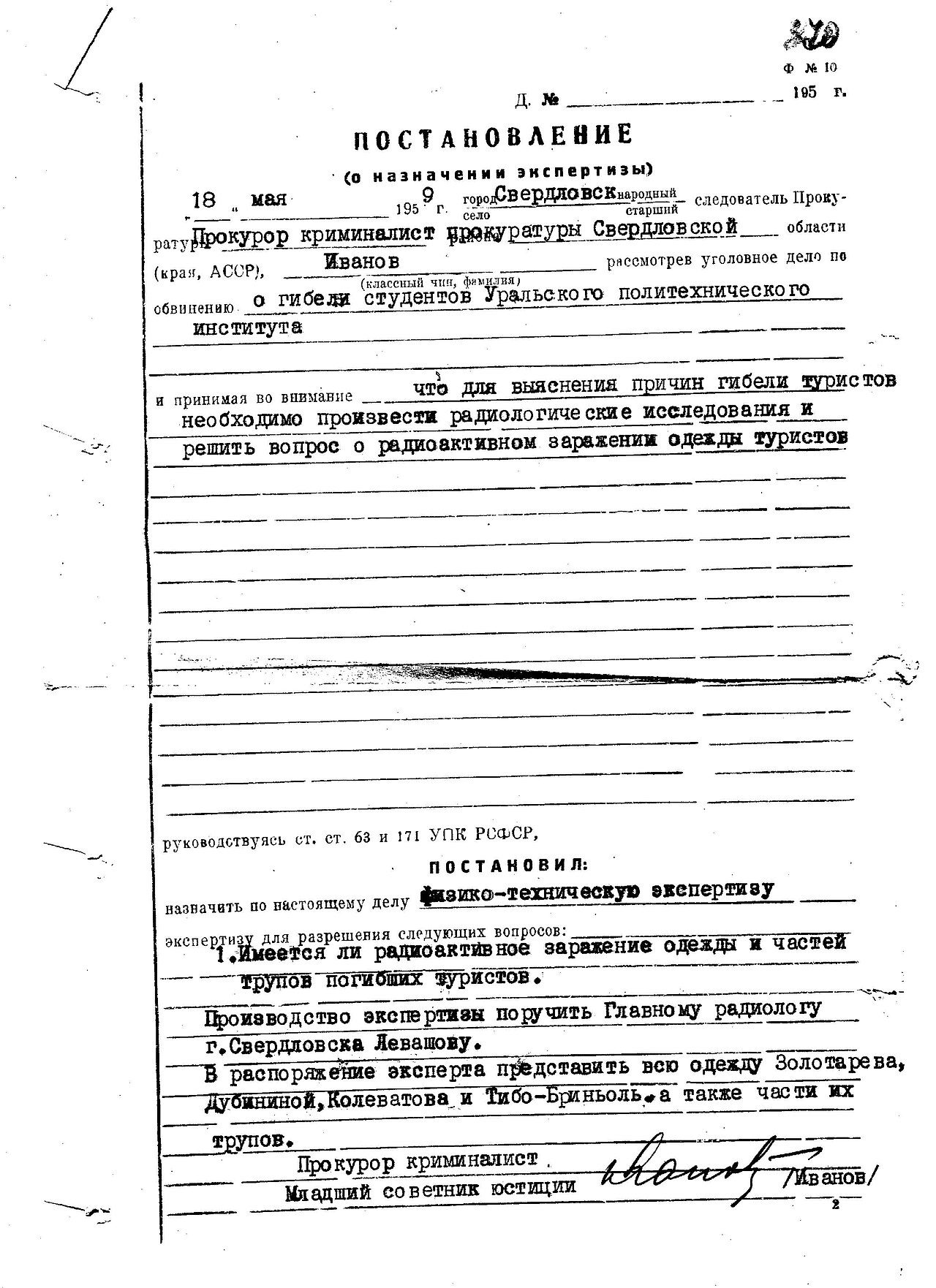
Prosecutor-criminologist L. N. Ivanov, 18 May 1959 (case file vol. 1, page 370). Public domain (Russian official document, not an object of copyright under article 1259 of the Civil Code of the Russian Federation). Picture source
The last four go a short way into a stream ravine, build a floor of branches in the snow, and are found there in May under deep snow.
Night of 1 to 2 February 1959; found 4 to 6 May 1959
The story
Lyudmila Dubinina, Semyon Zolotaryov, Nikolay Thibeaux-Brignolle and Aleksander Kolevatov move away from the fire into the ravine of a small stream. The resolution puts the spot 75 meters from the fire; the May protocol says 50 meters from the cedar.
They cut the tops of young firs and a birch and lay them on the snow as a floor, to keep their bodies off the snow. They have clothes taken from the two who died at the fire. Dubinina's bare leg is wrapped in Krivonischenko's wool trousers. Zolotaryov wears her fur jacket and cap.
In this reconstruction the snow bank of the ravine collapses on them in the night. Dubinina, Zolotaryov and Thibeaux-Brignolle suffer crushing injuries to the chest or skull. Kolevatov dies of the cold. This is the explanation the 2020 prosecutors gave; Gaume and Puzrin also say a later snow impact in the steep ravine is possible.
Their bodies lie under the snow until the spring melt. Searchers probing with poles find them on 4 May 1959, in running water at the bottom of the stream.
What the record says
Up the creek in a distance of six meters along the tracks a den was found at a depth of 3 to 2.5 meters. The den consists of 14 fir tree and 1 birch tops in the snow.
Protocol of inspection of the place where the four bodies were found, 6 May 1959, sheet 341
These injuries, especially appearing in such a way without any damage to the soft tissue of the chest, are very similar to the type of trauma that results from the shock wave of a bomb.
Testimony of forensic expert B. A. Vozrozhdenniy, 28 May 1959, sheet 382
The analyzed samples of clothing carry slightly excessive amounts of radioactive substances being the source of Beta-emission.
Radiation analysis report, May 1959, case file sheets 371 to 377
The den, the clothing and the injuries are recorded in the May 1959 protocol, the autopsies summarized in the closing resolution, and the expert's testimony. The depth of snow differs between documents: 2 to 2.5 meters in the 6 May protocol and 4 to 4.5 meters in the resolution. The forensic expert compared Thibeaux-Brignolle's skull injury to the impact of a fast car and the chest injuries to a bomb's shock wave, which is where explosion theories begin; he was describing the size of the force, not naming a cause. A 1959 lab found beta contamination on some clothing that partly washed off; the 2020 prosecutors linked it to the 1957 Mayak accident area, which the two men had visited. The protocol records that the bodies had lain in fast water and decayed, and Gaume and Puzrin list missing eyes and a missing tongue among the observations still debated.