A Flash on the Sun
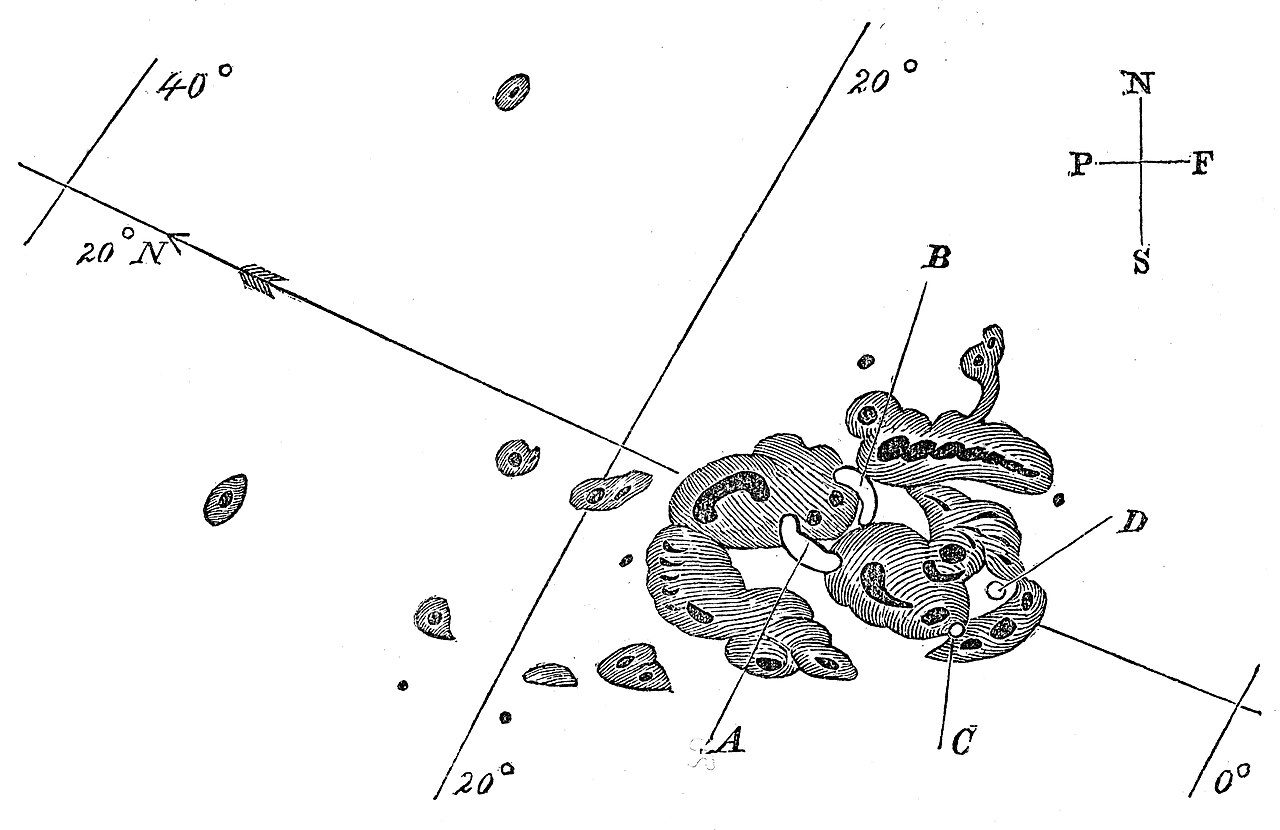
Richard Christopher Carrington (1859). Public domain. Picture source
In this story, the storm begins the way the 1859 storm did: with a sudden white flash over a giant sunspot.
Story: an imagined day in our time. Record: the morning of 1 September 1859
The story
What if it happened on an ordinary weekday? Picture a huge group of sunspots turning to face the Earth. Space weather forecasters have watched it for days. It is bigger than most they have seen.
Late one morning, a burst of light flares over the spots. Satellites see it first. The X-rays travel at the speed of light, so they arrive with the flash itself. There is no warning for that part.
On the sunny side of the planet, long-range radio starts to fade. Pilots over the ocean lose contact on their high-frequency radios. Phone maps drift a little as GPS signals pass through a stirred-up sky.
Then, in this story, the forecasters see something worse on their screens. A giant cloud is leaving the Sun, and it is pointed at us. They start sending warnings to power companies, airlines and satellite operators.
In 1859 one man saw a flash like this with his own eyes. His name was Richard Carrington. He ran to fetch someone to see it too. When he got back, less than a minute later, it was already fading.
What the record says
two patches of intensely bright and white light broke out, in the positions indicated in the appended diagram by the letters A and B
R. C. Carrington, Monthly Notices of the Royal Astronomical Society 20, page 13 (1859)
I hastily ran to call some one to witness the exhibition with me, and on returning within 60 seconds, was mortified to find that it was already much changed and enfeebled.
R. C. Carrington, Monthly Notices of the Royal Astronomical Society 20, page 14 (1859)
X-rays and extreme UV radiation reach Earth at light speed, ionizing the upper layers of our atmosphere; side-effects of this "solar EMP" include radio blackouts and GPS navigation errors.
NASA Science, 'Near Miss: The Solar Superstorm of July 2012' (2014)
Carrington's own report says he saw two patches of bright white light break out over a large sunspot group on 1 September 1859, and that they faded within about five minutes (11.18 to 11.23 Greenwich time). He noted that a magnetic storm began about four hours after midnight that night, but he warned against linking the two in haste. NASA explains that a flare's X-rays reach Earth at light speed and can black out radio and disturb GPS. The modern day in this chapter is imagined; the effects are the ones NOAA and NASA list for big flares.