The Radiation Storm
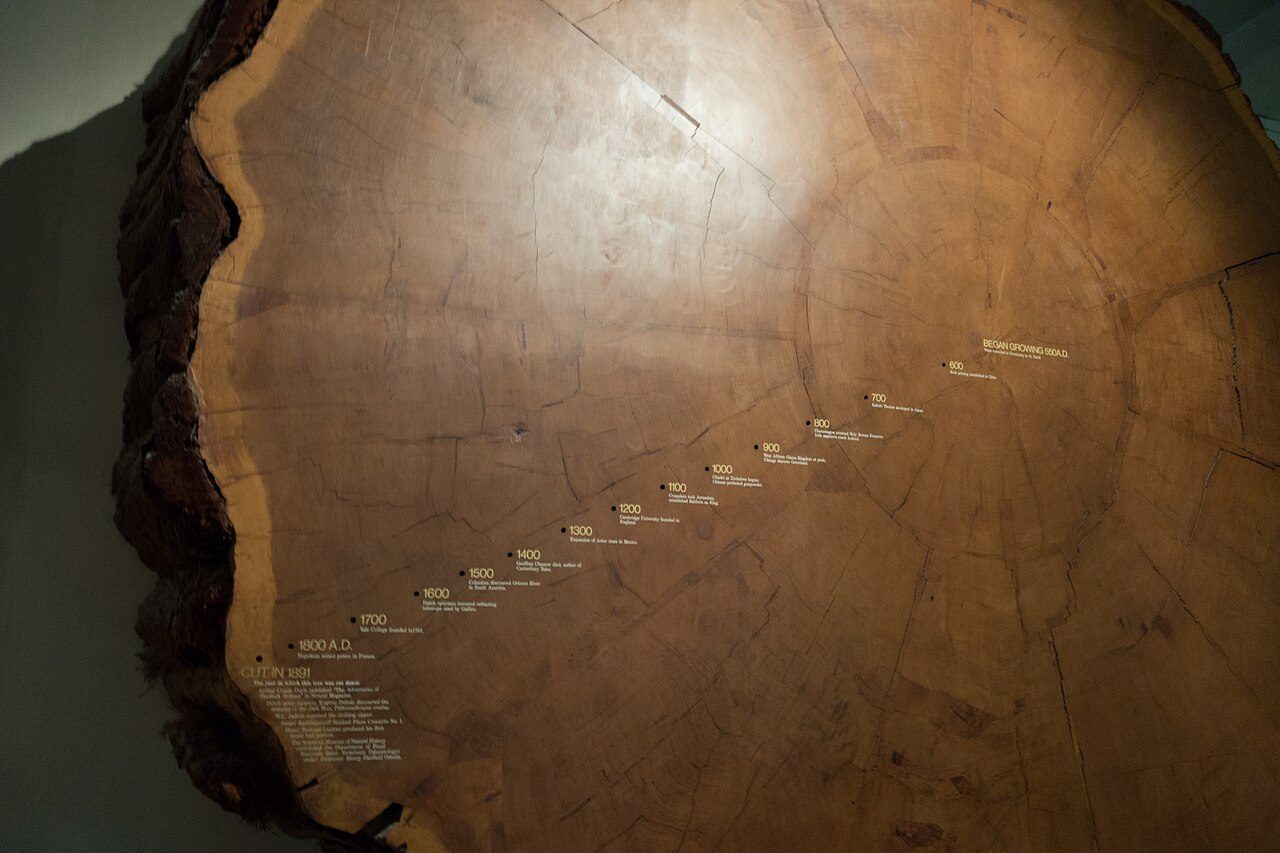
Thomas Quine (photographed at the American Museum of Natural History, New York, 2015). CC BY 2.0. Picture source
Within hours, a flood of fast particles from the Sun reaches Earth, the kind of storm that left its mark in tree rings in 774 CE.
Story: the first hours. Record: the summer of 774 CE, read in tree rings and ice
The story
What if the particle storm were as big as the one in 774? Minutes to hours after the flash, protons from the Sun arrive. They move almost as fast as light. Satellites feel them first.
In this story, some satellites start to glitch. Cameras on weather satellites fill with white speckles. A few spacecraft lose track of the stars they use to point themselves. Operators put the most delicate ones into safe mode and wait.
Airlines move flights away from the poles, where the radiation gets in most easily. Spacewalks are called off, because NOAA's scale warns of a high radiation hazard to astronauts outside.
Down on the ground, nobody feels a thing. The air above us soaks up the particles. But high in the sky, they hit nitrogen and make a rare kind of carbon. Trees take that carbon in. In this story, every tree on Earth quietly records the date.
That is exactly how scientists found the storm of 774. A tree ring from that year holds far more of this carbon than the rings around it.
What the record says
We find a rapid increase of about 12‰ in the 14C content from AD 774 to 775, which is about 20 times larger than the change attributed to ordinary solar modulation.
Miyake and others, Nature 486, 240 (2012), abstract
These results imply that the larger of the two events (AD 774/5) was at least five times stronger than any instrumentally recorded solar event.
Mekhaldi and others, Nature Communications 6, 8611 (2015), abstract
Satellites may be rendered useless, memory impacts can cause loss of control, may cause serious noise in image data, star-trackers may be unable to locate sources; permanent damage to solar panels possible.
NOAA Space Weather Scales, S5 (Extreme) radiation storm
In 2012 Fusa Miyake's team measured carbon-14 in yearly rings of two Japanese cedars and found a jump from 774 to 775 about 20 times larger than normal changes. The team first argued that neither a solar flare nor a nearby supernova was a likely cause. Later work changed that view: Usoskin and colleagues (2013) and Mekhaldi and colleagues (2015, using beryllium-10 and chlorine-36 in Arctic and Antarctic ice) concluded that it was most likely a huge solar particle event, at least five times stronger than any measured with instruments. In 2018 Buntgen's team found the same signal in 44 tree-ring records from five continents, starting in the northern summer of 774. The record shows a particle storm; it does not tell us how strong any magnetic storm that came with it was. That part is the story's guess.