What If the Great Solar Storm of 774 CE Struck Today?
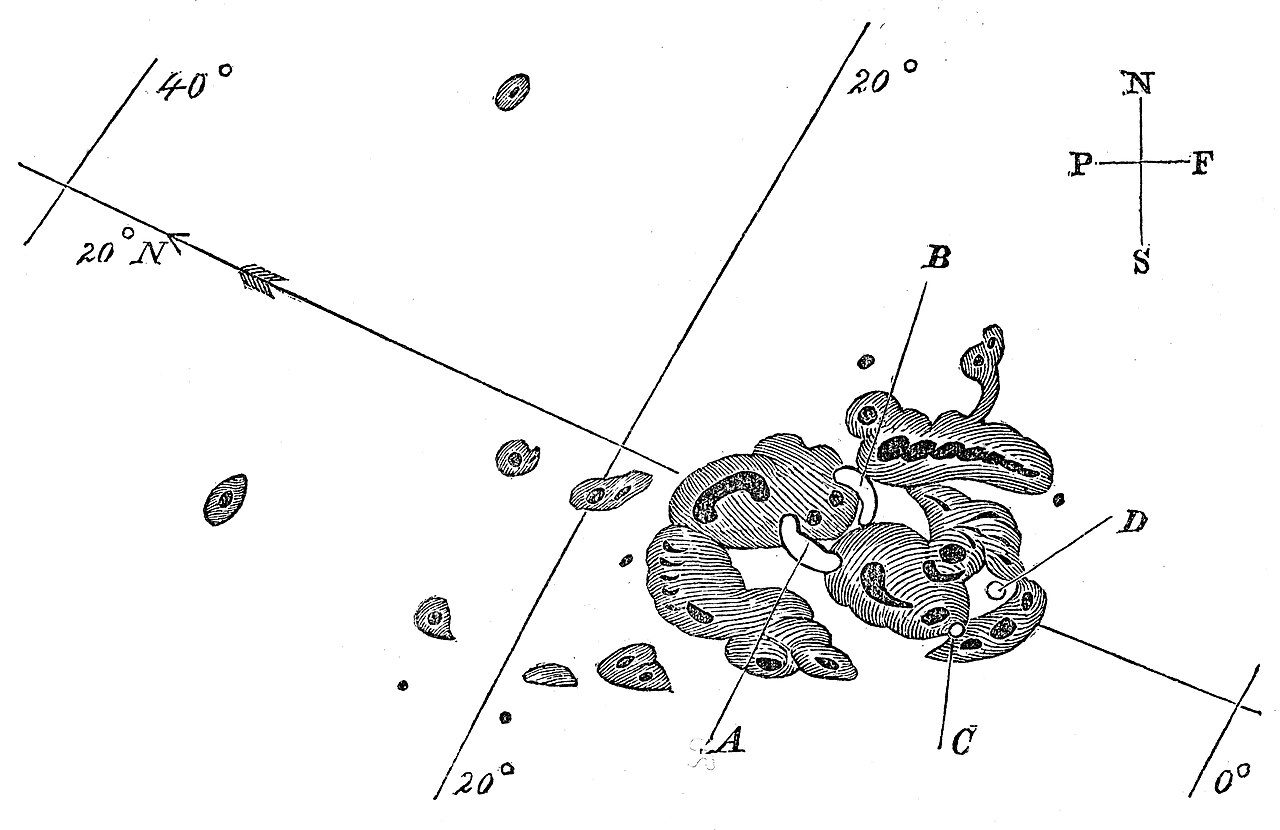
Richard Christopher Carrington (1859). Public domain. Picture source
In 774 CE the Sun hit Earth with a burst of particles so strong that trees around the world still carry its mark. This story imagines a storm like that arriving on an ordinary day now, and builds each step from the record: tree rings, a monk's chronicle, Carrington's 1859 report, the telegraph operators, the 1989 Quebec blackout and the official risk studies.
How to read it: start at chapter 1 and go in order. Each chapter tells the story first, then quotes the record it rests on and says what is actually known.
- 1. A Flash on the SunIn this story, the storm begins the way the 1859 storm did: with a sudden white flash over a giant sunspot.Story: an imagined day in our time. Record: the morning of 1 September 1859
- 2. The Radiation StormWithin hours, a flood of fast particles from the Sun reaches Earth, the kind of storm that left its mark in tree rings in 774 CE.Story: the first hours. Record: the summer of 774 CE, read in tree rings and ice
- 3. A Red Sign in the SkyWhen the cloud from the Sun hits, the northern lights spread far south and turn red, as English monks may have seen in 774.Story: the first night. Record: A.D. 774 in the Anglo-Saxon Chronicle; September 1859
- 4. The Wires Come AliveThe shaking magnetic field pushes electric current into long wires on the ground, just as it did to the telegraph lines of 1859.Story: the first night. Record: 28 August to 2 September 1859, in the United States
- 5. The Grid TripsIn about a minute, safety systems on a big power grid trip one after another and the lights go out, as they did in Quebec in 1989.Story: the middle of the night. Record: 2:44 a.m., 13 March 1989, Quebec
- 6. The Long DarkIf big transformers are damaged, the blackout could last weeks or longer, and water, hospitals and phones start to fail too.Story: the days and weeks after. Record: official risk studies from 2012, 2013 and 2019
- 7. The One That MissedA storm this big is not only history: one crossed Earth's orbit in July 2012 and missed us by about a week.Record: 23 July 2012, and the G5 storm of 10 May 2024
The modern day in this story is imagined. The 774 event, the 1859 storm, the 1989 blackout and the 2012 near miss are real and sourced, but no storm this size has hit the modern world, and experts disagree on how bad the damage would be.
All sources
- R. C. Carrington, 'Description of a Singular Appearance seen in the Sun on September 1, 1859', Monthly Notices of the Royal Astronomical Society 20, 13-15 (1859), scan from the NASA Astrophysics Data System
- Internet ArchiveA nonprofit digital library in San Francisco, founded in 1996, that holds millions of scanned books, papers and recordings. A scan there shows the pages of a real printed book or document.Monthly Notices of the Royal Astronomical Society, volumes 19 and 20 (1859-1860), full volume at the Internet Archive
- NASA ScienceNASA's official science website, with its research news, mission pages and reports, such as its 2023 study of UFOs.NASA Science, 'Near Miss: The Solar Superstorm of July 2012' (Tony Phillips, July 2014)
- NOAA Space Weather Prediction Center, 'NOAA Space Weather Scales' (geomagnetic storms G1-G5, radiation storms S1-S5, radio blackouts R1-R5)
- A research articleAn article written by a researcher and published in a scholarly journal or book. Most such journals have other experts check a paper before it is printed, so it carries more weight than a news story, though later studies can still change the picture.Fusa Miyake, Kentaro Nagaya, Kimiaki Masuda and Toshio Nakamura, 'A signature of cosmic-ray increase in AD 774-775 from tree rings in Japan', Nature 486, 240-242 (2012) Archived copy, 2026-09-23
- arXivA free website run by Cornell University where scientists post research papers. Papers there may not have been checked by other experts yet, so they carry less weight than journal articles.I. G. Usoskin and others, 'The AD775 cosmic event revisited: the Sun is to blame', Astronomy and Astrophysics 552, L3 (2013), free copy on arXiv
- NatureThe website of Nature, a weekly science journal founded in London in 1869 and one of the most respected in the world. Its research papers are checked by other experts before they are printed.Florian Mekhaldi and others, 'Multiradionuclide evidence for the solar origin of the cosmic-ray events of AD 774/5 and 993/4', Nature Communications 6, 8611 (2015)
- NatureUlf Buntgen and others, 'Tree rings reveal globally coherent signature of cosmogenic radiocarbon events in 774 and 993 CE', Nature Communications 9, 3605 (2018)
- The Anglo-Saxon ChronicleA year-by-year record of events in England, begun in the reign of King Alfred in the late AD 800s and kept up in several monasteries until 1154. Its entry for 774 reports a red cross seen in the sky after sunset.The Anglo-Saxon Chronicle, entry for A.D. 774, translated by James Ingram (1823) with readings from J. A. Giles (1847), Project Gutenberg ebook 657 Archived copy, 2026-09-17
- A research articleJonathon Allen, 'Clue to an ancient cosmic-ray event?', Nature 486, 473 (2012), the letter that first linked the Chronicle's red crucifix to the 774 spike
- Internet ArchiveGeorge B. Prescott, History, Theory, and Practice of the Electric Telegraph (Boston: Ticknor and Fields, 1860), pages 320-325 on the aurora of August and September 1859, Internet Archive
- Hydro-Quebec, 'In March 1989, Quebec experienced a blackout caused by a solar storm'
- North American Electric Reliability Corporation, 2012 Special Reliability Assessment Interim Report: Effects of Geomagnetic Disturbances on the Bulk Power System (February 2012)
- Lloyd's and Atmospheric and Environmental Research, Solar Storm Risk to the North American Electric Grid (2013)
- National Science and Technology Council, National Space Weather Strategy and Action Plan (March 2019)
- Lloyd's, report page for 'Solar storm risk to the North American electric grid'
- NOAA Space Weather Prediction Center, 'G5 Conditions Observed!' (May 10, 2024)
- NOAA, 'Strong geomagnetic storm reaches Earth, continues through weekend' (May 10, 2024)
Questions people ask about What If the Great Solar Storm of 774 CE Struck Today?
What happened in 774 CE?
Tree rings from around the world show a sudden jump in carbon-14 between 774 and 775 CE, first measured by Fusa Miyake's team in Japanese cedars (Nature, 2012). Ice cores show matching jumps in beryllium-10 and chlorine-36. Most scientists now think it was a huge burst of particles from the Sun, at least five times stronger than any solar event measured with instruments (Mekhaldi and others, 2015).
Was the red crucifix in the Anglo-Saxon Chronicle an aurora?
Maybe. The Chronicle's entry for 774 says a red crucifix appeared in the sky after sunset. Usoskin and colleagues (2013) read it as an aurora, but the Chronicle's dates are uncertain and they did not tie it directly to the carbon-14 spike.
What was the Carrington Event?
On 1 September 1859 the astronomer Richard Carrington saw a white flash over a sunspot group. A great magnetic storm followed. Auroras were seen as far south as Cuba, and telegraph operators in Boston and Portland sent messages for about two hours using only the current the storm put in their wires.
What would a huge solar storm do today?
Official studies warn of radio and GPS problems, damaged satellites and wide power blackouts. A 2013 Lloyd's study estimated that 20 to 40 million people in the US could lose power for 16 days to 1 or 2 years. NERC, the grid reliability body, thinks a wide but shorter blackout from voltage collapse is more likely than mass transformer damage.
Has a storm that big nearly hit Earth?
Yes. NASA reports that on 23 July 2012 a solar eruption at least as strong as the Carrington Event crossed Earth's orbit and missed us by about a week, hitting the STEREO-A spacecraft instead.
Updated