A Red Sign in the Sky
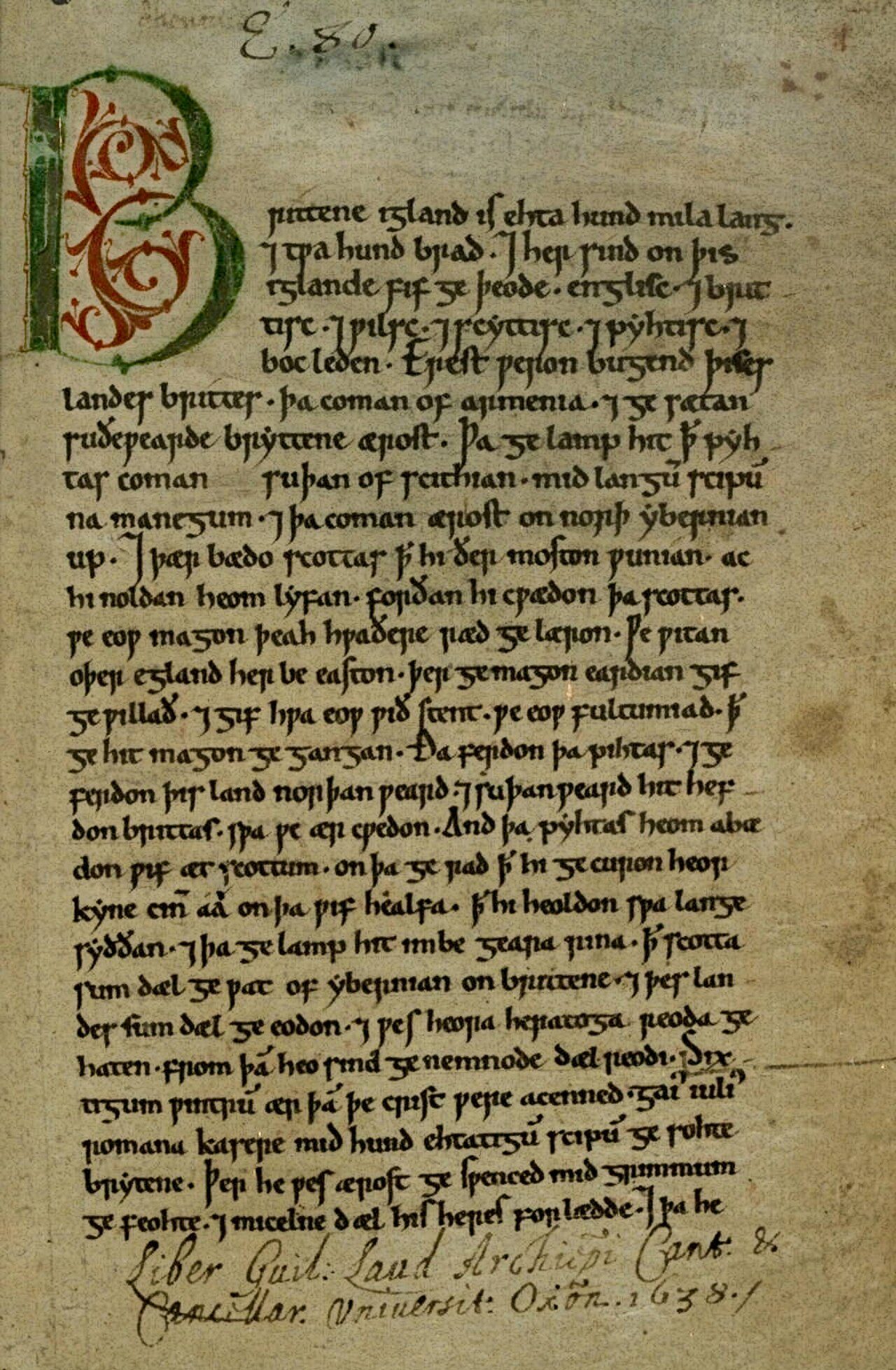
Monastic scribes of Peterborough (manuscript); photographed by Geogre. Public domain. Picture source
When the cloud from the Sun hits, the northern lights spread far south and turn red, as English monks may have seen in 774.
Story: the first night. Record: A.D. 774 in the Anglo-Saxon Chronicle; September 1859
The story
In this story, the cloud from the Sun arrives the next evening. It is a billion tons of charged gas wrapped in its own magnetic field. When it slams into Earth's magnetic field, the whole field shakes.
After sunset the sky lights up. People as far south as Florida and Texas step outside to see glowing red curtains moving overhead. Many have never seen the northern lights before.
Phones fill with photos. Some people are delighted. Some are scared. To them it looks like the sky is on fire.
More than 1,200 years ago, a monk in England may have seen something like this. He wrote that a red crucifix appeared in the heavens after sunset. In the same entry he wrote that wonderful serpents were seen in the land of the South Saxons.
He had no word for an aurora. He used the words he had.
What the record says
This year also appeared in the heavens a red crucifix, after sunset; the Mercians and the men of Kent fought at Otford; and wonderful serpents were seen in the land of the South-Saxons.
Anglo-Saxon Chronicle, A.D. 774 (Ingram translation)
Allen (2012) interprets the red cross (Anglo-Saxon Chronicle) as an exotic nearby supernova with an unobservable remnant, but we interpret this as an aurora.
Usoskin and others, Astronomy and Astrophysics 552, L3 (2013), section 5
Intense geomagnetic storms ignited Northern Lights as far south as Cuba and caused global telegraph lines to spark
NASA Science on the Carrington Event of 1859
The Anglo-Saxon Chronicle's entry for 774 does record a 'red crucifix' in the sky after sunset and 'wonderful serpents' in Sussex. In 2012 Jonathon Allen suggested in Nature that it might point to a hidden supernova behind the 774 carbon spike. Usoskin's team read it as an aurora, noted that serpents often appear in old aurora reports, and listed Chinese aurora records from 770, 773 and 775. They also warned that the Chronicle's dates are uncertain (one translator, Swanton, moves these events to 776), so they did not tie any one sighting to the spike. Whether the 774 storm made great auroras is not proven. NASA says the 1859 storm brought auroras as far south as Cuba.