The Wires Come Alive
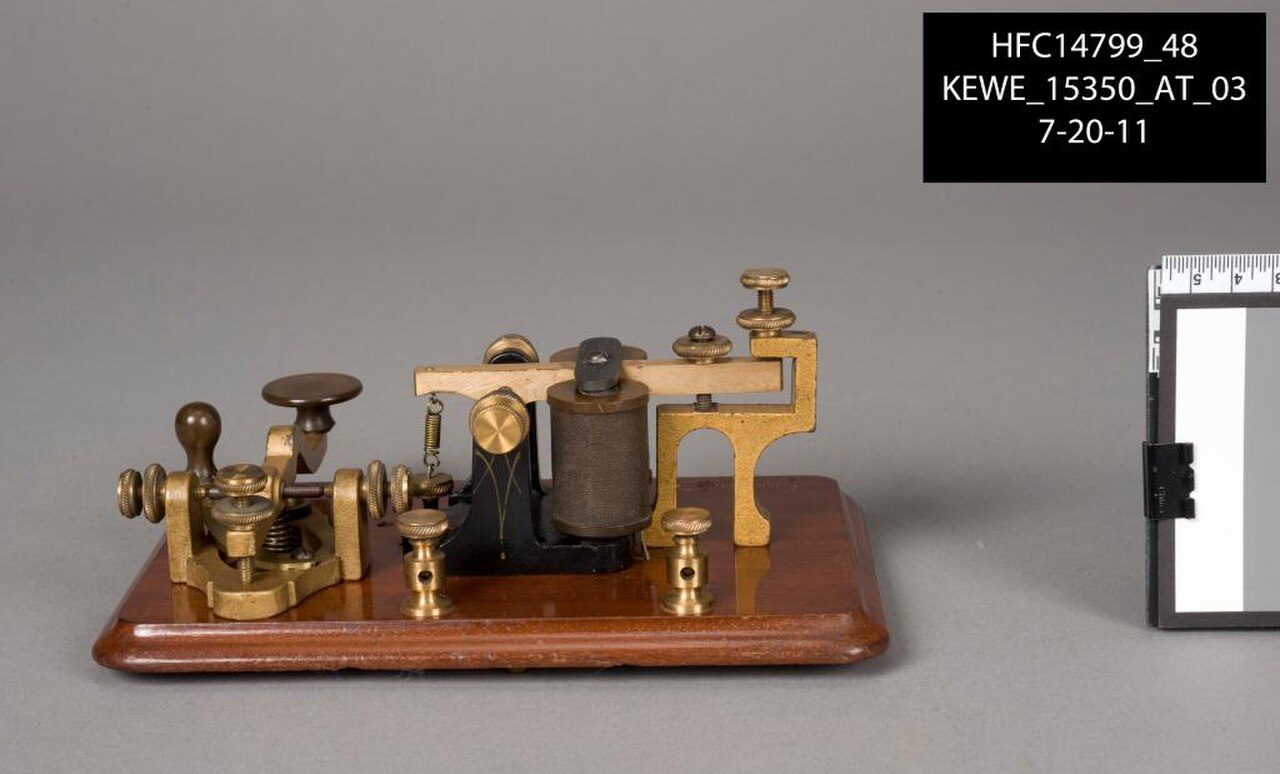
National Park Service photo (NPGallery). Public domain. Picture source
The shaking magnetic field pushes electric current into long wires on the ground, just as it did to the telegraph lines of 1859.
Story: the first night. Record: 28 August to 2 September 1859, in the United States
The story
A moving magnetic field makes electric current flow in anything long that conducts it. In this story, that means power lines and pipelines. The longer the line, the bigger the push.
Pipeline companies see strange currents on their gauges. Most people notice nothing yet.
The people of 1859 noticed. Their only long wires were telegraph lines, and those lines went wild. In Washington, an operator leaned toward his machine, grazed a wire with his forehead, and got a shock that stunned him. A man in the room said he saw a spark jump from the operator's head.
In Boston, the operators did something stranger. They unhooked their batteries and sent messages to Portland, Maine, using only the current the storm pushed into the wire. They said it worked better than usual.
Our world has far more long wires than 1859 did. In this story, that is where the real trouble starts.
What the record says
I have already done so," was the answer. "We are working, with the aid of the aurora alone. How do you receive my writing?
Prescott, History, Theory, and Practice of the Electric Telegraph (1860), page 321, Boston to Portland line, 2 September 1859
Immediately I received a very severe electric shock, which stunned me for an instant. An old man who was sitting facing me, and but a few feet distant, said that he saw a spark of fire jump from my forehead to the sounder.
Frederick W. Royce, telegraph operator at Washington, D.C., in Prescott (1860), pages 324-325
George Prescott, a telegraph manager, printed the operators' own reports in 1860. He says the Boston to Portland line worked for more than two hours on 2 September 1859 'with the aid of the aurora alone', and that a line from South Braintree to Fall River ran the same way. The Washington operator Frederick Royce reported the shock and the spark. NOAA's scale says that in the worst storms, pipeline currents can reach hundreds of amps. The modern pipelines in this chapter are the story's picture of what that scale describes.